Your bill arrives four days before the due date. Or it doesn't arrive at all, and you find out you missed the deadline when the next one shows up with a surcharge attached. Anyone who has rented a flat in Lahore or Karachi knows this routine.
The paper copy stopped being necessary years ago. Every distribution company in Pakistan puts your bill online, and pulling it up takes about twenty seconds once you know your reference number. That last part is where most people get stuck, so let's start there.
The reference number is the whole game
Look at any old bill. Near the top you'll find a long number, usually labelled "Reference No." It runs to 14 digits. That number is your connection's identity inside your company's billing system, and it doesn't change from month to month.
People confuse it with the customer ID, which is shorter and sits somewhere nearby. For checking your bill online, you want the 14-digit one.
My advice, and I say this from having watched relatives dig through drawers for old bills: type the number into your phone's notes app right now. Once it's saved, you never need a paper bill again.
If every copy is genuinely gone, ring your company's helpline. Most WAPDA-affiliated companies use 118. A neighbour on the same meter batch can sometimes help too, because reference numbers in one street often run in sequence.
Checking the bill, start to finish
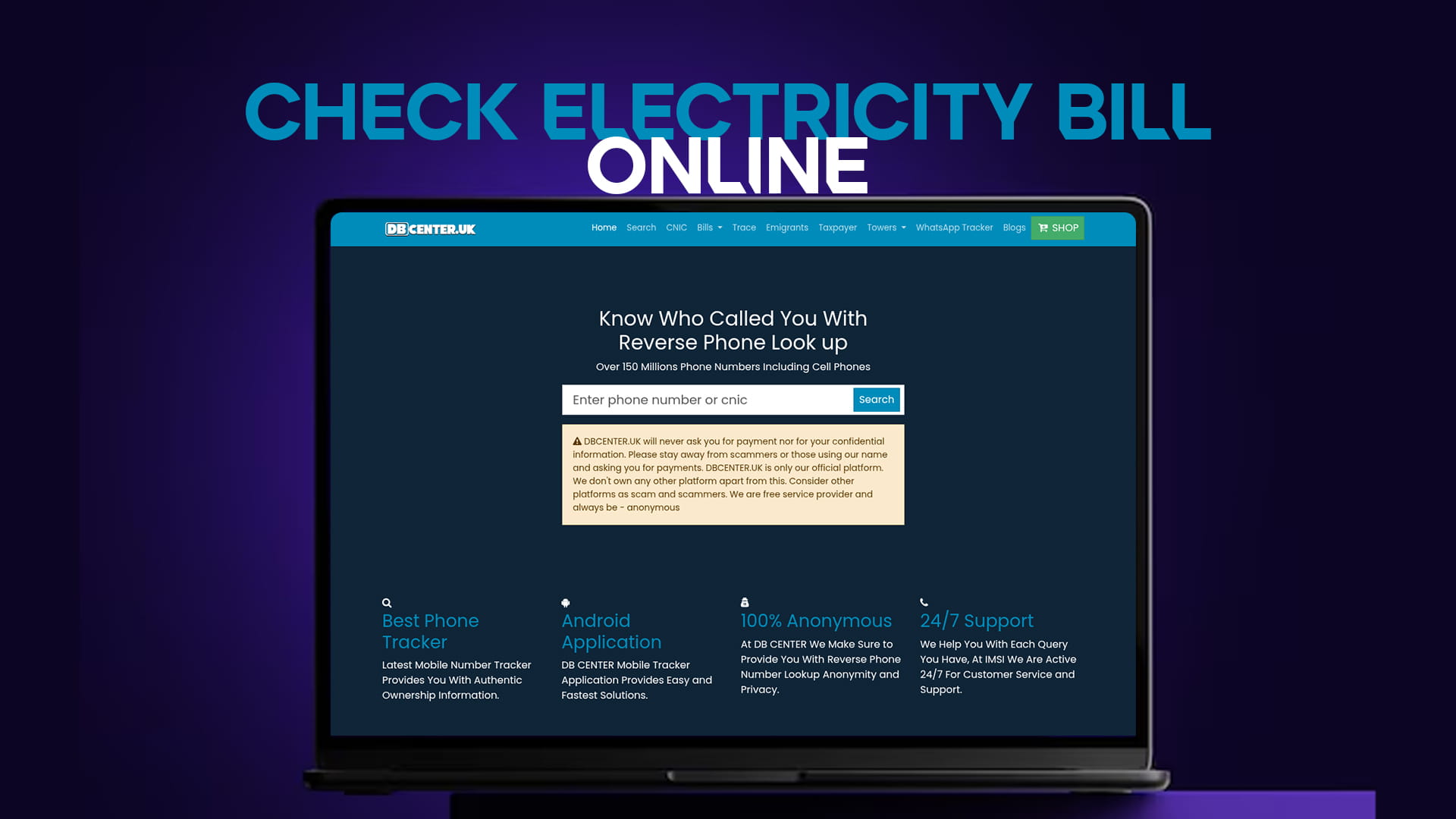
Open the electricity bill checker, type in your 14 digits, and submit. Your current bill loads on screen with the units you consumed, the amount payable, the issue date and the deadline.
No account. No fee. It works the same on a phone as on a laptop.
DB Center is Pakistan's No 1 SIM and CNIC details checker, and the bill tools sit on the same platform, which is why there's nothing to sign up for. If the page won't load at all, that's usually your internet provider filtering it rather than a problem with the site. Switch on any free VPN, Proton VPN and Windscribe both do the job, and it opens straight away.
Which company actually bills you
Pakistan doesn't have one national electricity biller. The country is carved up between regional distribution companies, and the one that bills you depends entirely on your address.
Lahore, Kasur, Sheikhupura and Okara fall under LESCO, and you can go directly to the LESCO bill page if that's your area. Multan and most of southern Punjab belong to MEPCO. Faisalabad is FESCO territory, Gujranwala is GEPCO, and Islamabad and Rawalpindi are both handled by IESCO, which surprises people who assume the twin cities have separate suppliers. Peshawar and Khyber Pakhtunkhwa fall to PESCO. Sindh outside Karachi splits between HESCO and SEPCO. Balochistan has just one, QESCO, covering the entire province. The tribal districts are served by TESCO.
Karachi is the odd one out. K-Electric supplies the city and runs its own separate billing system.
Not sure which applies to you? The company name is printed across the top of any old bill.
What the numbers actually mean
Pulling the bill up is easy. Reading it is where people give up, so here's the short version of what matters.
Units consumed is the gap between this month's meter reading and last month's, measured in kilowatt-hours. It drives most of your charge. Compare it against last month, and against the same month last year if you have the copy. A sudden jump with no change in your household is worth investigating.
The energy charge is your units multiplied by whatever slab rate applies. Pakistan uses a rising scale, so heavier use pushes you into a dearer band. This is why a modest increase in consumption can produce an alarming increase in the total, and why summer bills bite so hard once an air conditioner is running.
Fuel price adjustment is the line nobody explains. It's a per-unit charge that moves every month depending on what it actually cost to generate the electricity, and it's applied a couple of months in arrears. Two months with identical usage can produce different totals purely because of this.
Fixed charges get billed whether you use any electricity or not.
Then there are the government additions: sales tax, electricity duty, a television fee, and a quarterly adjustment that turns up periodically and makes certain bills heavier than the ones either side of them.
At the bottom you'll see two amounts. One applies if you pay by the due date, the other if you don't. The gap between them is money thrown away for no reason, and paying on time is the easiest saving available on any bill in Pakistan.
Paying it
Once the bill is in front of you, nobody needs to queue at a bank. Open JazzCash or Easypaisa, go to bill payment, enter the same reference number, check the amount, pay. Your bank's app does the same thing, and so does internet banking. ATMs have a utility payment option. Cash at a designated branch still works if you prefer it.
Hold on to the confirmation message until the payment shows up as cleared. Settlement sometimes takes a day or two, and a screenshot is useful if anyone later claims the bill went unpaid.
When the check doesn't work
Three things go wrong, and the first two are trivial.
Nine times out of ten you've mistyped a digit. Count the number again. It must be exactly 14, with no spaces.
If the page itself refuses to load, rather than returning a "not found" message, that's a connection problem. A VPN clears it.
The third one occasionally matters. Brand-new connections can take a billing cycle to appear online, which is harmless, but a number that has worked before and suddenly returns nothing is worth a phone call. If the digits are right, the connection isn't new, and the site loads fine, ring your company and ask whether the reference number is still active on their side.
Gas works the same way
While you're at it, the same routine applies to your gas bill. Find the reference number, enter it, view or pay. The gas bill tool covers SNGPL and SSGC, so both utilities can be handled in one sitting instead of hunting down two separate portals.
Questions people actually ask
Can I check my bill without the reference number? Not realistically. The online systems are built around it. Get the number from an old bill, your company's helpline, or a neighbour on the same meter batch, and save it somewhere permanent afterwards.
Is the downloaded copy a valid bill? Yes. It comes from your company's own billing records. Banks, landlords and tax filings accept the printed or PDF version.
Why is my bill higher than last month when nothing changed? Most often the fuel price adjustment moved, a quarterly adjustment landed, or your usage crossed into a dearer slab. Look at the per-unit lines rather than the total to see which.
How early should I check? A few days before the due date. Late enough that the bill has been issued, early enough to pay without the surcharge.
Does this cost anything? No. Checking is free and needs no login. You only pay the bill itself.
The short of it
Find your 14-digit reference number, keep it somewhere you won't lose it, and check the bill a few days before it's due. That's the whole system. The bill arrives online whether the postman turns up or not, and the surcharge only catches people who waited for paper.