You handed over your CNIC at a bank, a government office, or a telecom shop. The system came back with a rejection. "Verification failed." No further explanation.
This happens more often than people realise — and the reasons behind it are not always obvious. A blocked or flagged CNIC is a different problem from an expired one. It does not fix itself with a renewal, and ignoring it tends to make things worse.
This guide covers every type of CNIC block in Pakistan — NADRA, FBR, and PTA — what causes each one, how to check your status for free right now, and what to do if your card is flagged.
The Difference Between Expired, Blocked, and Flagged
These three terms get mixed up constantly, and the confusion leads people to waste time at NADRA counters trying to solve the wrong problem.
Expired means the card's validity period has ended. The fix is renewal. Your identity record is intact.
Blocked means NADRA has administratively restricted the card. The record exists but is marked as inactive or suspended. This does not get resolved through a standard renewal — it requires a specific clearance process.
Flagged is a broader term that can mean different things depending on which authority has raised the flag. FBR flags a CNIC for tax non-compliance. PTA flags one when there are SIM registration irregularities. A court can order a flag through NADRA. Each type has its own resolution path.
Knowing which category you are in is the first step.
How to Check If Your CNIC Is Blocked — Right Now
Method 1: DB Center (Free, Instant)
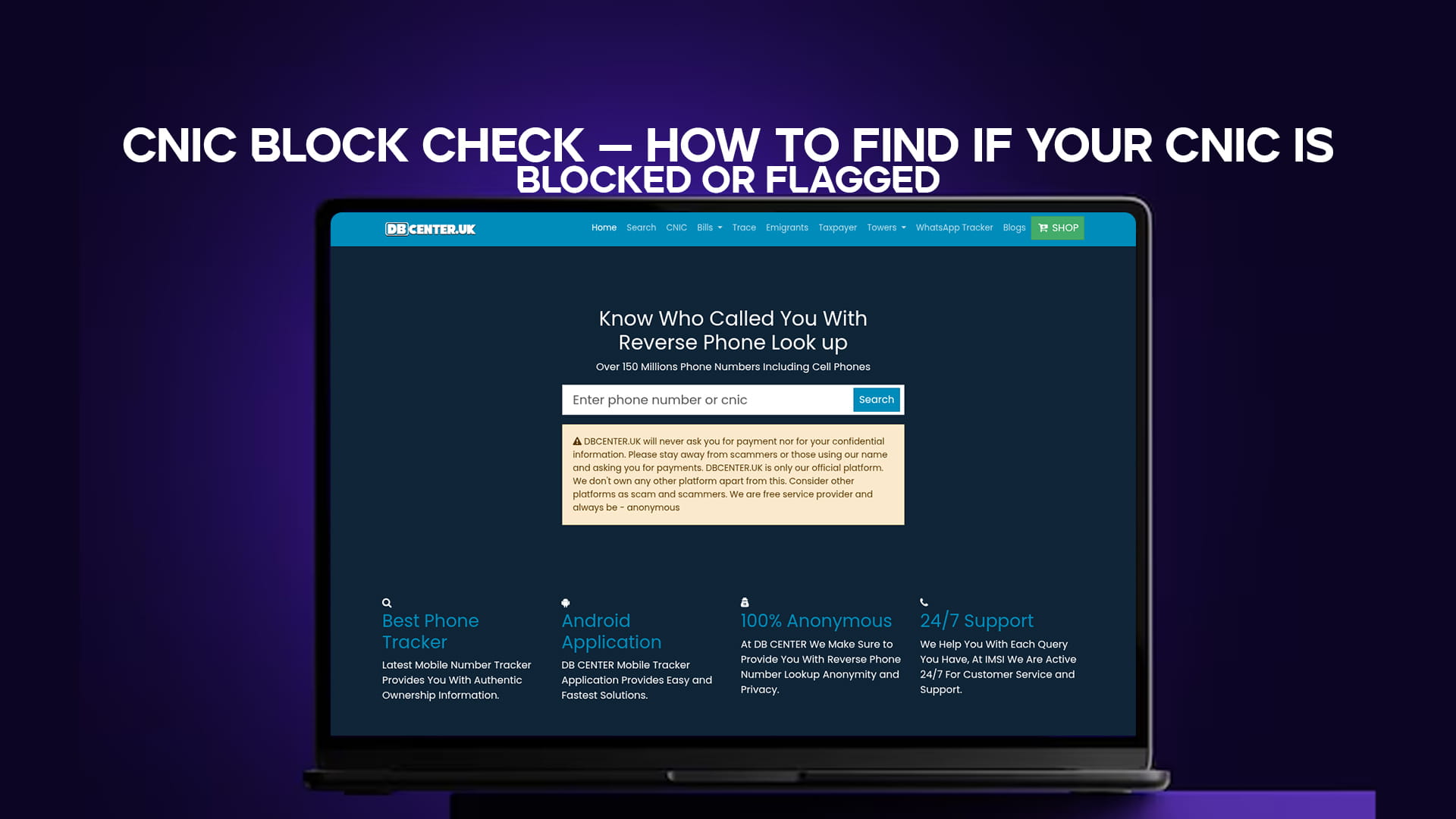
DB Center is Pakistan's most used free CNIC status checker. Enter your 13-digit number and the result will clearly indicate if your card is active, expired, or blocked. No account needed, no payment.
Step 1: Open dbcenter.uk/cnic on any device.
Step 2: Enter your 13-digit CNIC number — with or without dashes.
Step 3: Hit search. The status comes back within seconds.
A result showing "blocked" or an unexpected status is your signal to dig further into which authority triggered it and why.
Site not loading? Your ISP may be filtering it. Switch on any free VPN — Proton VPN or Windscribe work fine — and the site opens immediately.
Method 2: NADRA SMS to 8400
Send your 13-digit CNIC number (no dashes) as an SMS to 8400. The automated reply from NADRA will show the current status of your card — valid, expired, or blocked.
This works on Jazz, Telenor, Ufone, and Zong. Standard SMS rates apply.
Method 3: NADRA Registration Centre
If the above methods show a blocked status and you need to understand the specific reason, a visit to your nearest NADRA registration centre is the next step. Bring your original CNIC and any supporting documentation. The counter staff can pull up the detailed record and tell you exactly what type of block is on the card and which authority placed it.
NADRA Blocks — What Causes Them and How to Resolve
NADRA can block a CNIC for several distinct reasons. Each has a different resolution path.
Duplicate Record / Data Conflict
This is one of the most common causes of a NADRA block. It happens when two registrations exist with overlapping identity information — usually the result of a clerical error during the original registration or a subsequent update. NADRA flags the account pending manual review.
Resolution: Visit any NADRA centre with your original supporting documents — birth certificate, family registration certificate (FRC), and school certificate. The records team can identify and merge the duplicate entries after biometric verification.
Court Order / Legal Hold
A court in Pakistan can instruct NADRA to block a specific CNIC as part of civil or criminal proceedings — property disputes, fraud cases, and matrimonial cases being the most common triggers. The block remains in place until the court issues a clearance order.
Resolution: This can only be resolved through the courts, not through NADRA directly. A lawyer familiar with the relevant case needs to apply for the hold to be lifted. NADRA cannot unblock a court-ordered restriction without the court's written clearance.
Voluntary Block by the Cardholder
NADRA allows citizens to voluntarily block their own CNIC if the card is lost or stolen. This prevents someone else from misusing the card while a replacement is being processed. This type of block is straightforward to lift — the card holder visits a NADRA centre in person, passes biometric verification, and requests the block to be removed or a replacement card issued.
Resolution: Walk into any NADRA centre, complete biometric verification, and request reactivation or replacement.
Administrative / Policy Block
In some cases NADRA places a block following directives from other government bodies — intelligence agencies, NAB, or other authorities — under security or national interest grounds. These are less common but exist.
Resolution: These require formal correspondence between NADRA and the issuing authority. Legal assistance is typically necessary to navigate this process.
FBR Blocks — When Your CNIC Is Flagged for Tax Reasons
The Federal Board of Revenue maintains its own flagging system that ties to CNIC numbers. While FBR does not technically "block" a CNIC through NADRA's system, an FBR flag creates real-world consequences that function almost identically to a block.
What FBR Flags Cause
When FBR flags a CNIC for tax non-compliance, the following typically get restricted:
- Property purchase and registration above certain thresholds
- Vehicle registration
- Foreign travel (in some enforcement campaigns)
- Bank account activity above certain transaction limits
- Business licensing in some sectors
Banks and registrars cross-check FBR's Active Taxpayer List (ATL) and blocked person lists as part of their standard compliance process. If your CNIC shows up on a restricted list, transactions get declined or flagged for manual review.
How to Check FBR Status
DB Center's taxpayer verification tool lets you check whether a CNIC is registered as an active tax filer or appears on any FBR restriction list. Enter the CNIC number and the current ATL and filer status comes back immediately.
You can also check directly on FBR's portal at fbr.gov.pk under the Active Taxpayer List section.
How to Resolve an FBR Flag
Non-filer status: File your tax returns through the IRIS portal at iris.fbr.gov.pk. Once your return is filed and processed, your status on the ATL updates. This typically takes a few weeks after filing.
Specific enforcement action: If FBR has taken a specific enforcement action against your CNIC — not just non-filer status — you will need to visit your nearest FBR Regional Tax Office (RTO) with your CNIC and tax records. A tax consultant or lawyer speeds this up considerably.
PTA Blocks — When Your CNIC Is Flagged for SIM Irregularities
The Pakistan Telecommunication Authority (PTA) does not block a CNIC directly, but PTA-driven actions can make a CNIC functionally unusable for telecom-related transactions.
What Causes PTA-Related CNIC Issues
Excess SIM registrations: PTA rules allow a maximum of 5 SIM cards per CNIC across all networks. If someone has registered SIMs against your CNIC without your knowledge — a common form of identity misuse — your CNIC may hit the limit, blocking any new SIM registration.
SIMs registered fraudulently: If SIM cards were registered using a stolen or misused CNIC, PTA can flag the number for investigation.
Biometric verification failures: Repeated failed biometric checks when registering a SIM can trigger a temporary flag on the CNIC for telecom purposes.
How to Check SIMs Registered on Your CNIC
Send your 13-digit CNIC number to 668 via SMS. PTA's automated system replies with a list of all active SIM cards registered against your identity across all networks. If you see numbers you do not recognise, those are either fraudulently registered or registered by someone else using your card.
You can also check via the DB Center general search tool for related identity lookups.
How to Resolve PTA SIM Issues
For fraudulent SIMs: Visit your nearest telecom franchise with your original CNIC and report the unauthorised registrations. The operator will block the fraudulent SIMs and submit a correction to PTA. You may need to visit multiple operator franchises if the fraudulent SIMs span different networks.
For reaching the 5-SIM limit: Request deregistration of SIMs you no longer use. This frees up capacity for new registrations under your CNIC.
CNIC Blocked Due to Death Record Error
This is an unfortunately common situation. When someone passes away, family members are required to update NADRA's records. In cases where a death is reported incorrectly — or where two people share similar details and a death record gets misapplied — a living person's CNIC can end up marked as deceased. The card gets blocked immediately.
If you are trying to use your CNIC and the system reports it as belonging to a deceased individual, do not try to resolve this by phone or online portal. Go to a NADRA centre in person with your original CNIC, your biometrics will be taken as proof of life, and the erroneous death record will be corrected. Bring a copy of your Family Registration Certificate (FRC) if possible.
This type of error, once flagged, is typically resolved at the centre level without needing to escalate further.
Overseas Pakistanis: How to Check and Resolve a Block From Abroad
If you are outside Pakistan and have discovered your CNIC is blocked, DB Center can confirm the status from anywhere in the world — connect via VPN if your local network filters the site. The emigrants verification tool at DB Center also supports related overseas Pakistani identity checks.
For resolution, most types of CNIC blocks require an in-person visit to a NADRA centre or — for overseas Pakistanis — to the Pakistani embassy or consulate in your country of residence. The embassy has a NADRA facilitation desk in most major countries.
NICOP holders (National Identity Card for Overseas Pakistanis) who face a block on their NICOP can initiate the resolution process through the embassy. Bring your NICOP, passport, and any supporting documents explaining the reason for the block.
What to Do If You Do Not Know Why Your CNIC Is Blocked
If the DB Center check shows a blocked status but you have no idea why, work through this sequence:
First: Visit a NADRA centre and ask for a full status report on your CNIC. They can tell you which authority placed the block and when.
Second: If it is NADRA-originated, follow the resolution steps for duplicate records or voluntary blocks described above.
Third: If it originated from FBR, go to your nearest RTO with your tax history.
Fourth: If it originated from a court order, you need legal representation before anything else can happen.
Fifth: If the source is unclear or the NADRA staff cannot give you a straight answer, file a formal complaint through NADRA's complaint management system — available at nadra.gov.pk — and request a written explanation of the block reason. Having it in writing is important if you need to escalate.
Do not let a blocked CNIC sit unresolved. The longer it stays blocked, the more transactions and services get disrupted, and in some cases secondary complications arise — bank accounts get flagged, SIM registrations get rejected — that take additional time to clean up.
Frequently Asked Questions
How do I check if my CNIC is blocked online for free? Use DB Center's CNIC tool — enter your 13-digit number and the current status shows immediately at no cost. If the site does not open, use a VPN. Alternatively send your CNIC number to 8400 via SMS.
What is the difference between a blocked and expired CNIC? An expired CNIC simply needs renewal — the identity record is intact. A blocked CNIC has been administratively restricted, which is a different problem that renewal alone does not fix. The block needs to be cleared separately before or alongside any renewal.
Can I unblock my CNIC online? Most types of blocks require at least one in-person visit — either to a NADRA centre, an FBR office, or a court, depending on the type. The initial check can be done online for free, but resolution is generally an in-person process.
If my CNIC is blocked, can I still use it for travel within Pakistan? A blocked CNIC creates complications at various checkpoints. The severity depends on the type of block. A court-ordered or FBR enforcement block carries more weight than a voluntary block the cardholder placed themselves. When in doubt, resolve the block before travelling with it as your primary ID.
How long does it take to unblock a CNIC? A voluntary block (lost or stolen card) can typically be resolved in a single NADRA centre visit. A duplicate record block takes a few days to a few weeks depending on the complexity. A court-ordered block has no fixed timeline — it depends entirely on the court proceedings. FBR-related flags after filing returns usually clear within a few weeks.
Can someone else's blocked CNIC affect me? Not directly. But if a family member's CNIC is blocked and you share a registered address or family registration certificate, some transactions — particularly those involving joint property or shared accounts — may face complications. It is worth checking.
My CNIC shows as valid on DB Center but verification still fails at certain places. Why? DB Center checks NADRA's registration status. Some institutions run their own verification checks against FBR's lists, PTA's records, or other databases. A CNIC can be valid in NADRA's system while still appearing on FBR's non-filer list or PTA's restricted list. Check your FBR status via the taxpayer tool and your SIM status via SMS to 668 to identify the specific source.
The Quick Version
Check your CNIC status right now at dbcenter.uk/cnic — free, no login, takes under a minute. If it shows blocked, identify the source (NADRA, FBR, or PTA), then follow the relevant resolution path. A blocked CNIC does not go away by itself, and it tends to create cascading problems across banking, telecom, and property transactions the longer it stays unresolved.
If the site does not open, VPN fixes it.