In Pakistan, the Computerized National Identity Card — commonly known as the CNIC — is the most important piece of identification a person can hold. It is required for opening a bank account, registering property, casting a vote, applying for a passport, and dozens of other essential activities in daily life. But there is one more thing that your CNIC is connected to that many people do not think about carefully enough — your mobile phone SIM cards.
Every SIM card purchased in Pakistan must be biometrically registered against a valid CNIC. This means that your CNIC is not just a document you carry in your wallet — it is the anchor of your entire mobile identity. Every SIM registered in your name is legally tied to your CNIC number, and every call, message, or online transaction made from those SIMs is ultimately linked back to you.
This makes CNIC information one of the most sensitive and important categories of data in Pakistan's telecom landscape. It also makes verifying your SIM ownership details using your CNIC one of the most powerful things you can do to protect your personal identity in the digital age.
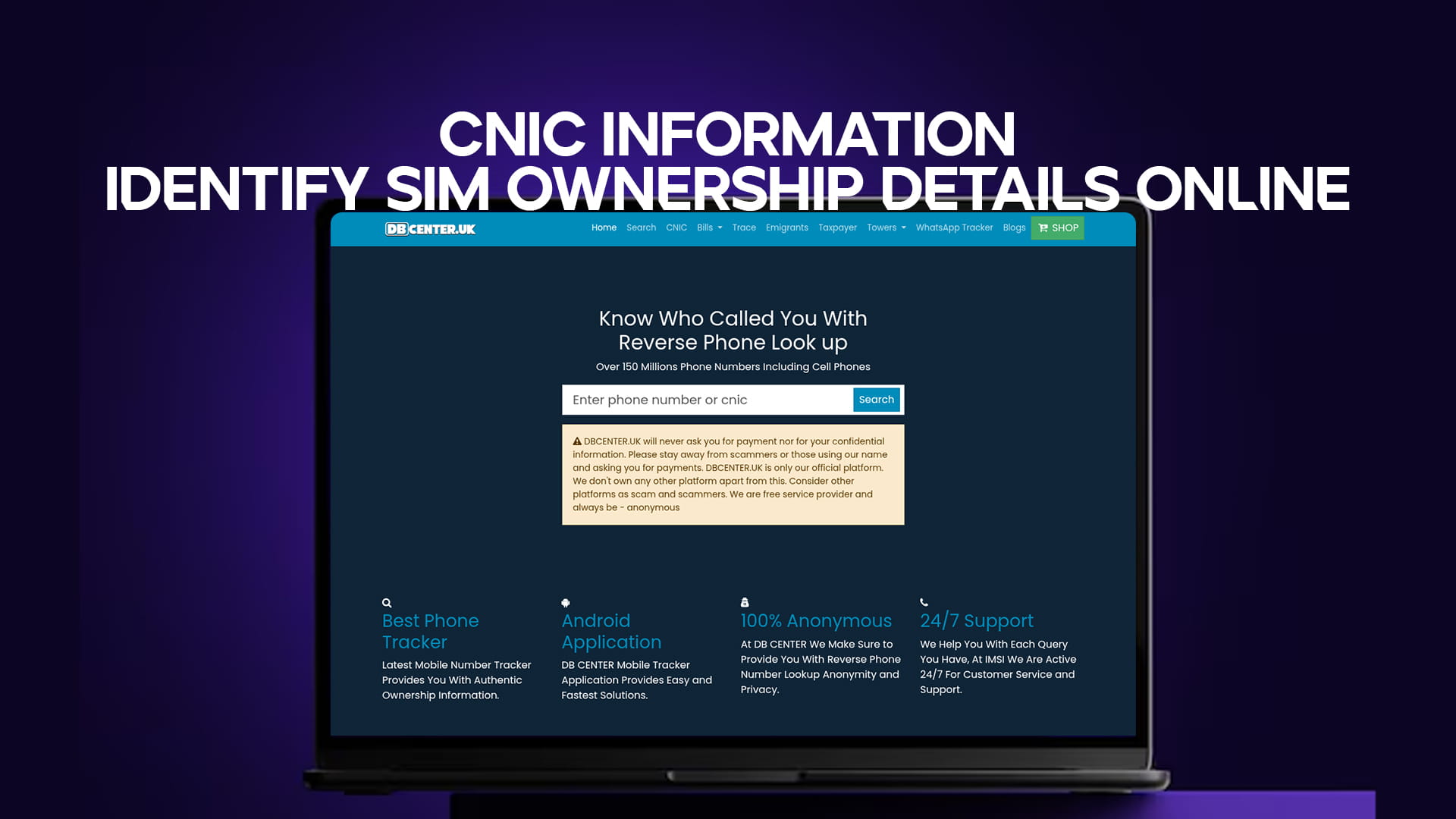
DB Center is the platform that makes this verification process simple, free, and accessible for everyone in Pakistan. With a reverse phone lookup database covering over 150 million phone numbers, DB Center helps users identify which SIM cards are registered against a CNIC, verify phone number ownership, and take control of their mobile identity before it is misused.
This article covers everything you need to know about CNIC information in the context of SIM ownership, why it matters, and how you can use DB Center to identify SIM ownership details online today.
What Is a CNIC and Why Is It Central to SIM Ownership?
The CNIC is a national identity document issued by NADRA — the National Database and Registration Authority of Pakistan. It contains a unique 13-digit number assigned to every Pakistani citizen, along with their name, date of birth, address, and biometric information including fingerprints and a photograph.
Since 2015, the Pakistan Telecommunication Authority has required that all SIM cards be registered against a valid CNIC through biometric verification. This means that when you go to a mobile network outlet to buy a SIM card, your fingerprint is scanned, matched against your CNIC, and recorded in the telecom operator's database. The SIM is then linked to your CNIC in the national subscriber registry.
This system was designed with several goals in mind. First, it ensures that every active SIM in Pakistan belongs to a verified, real identity — making it far harder for criminals to operate anonymously via mobile phone. Second, it allows law enforcement to trace phone-based crimes back to registered individuals. Third, it gives SIM owners legal accountability and responsibility for how their registered numbers are used.
The result is a system where your CNIC is the gateway to your mobile identity. And because of this, checking your CNIC-linked SIM ownership details is one of the most important things you can do to maintain control over that identity.
The Connection Between CNIC Information and SIM Ownership
When a SIM is registered against your CNIC, it creates a permanent link in the telecom database between your national identity and that mobile number. This link persists until the SIM is formally deregistered or blocked. Even if you stop using a SIM, as long as it remains active in the network's records, it continues to be tied to your CNIC.
This connection has significant implications for your safety and legal standing. Here is why:
Legal Responsibility
Under Pakistan's telecom regulations, the CNIC holder is legally responsible for all activity carried out on SIMs registered in their name. If someone else is using a SIM registered on your CNIC — whether with or without your knowledge — and that SIM is used for fraud, threats, or other criminal activity, your identity is associated with those actions until proven otherwise.
Financial Vulnerability
Mobile banking and digital payment services in Pakistan — including JazzCash, Easypaisa, Nayapay, and others — are tied to mobile numbers. If a SIM is registered against your CNIC without your knowledge, the person controlling that SIM can potentially link it to financial services, intercept OTPs, and access or drain accounts.
Reputation Damage
Harassment, scam calls, or threatening messages made from a SIM registered in your name can cause serious damage to your reputation — especially if the victim reports the number to authorities and the trail leads back to your CNIC.
Identity Hijacking
In extreme cases, unauthorized SIMs registered under a CNIC can be used to construct an entirely parallel digital identity — one that is tied to your name but controlled by someone else entirely.
All of these risks make it essential for every Pakistani citizen to stay informed about which SIMs are linked to their CNIC and to verify this information regularly.
How to Identify SIM Ownership Details Using CNIC Information Online
Identifying the SIM cards registered against a CNIC used to require a visit to a telecom franchise or a government office. Today, thanks to platforms like DB Center, you can access this information online in a matter of seconds. Here is how the process works:
Step 1 – Access DB Center Open your browser and go to DB Center. The platform is mobile-friendly and accessible on any device — smartphone, tablet, or desktop computer.
Step 2 – Navigate to the SIM Ownership or CNIC Lookup Section DB Center offers multiple search tools. Look for the CNIC-based SIM ownership lookup feature, which allows you to check which SIM cards are registered against a specific CNIC number.
Step 3 – Enter the CNIC Number Type in the 13-digit CNIC number you want to search. Double-check that the number is entered correctly, as even a single digit error will return no results or incorrect information.
Step 4 – Submit Your Search Click the search or verify button. The system will query its database and compile available SIM ownership records linked to that CNIC.
Step 5 – Review the Results Your results will show the SIM cards currently registered against the CNIC, including details about the mobile networks they belong to and any other available information. Take note of any SIMs you do not recognize.
Step 6 – Take Action if Needed If you find unauthorized SIMs registered in your name, proceed with reporting and blocking them through the steps outlined later in this article.
What CNIC Information Reveals About SIM Ownership
When you look up CNIC information through DB Center's SIM ownership tool, the results can reveal a range of useful details. Here is what you might typically find:
Number of Registered SIMs
The most basic piece of information is how many SIM cards are registered against the CNIC. Pakistan's regulations allow a maximum of five SIMs per CNIC across all networks. If the result shows more than five, or if it shows SIMs that you did not personally register, this is an immediate red flag.
Mobile Network Affiliation
The results will typically show which telecom operator each registered SIM belongs to — Jazz, Telenor, Zong, Ufone, or SCOM. This helps you identify precisely which operator to contact in order to block or deregister an unauthorized SIM.
Phone Numbers Linked to the CNIC
Depending on the data available, you may be able to see the actual phone numbers registered against the CNIC. This helps you cross-reference the registered numbers against the ones you actually own and use.
Registration Location and Date
In some cases, additional details such as the city where the SIM was registered and the approximate date of registration may be available. This can be useful information when filing a complaint about unauthorized registration — especially if the SIM was registered in a city where you have never lived or traveled.
The Official PTA Method vs. DB Center
Many people in Pakistan are aware that the Pakistan Telecommunication Authority provides an official way to check the number of SIMs registered against a CNIC. This is done by sending an SMS with your CNIC number to the short code 668 from any mobile phone. PTA will respond with a message showing how many SIMs are registered against that CNIC across all networks.
While this official method is useful, it has limitations:
- It only shows the count of registered SIMs, not always the specific numbers or networks
- It requires access to a working mobile connection
- It does not provide community-reported fraud alerts or additional context
- It does not support searching for other types of phone number ownership details
DB Center complements the official PTA method by offering a more detailed and user-friendly lookup experience. With DB Center, you get not only ownership information but also reverse phone lookup capabilities, community reports, network identification, and location data — all in one place, and all without needing to send an SMS or navigate government service portals.
For the most thorough verification, using both the PTA SMS method and DB Center together gives you the most complete picture of your CNIC-linked SIM ownership status.
Common Scenarios Where CNIC SIM Ownership Lookup Is Essential
Understanding when and why to check your CNIC SIM ownership details makes the process feel less abstract. Here are some of the most common real-life scenarios where people in Pakistan need to access this information:
After Losing Your Wallet or CNIC
If your wallet is stolen or your CNIC is lost, your identity documents are in someone else's hands. One of the first things you should do — in addition to reporting the loss to NADRA — is check your CNIC SIM ownership details on DB Center to see if any new SIMs have already been registered using your identity.
When Applying for a New SIM Card
Before buying a new SIM card, it is worth checking how many SIMs are already registered against your CNIC. If you are already at the five-SIM limit without realizing it — perhaps because you forgot about old SIMs you rarely use — you may be unable to register a new one until old ones are deactivated.
After Receiving Suspicious Calls About Your Identity
If you receive a call from someone claiming to know your CNIC number, or claiming to be a bank or government official with information about your registered mobile numbers, this could be a sign that your CNIC data has been accessed by unauthorized parties. Immediately checking your SIM ownership details on DB Center helps you assess whether any damage has already been done.
For Parents and Guardians
Parents who want to monitor what mobile connections are registered in their family members' names — particularly elderly relatives or young adults — can use DB Center to check CNIC-linked SIM details as a basic family safety measure.
For Business Owners
Business owners and employers often receive calls from employees or contractors using multiple numbers. Verifying which numbers are legitimately registered can be part of a basic due diligence process when onboarding new contacts or partners.
How Unauthorized SIM Registration Happens in Pakistan
Despite the mandatory biometric verification system, unauthorized SIM registration still occurs in Pakistan. Understanding how it happens helps you better protect yourself from it. Here are the most common methods fraudsters use:
Misuse of CNIC Photocopies
CNIC photocopies are required for countless routine transactions in Pakistan — renting a property, opening a bank account, registering a child at school. Every time you hand over a CNIC photocopy, there is a small risk that it could end up in the wrong hands and be used at a mobile franchise for unauthorized SIM registration.
Corrupt Franchise Agents
Some mobile network franchise agents have been known to exploit their access to registration systems to register SIMs against CNICs without the owner's knowledge. This is a criminal act, but it does happen, particularly at smaller, less regulated outlets.
Data Breaches and Identity Leaks
CNIC numbers and personal details can be exposed through data breaches at organizations that store this information. Once your CNIC data is in the hands of fraudsters, it can be used for SIM registration without any physical copy of your card.
Social Engineering
Fraudsters sometimes call people pretending to be telecom company representatives and convince them to share their CNIC numbers verbally. This information is then used to register SIMs under the victim's identity.
Being aware of these methods helps you take preventative action — and makes it clear why checking your SIM ownership details regularly is so important.
Steps to Block an Unauthorized SIM Registered on Your CNIC
If you discover through DB Center or any other method that a SIM has been registered against your CNIC without your consent, here is the process to get it blocked and removed:
Contact the Telecom Operator Immediately
Visit the nearest service center of the network the unauthorized SIM belongs to. Bring your original CNIC and request that the SIM be blocked immediately. Most telecom operators have a dedicated process for handling unauthorized SIM registration complaints.
File a Complaint With PTA
Submit a formal complaint to PTA through their helpline (0800-55055) or online complaint portal. PTA investigates unauthorized SIM registration cases and can take action against the parties responsible, including the franchise agents who processed the registration.
Notify NADRA if Your CNIC Was Stolen
If your CNIC was physically stolen or you believe your identity documents have been compromised, contact NADRA to flag your CNIC and initiate the process for getting a replacement issued with updated security features.
File an FIR if Criminal Activity Occurred
If the unauthorized SIM was used to commit fraud, make threats, or carry out any other criminal act in your name, visit your local police station to file a First Information Report. The documentation from your DB Center search and PTA complaint will support your case.
Monitor Ongoing SIM Activity
After resolving the immediate issue, continue to check your CNIC SIM ownership details on DB Center every few months to ensure no new unauthorized SIMs appear in your name.
Why DB Center Is the Right Tool for CNIC-Based SIM Ownership Verification
There are several reasons why DB Center stands out as the most practical and effective platform for identifying SIM ownership details using CNIC information in Pakistan:
Comprehensive Coverage: With over 150 million phone numbers in its database, DB Center offers the most extensive phone number coverage available for Pakistan. This means higher accuracy and more complete results when you search.
Community Intelligence: The platform combines database-driven results with user-submitted reports, creating a richer layer of information that includes real-world fraud alerts, spam warnings, and ownership confirmations from other users across Pakistan.
Zero Cost: DB Center's core lookup features are completely free. There are no hidden charges, no premium tiers required for basic searches, and no subscription fees. Everyone in Pakistan has equal access.
No Technical Knowledge Required: The platform is designed for ordinary people, not tech experts. The search process is clean, fast, and easy to follow regardless of your age, education, or tech experience.
Privacy Respectful: DB Center does not require you to share personal information to run a search, and it does not store or misuse your search data. You can check your CNIC SIM ownership details with complete peace of mind.
Conclusion: Protect Your CNIC Identity, Starting Today
Your CNIC is the foundation of your identity in Pakistan — and your SIM ownership details are one of the most important extensions of that identity in the digital world. Knowing which SIM cards are registered in your name, identifying any unauthorized registrations, and taking swift action to address them is not something to leave until later. It is something every Pakistani citizen should be doing regularly, right now.
DB Center makes this process easier than ever. In under a minute, you can identify every SIM registered against a CNIC, detect potential misuse, and take steps to protect yourself from the serious consequences of unauthorized SIM registration. With a database of over 150 million numbers and a growing community of users contributing reports and information, DB Center is the most capable and accessible tool available for this purpose in Pakistan.
Do not wait until your identity is misused to start paying attention. Check your CNIC SIM ownership details on DB Center today, and make it a regular part of how you manage and protect your digital identity in Pakistan.