Pakistan's Computerized National Identity Card, better known as the CNIC, is one of the most important documents a citizen can hold. Without it, you cannot open a bank account, get a SIM card, vote, register property, or access dozens of government services. It is, in a very real sense, your official identity in Pakistan.
But the CNIC is not just a card you carry in your wallet. The 13-digit number printed on it connects to a database of personal information — name, date of birth, address, family details, and more. That database is managed by the National Database and Registration Authority, known as NADRA. And for good reason, access to that data is controlled. Not everyone can pull up someone's full CNIC file on demand.
Still, there are situations where you genuinely need to verify CNIC information. Maybe you received a call from an unknown number and the person on the other end claimed a specific identity. Maybe you are a small business owner trying to confirm the details of someone you are about to hire. Maybe a relative gave you their CNIC number and you want to double-check it is valid before submitting paperwork. These are real, practical situations that come up in everyday life in Pakistan.
This article explains what CNIC information is, how the system works, what you can and cannot check legally, and how tools like DB Center can help when you need to identify unknown contacts.
What Is a CNIC and What Information Does It Contain?
The CNIC replaced the older NIC (National Identity Card) system in Pakistan. NADRA started issuing CNICs in 2000, and today virtually every adult Pakistani citizen is required to have one. Overseas Pakistanis use a similar card called NICOP — National Identity Card for Overseas Pakistanis.
The 13-digit CNIC number is not random. It follows a specific structure. The first five digits represent the province and district where the person was registered. The next seven digits are a unique sequence assigned to the individual. The final digit is a check digit — 1 for male, odd numbers for male, and even for female in some formats (NADRA has refined this over time).
The card itself shows:
- Full name in Urdu and English
- Father's or husband's name
- Date of birth
- Place of birth
- Gender
- CNIC number
- Issue date and expiry date
- A photograph of the holder
- Digital fingerprint data embedded in the card's chip
What the card does not show — but what NADRA's database holds — includes home address, family tree information, previous addresses, and linked records such as vehicle registrations, property holdings, and mobile SIM registrations.
Why People Search for CNIC Information
People search for CNIC-related information for very different reasons, and it helps to understand those differences.
Identity verification is the most common reason. In Pakistan, a massive amount of daily business still runs on trust and personal relationships. When someone applies for a job, rents a flat, or enters a business agreement, the other party often wants to confirm the CNIC is real. Fake CNICs do exist, and scammers sometimes use altered or stolen identity numbers.
Missing person searches are another scenario. A family that has lost contact with a relative sometimes tries to trace them through their CNIC number. NADRA does have a process for this, though it requires going through official channels.
Unknown caller identification is increasingly common. Pakistan has over 180 million mobile subscribers. Scam calls, harassment calls, and fraud attempts via phone are not rare problems. Someone who receives a suspicious call might know the caller's number but nothing about who they actually are. This is where reverse phone lookup tools become useful.
SIM registration verification matters because every SIM in Pakistan must be registered against a CNIC. The Pakistan Telecommunication Authority (PTA) has systems that let you check how many SIMs are registered to your own CNIC — an important security check given that fraudsters sometimes register SIMs using stolen identity numbers without the owner's knowledge.
What You Can Legally Check Yourself
NADRA provides several official channels for checking CNIC-related information. These are free, legitimate, and designed for citizens.
NADRA's SMS service lets you verify a CNIC number quickly. Send the 13-digit CNIC number to 8009, and NADRA's system will reply with a confirmation of whether the number is valid and the name associated with it. This is a basic validation check, not a full profile lookup.
NADRA's e-Sahulat centers across Pakistan let you verify documents, apply for new or renewed CNICs, and check the status of existing applications. For businesses that need to verify employee or customer CNICs regularly, this can be a practical option.
PTA's SIM verification service lets you check how many SIMs are registered against your own CNIC by sending an SMS to 668. If you find SIMs you did not register, you can report them to your telecom provider and PTA immediately.
NADRA's online portal and Pak Identity app let you check the status of CNIC applications and verify some details online if you have the right credentials.
It is worth being clear here: NADRA does not publicly expose full CNIC records. The database is secure and access is restricted. Full lookups are only possible through official government-to-business verification channels, typically for licensed entities like banks, telecom companies, and employers who have formal agreements with NADRA.
The Problem of Unknown Callers and Identity Fraud
If you live in Pakistan, the chances are high that you have received a call from an unknown number at some point — a call that felt suspicious. Maybe someone claimed to be calling from your bank. Maybe they said they were from a government agency. Maybe it was a stranger claiming to know you.
Telephone fraud in Pakistan has grown considerably over the past decade. SIM card fraud, phone-based scams, and harassment calls are reported regularly across the country. The challenge is that knowing a phone number does not immediately tell you who is behind it.
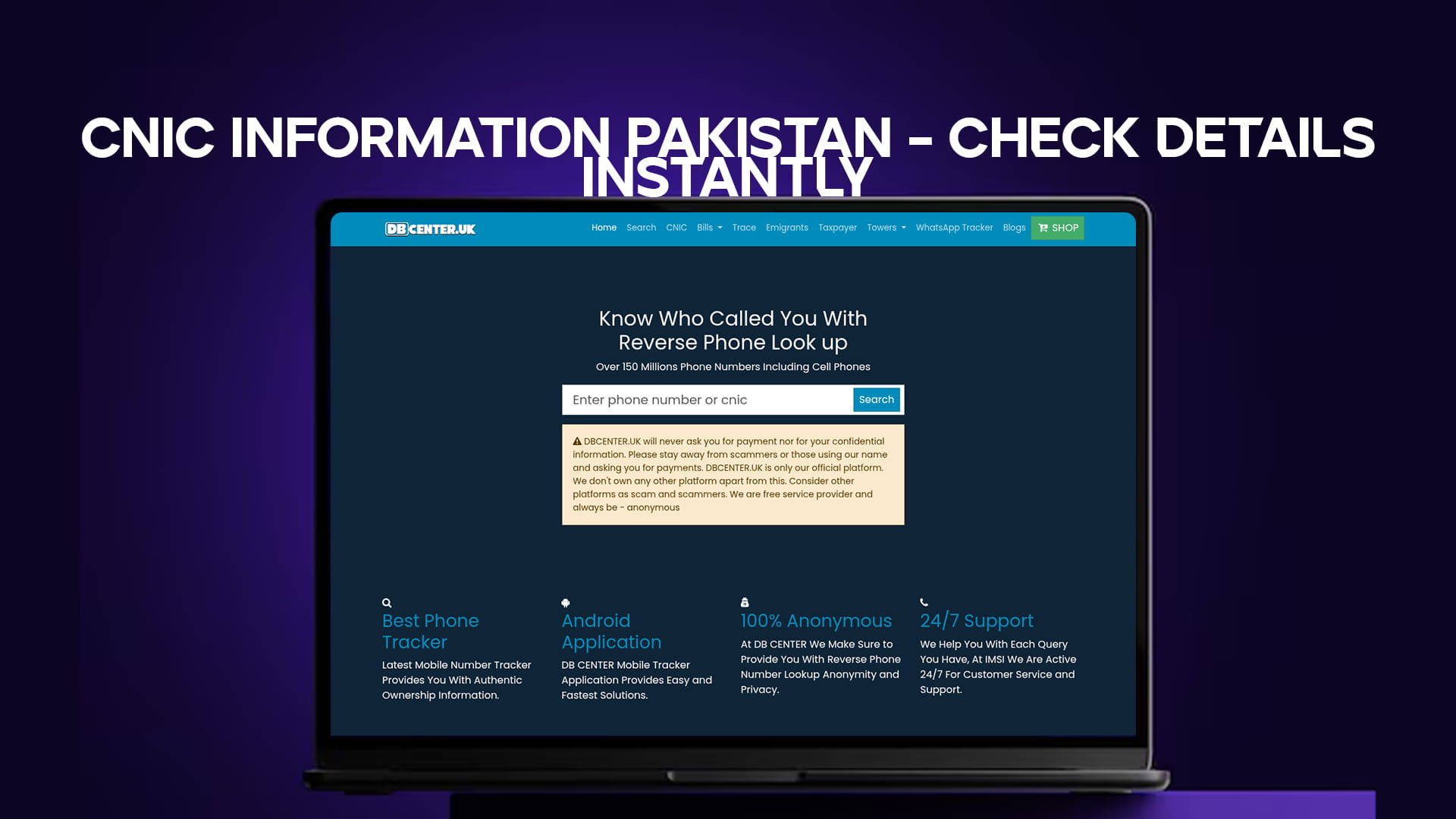
This is the gap that reverse phone lookup services address. A service like DB Center stores information linked to phone numbers — names, locations, and other details derived from public sources, user reports, and aggregated data. When someone enters a phone number into the search, the tool returns whatever information it has associated with that number.
DB Center covers over 150 million phone numbers, including cell phones. For Pakistani users worried about unknown contacts, this kind of resource can offer quick answers without needing to go through formal channels.
How DB Center Works for Pakistan Users
DB Center is a reverse phone lookup service. You enter a phone number, and the platform searches its database to find any associated information. This includes the name of the person the number is registered to, the general location, and sometimes whether other users have flagged the number as suspicious, a scammer, or a robocall.
It works for mobile numbers and landlines. The database pulls from publicly available records and user-submitted information, which means coverage can vary — some numbers will return detailed results, others may show limited data, and some may not appear at all if the number is completely unlisted or very new.
For Pakistani users, DB Center can be particularly useful in a few ways:
First, if you receive a call and want to know whether the number belongs to a known scammer or telemarketer, DB Center gives you a way to check before calling back or engaging further.
Second, if someone claiming a certain identity contacts you and provides a phone number, you can run that number through DB Center to see if the name they gave matches what the database shows.
Third, if you are doing any kind of due diligence — screening someone you met online, verifying a business contact, or checking on someone who applied for a position — DB Center gives you a starting point.
The service is accessible online and does not require you to provide your own personal information to run a search.
CNIC Numbers and SIM Registration — An Important Link
There is a direct link between CNIC numbers and phone numbers in Pakistan that makes identity verification particularly important. Every SIM card sold in Pakistan must be biometrically verified and registered against a valid CNIC. This means, in theory, every phone number in the country is tied to a real identity.
In practice, the system works well but is not perfect. Fraudsters sometimes register SIMs using stolen CNIC data. There have been cases where people discovered SIMs registered in their name without their knowledge, used for scams or crimes. This is why PTA's SIM check service (668 SMS) is something every Pakistani should use at least once to confirm their CNIC has not been misused.
Understanding this link also explains why reverse phone lookup data in Pakistan can often surface names — because the registration requirement creates a traceable connection between numbers and identities. When DB Center returns a name associated with a Pakistani number, it is drawing on data that ultimately traces back to the registered identity behind that SIM.
Tips for Verifying CNIC Information Safely and Legally
Pakistan has laws around data privacy and misuse of personal information. The Prevention of Electronic Crimes Act (PECA) and other regulations mean that attempting to access NADRA's database without authorization, using someone's CNIC without consent for financial fraud, or misusing personal data can carry serious legal consequences.
Here is what you can do safely:
Use official NADRA channels for any formal verification. If you are a business hiring someone, there are legal paths to verify their CNIC through NADRA's verification services for businesses.
Use NADRA's SMS verification (8009) to confirm a CNIC number is valid and matches the name you were given.
Check PTA's SIM database (668) to verify your own CNIC has not been misused for unauthorized SIM registrations.
Use DB Center for phone number lookups when you receive unknown calls or want to verify a number someone has given you. This is using publicly available information and does not require accessing any protected database.
Do not share your CNIC unnecessarily. Be careful about who you give your CNIC number to. Scammers sometimes collect CNIC data through fake form fills, fake prize schemes, and phishing calls claiming to be banks or government agencies.
Check your NADRA records periodically. NADRA allows citizens to update their address and personal details. Keeping your records current also helps you spot if anything has been tampered with.
Recognizing Common Scams That Involve CNICs
Several common scams in Pakistan specifically exploit CNIC data. Knowing what they look like helps you avoid them.
Bank impersonation calls are among the most common. The caller claims to be from your bank, asks you to confirm your CNIC number "for security purposes," and uses whatever you say to either steal your identity or access your account. Real banks do not ask for full CNIC numbers over the phone. They already have them.
SIM replacement fraud happens when a fraudster walks into a telecom shop with a forged CNIC and requests a SIM replacement for your number. Once they have your SIM, they can receive OTP codes and potentially access your mobile banking. If your SIM suddenly stops working without explanation, call your telecom provider immediately.
Job scam calls ask applicants to send photos of their CNIC as part of a fake job application process. The scammer then has your identity document image and can misuse it. Verify any company before sending CNIC copies anywhere.
Government agency impersonation involves callers claiming to be from FBR, NADRA, or other agencies telling you that your CNIC has been used in a crime or is about to be blocked. They then ask for personal information or payment to "fix" the problem. This is always a scam.
Running an unknown number through DB Center before engaging with any suspicious caller is a simple first step that can save you a great deal of trouble.
How to Check If Your CNIC Is Being Misused
If you suspect your CNIC information has been stolen or misused, here are the steps to take.
Start by checking SIMs registered to your CNIC via PTA's 668 service. If there are numbers you do not recognize, report them to PTA and your telecom provider immediately.
Contact NADRA directly if you believe someone has altered records linked to your CNIC or is using a fraudulently obtained copy of your card.
File a complaint with the Federal Investigation Agency (FIA) Cybercrime Wing if you have evidence of identity theft, particularly if it involves online fraud or digital misuse of your information.
Check your bank accounts for any unusual activity. Identity thieves who have CNIC data sometimes try to open accounts, apply for loans, or conduct transactions in your name.
Change passwords and enable two-factor authentication on all digital accounts linked to your phone number or email.
Why Reliable Information Tools Matter
Pakistan is a country of over 230 million people, a complex mix of urban centers with advanced digital infrastructure and rural areas where records are sometimes incomplete or inconsistently maintained. The gap between official databases and the reality on the ground means that people often need practical tools to fill information gaps.
DB Center addresses a real need. When official channels are too slow, too complex, or not built for the specific thing you want to check — like figuring out who just called you — having access to a searchable database of over 150 million phone numbers gives you a quick, practical answer.
It is not a replacement for official verification. For anything legally significant — hiring decisions, financial transactions, property matters — you should always use official NADRA verification channels. But for the everyday question of "who is this number?" or "is this person who they claim to be?", DB Center gives you a starting point that official services simply do not offer.
Final Thoughts
Your CNIC is your identity in Pakistan. Protecting it matters. So does having access to tools that help you verify the identities of people you interact with, especially in a world where phone scams and identity fraud are increasingly common.
Official channels — NADRA's SMS service, PTA's SIM check, e-Sahulat centers — are your first line of defense for anything formal. For everyday reverse phone lookups and quick identity checks, DB Center offers fast, accessible information drawn from a database of over 150 million numbers.
Staying informed, using the right tools, and knowing your rights under Pakistani law are the three things that make the difference between being a target and being protected.