Your phone lights up. A number you do not recognise. You stare at it for a moment, let it ring, and then it stops. A minute later it rings again. Same number.
You have two choices. Call back and find out — which is sometimes fine and sometimes a very bad idea. Or look the number up before doing anything.
Most people in Pakistan do not know the second option exists, or they assume it requires money, a government portal, or some technical knowledge they do not have. None of that is true. Reverse phone lookup tools are free, fast, and require nothing more than typing a number into a search bar.
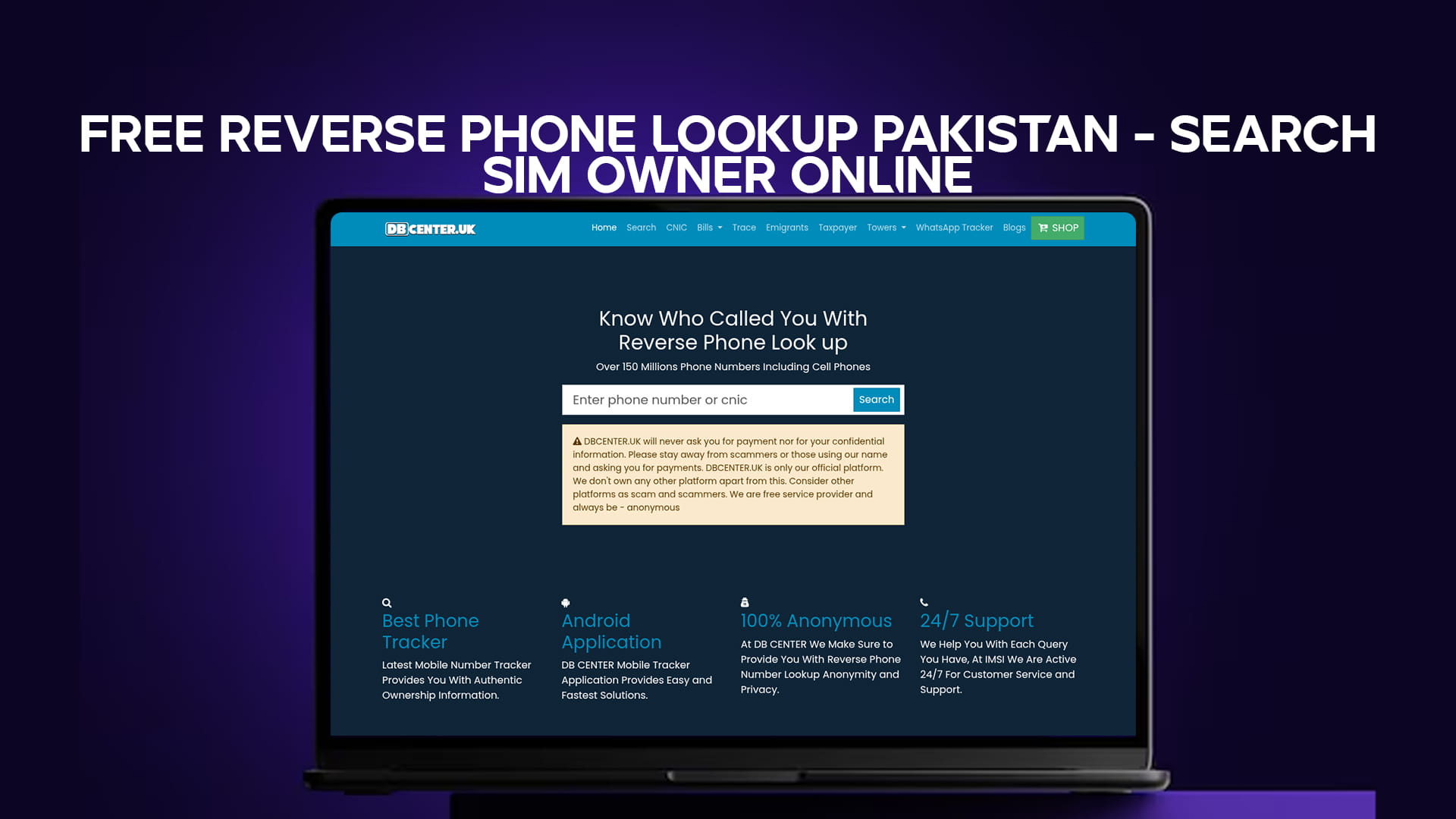
DB Center is one of the most reliable of these tools available today. It covers over 150 million phone numbers — mobile and landline — across multiple countries including Pakistan. You search a number, you get back whatever the database has: the owner's name, the carrier, the region, and whether other people have flagged it as spam or fraud. That information is often enough to make a clear decision about whether to engage or block.
This article is a complete guide to reverse phone lookup in Pakistan — how it works, how to use it, what you can and cannot find, and why it matters more than most people realise.
What Reverse Phone Lookup Actually Means
The term sounds technical but the concept is simple. A standard phone directory lets you search by name to find a number. Reverse phone lookup flips that. You start with the number and search for the name behind it.
That is the whole idea. You have a phone number. You want to know who it belongs to. You enter it into a lookup tool and the system checks it against a database of compiled phone records, carrier information, and user-submitted data.
The results depend on what is in the database for that particular number. Some numbers return a full name and carrier. Others return partial information — just the carrier and region, for example. And some numbers, particularly very new ones or those registered under minimal documentation, may return limited data but still show community reports from other users who have been called by the same number.
For Pakistani numbers, reverse lookup tools have become significantly more useful in recent years. Pakistan's biometric SIM registration requirement — which links every active SIM to a verified CNIC — means most numbers have real identity data attached to them at the carrier level. While that government data is not publicly searchable in full, it has fed into broader compiled databases that services like DB Center draw from.
Why Pakistanis Need Reverse Phone Lookup More Than Ever
Pakistan has one of the highest mobile penetration rates in South Asia. There are well over 190 million active SIM subscriptions in a country of roughly 230 million people. That means almost every adult has a phone. Many have more than one number.
With that volume of mobile users comes volume of phone-based fraud. The Federal Investigation Agency's Cybercrime Wing handles thousands of phone fraud cases every year. The PTA receives hundreds of thousands of spam and scam complaints annually. The numbers make it clear: phone-based fraud is not a minor issue.
The scams follow recognisable patterns. Prize calls. Fake government officials demanding CNIC verification. Loan offers with hidden terms. Investment schemes. Job offers requiring upfront fees. Romance fraud. Blackmail calls. In almost every case, the fraudster is using a mobile number — often a SIM registered under someone else's identity or under minimal documentation before the biometric rules tightened.
For ordinary people, a reverse lookup is a first line of defence. It does not catch every scam — no single tool does — but it catches many of them. A number that has been flagged by fifty users as fraud does not need a second look. Block it and move on.
Beyond fraud, there are dozens of ordinary reasons to look up a number. Someone left a business card with a number that does not seem to match who they said they were. An old contact reached out from a new number. A delivery service called and did not leave a message. Life generates unknown numbers constantly, and having a quick, free way to check them is genuinely useful.
How to Do a Reverse Phone Lookup for Pakistani Numbers
The process on DB Center takes less than two minutes. Here is how it works from start to finish.
Step 1: Open DB Center. Go to the website on any browser — desktop, tablet, or phone. The homepage is clean with a search bar at the top. That is where you start.
Step 2: Format the number correctly. Pakistani mobile numbers start with 03 domestically. For an international reverse lookup, you replace the leading zero with Pakistan's country code: +92. So a number like 0321-4567890 becomes +923214567890. DB Center handles both formats, but the international format tends to return more complete results.
Step 3: Enter the number and search. Type or paste the number into the search bar and hit enter. The system scans its database and returns results within seconds.
Step 4: Read the results. The results page shows everything the database has on that number. This typically includes the registered name (if available), the mobile carrier, the country and general region, the number type (mobile, landline, or VoIP), and any community reports.
Step 5: Check the community reports carefully. This step matters. Even when a number has no name attached — because the registration is new or the data has not been compiled yet — the community reports can tell you a great deal. If multiple users have flagged the number as a scam, a telemarketing call, or worse, that is current information. It reflects real people's recent experiences with that exact number.
Step 6: Act on what you found. Block the number, call back confidently, save the contact, or file a formal report — whatever the situation calls for. DB Center gives you the information; what you do with it is your decision.
Understanding Pakistani Phone Number Formats
When searching Pakistani numbers, knowing the format helps you get better results and avoid errors.
All Pakistani mobile numbers have ten digits when dialled domestically, starting with 03. The digits immediately after the zero identify which carrier the SIM belongs to. This is publicly available information and worth knowing.
Jazz (Mobilink): Numbers starting with 0300, 0301, 0302, 0303, 0320, 0321, 0322, 0323, 0330, 0331, 0332, and 0333
Telenor Pakistan: Numbers starting with 0340, 0341, 0342, 0343, 0344, 0345, and 0346
Zong (China Mobile Pakistan): Numbers starting with 0310, 0311, 0312, 0313, 0314, and 0315
Ufone (PTCL): Numbers starting with 0333 (shared range with Jazz in some cases), 0334, 0335, 0336, and 0337
SCOM: Numbers starting with 0350, 0351, and 0352 — these serve Azad Kashmir and Gilgit-Baltistan specifically
Landlines: Pakistani landlines use area codes before a six or seven-digit local number. Karachi numbers start with 021, Lahore with 042, Islamabad and Rawalpindi with 051, Peshawar with 091, and so on.
Knowing the carrier from the prefix is sometimes enough to spot something odd. A company claiming to run a national customer service line from what is clearly a personal mobile SIM is worth questioning. Legitimate large businesses use landlines or registered corporate mobile lines, not standard personal SIMs.
What Information Does Reverse Lookup Actually Return
This question comes up a lot and the honest answer is: it depends on the number.
For numbers that are well-documented in the database — older numbers, business lines, frequently reported numbers — you can typically find:
The name of the registered owner or business. The mobile carrier and specific number range. The country and in some cases the general region or city. Whether the number is mobile, landline, or VoIP. Any spam or fraud flags added by other users. Specific comments from users describing what they experienced when they received a call from that number.
For numbers with limited database coverage — newer SIMs, recently ported numbers, or numbers registered under low-documentation circumstances before biometric rules fully took hold — results may be partial. You might see only the carrier and region. In some cases, the community report data is the most useful part even when registered name data is absent.
What reverse lookup tools do not return, to be clear: home addresses, precise GPS locations, full CNIC numbers, real-time call records, or private financial details. Those sit in government and carrier systems that are not publicly accessible, and that is appropriate — a public tool showing that level of private data would create serious risks.
The value of the tool is in answering the core question: do I know anything about this number? Often the answer is yes, and that is enough.
Common Situations Where This Tool Saves Time and Money
The midnight call. It is past midnight. An unknown number calls twice, then stops. In the morning you check it. DB Center shows it has been flagged by thirty users as a fake kidnapping scam — a type where callers claim a family member has been taken and demand an immediate transfer. You know what it is before you have spent a second worrying about it.
The WhatsApp buyer. You listed your laptop for sale online. A buyer contacts you via WhatsApp from a number you do not know. Before you agree to meet, you look up the number. It is clean, no flags, registered carrier matches the city they said they are in. You proceed, but with your eyes open.
The investment pitch. A text arrives offering guaranteed monthly returns on a property investment. The number is unfamiliar. You search it and find twelve community reports all describing the same pitch and warning it is a scam. You delete the message.
The job recruiter. Someone calls offering you a job placement overseas. They ask you to pay a registration fee before they can process your application. You look up the number. It has been flagged repeatedly as a fraudulent overseas employment scheme. You hang up.
The threatening ex. Someone from a past relationship has started calling from a number you do not recognise. You think it might be them using a new SIM. You look it up. The carrier and region match. You save the details and report it to the police with the information attached.
The business call you missed. You missed a call while in a meeting. The number is not in your contacts but it looks like it could be a client. You search it and find it is registered to a business in the same industry. You call back.
These are not edge cases. They are everyday situations that a free reverse lookup tool handles in seconds.
How the PTA's SIM Regulations Make Lookups More Reliable
Pakistan's approach to SIM registration has become one of the stricter frameworks in the region. The PTA's biometric verification requirement — introduced and progressively tightened over the past decade — means that as of 2026, almost every active SIM in Pakistan is linked to a verified CNIC.
Here is what that means in practice for reverse lookup reliability. When a number is registered, it creates a data trail. Carrier records exist. NADRA has the biometric match. The number is not anonymous in the way a prepaid SIM in a less regulated country might be. That underlying registry feeds, in various indirect ways, into the compiled databases that lookup tools draw from.
The SIM cap — the limit on how many SIMs can be registered per CNIC — also reduced the pool of throwaway numbers. Before strict enforcement, individuals could hold large numbers of SIMs under fake or borrowed identities. The biometric requirement and cap together forced a cleanup. The numbers still active after that cleanup are, in a higher proportion than before, legitimately registered.
None of this means the system is perfect. Fraud still happens. Numbers still get misused. But the data quality behind Pakistan's SIM registry is better than it was, and that shows up in the quality of reverse lookup results.
The Role of Community Reports in Reverse Lookup
One thing that makes a good reverse lookup tool different from a simple database search is community reporting. DB Center includes this layer, and it matters more than people initially expect.
Here is why. A database entry for a number tells you what was true when the data was compiled. A number could be clean in the database but have been used for scam calls in the past three months. Community reports capture that current behaviour.
When users receive a scam call and they flag the number on a lookup platform, that information goes live. The next person to search that number sees those flags immediately. One flag might mean nothing. Forty flags from different users, all describing the same script, is a very strong signal.
Over time, this creates a crowdsourced fraud registry that complements the static database. It is self-updating in a way that no compiled database can be on its own. Real people experiencing real calls leave real records. That is valuable.
If you look up a number and it has zero flags, that does not automatically mean it is safe — it may just mean nobody has reported it yet. But a number with many flags, especially recent ones, is telling you something worth listening to.
And if you receive a scam or spam call, reporting the number yourself takes under a minute. That small action protects the next person who searches it.
Protecting Yourself Beyond the Lookup
Reverse phone lookup is one tool. A complete approach to phone safety in Pakistan involves a few additional habits.
Never share your CNIC details, OTP codes, or bank account information over the phone with someone who called you. Legitimate institutions — banks, NADRA, the FIA, your mobile carrier — do not call you out of nowhere and ask for sensitive information. If someone claiming to be from any of these organisations asks for that information, hang up and call the institution directly using a number from their official website.
Do not call back unfamiliar international numbers. Some call fraud works by getting you to dial back a premium-rate number. The charges accumulate quickly. If you do not recognise an international number, look it up before calling.
Use your phone's built-in blocking feature. Both Android and iOS make it easy to block numbers permanently. Use it. A blocked number cannot reach you again regardless of what they try.
If you have lost money to phone fraud, report it. Go to the FIA Cybercrime Wing's complaint portal, include the number, describe what happened, and attach any evidence — screenshots, call logs, transaction records. The FIA does act on these complaints, particularly when they involve financial fraud.
Enable spam call filtering through your carrier. Jazz, Telenor, Zong, and Ufone all have some level of spam filtering available. Check your account settings or contact customer support to activate it.
These habits, combined with a quick reverse lookup when an unknown number appears, build a reasonable defence against the most common phone-based threats in Pakistan.
Who Uses Reverse Phone Lookup — And Why It Is Not Just for Suspicious Calls
It is easy to think of reverse phone lookup as something you only need when something feels wrong. In practice, people use it for completely routine reasons all the time.
A mother wants to confirm her daughter's new friend's number before allowing a meetup. A landlord gets a call from a potential tenant and wants to verify the name they gave matches the number they are using. A small business owner receives a call claiming to be from a supplier and wants to confirm it is genuine before discussing pricing. An elderly person got a call about a utility bill and is not sure if it is legitimate.
None of these situations involve active suspicion of fraud. They are just ordinary moments where knowing who is behind a number would be useful. That kind of casual, routine use is exactly what free tools like DB Center are built for. The barrier to use is low — no cost, no registration, no technical knowledge — which means there is no reason not to check.
Final Thoughts
Pakistan's mobile landscape is large, busy, and not always safe to navigate blind. Unknown calls, suspicious numbers, unverified contacts — these are daily realities for millions of people.
Free reverse phone lookup removes the guesswork. DB Center makes it as simple as typing a number and reading the results. With over 150 million numbers in its database and an active community reporting system, it covers Pakistani mobile numbers across all carriers — Jazz, Telenor, Zong, Ufone, SCOM — and returns results that are genuinely useful.
You do not need to call back an unknown number without knowing anything. You do not need to engage with a suspicious message without checking the source first. The information is available and the tool is free. Use it before you decide, not after.