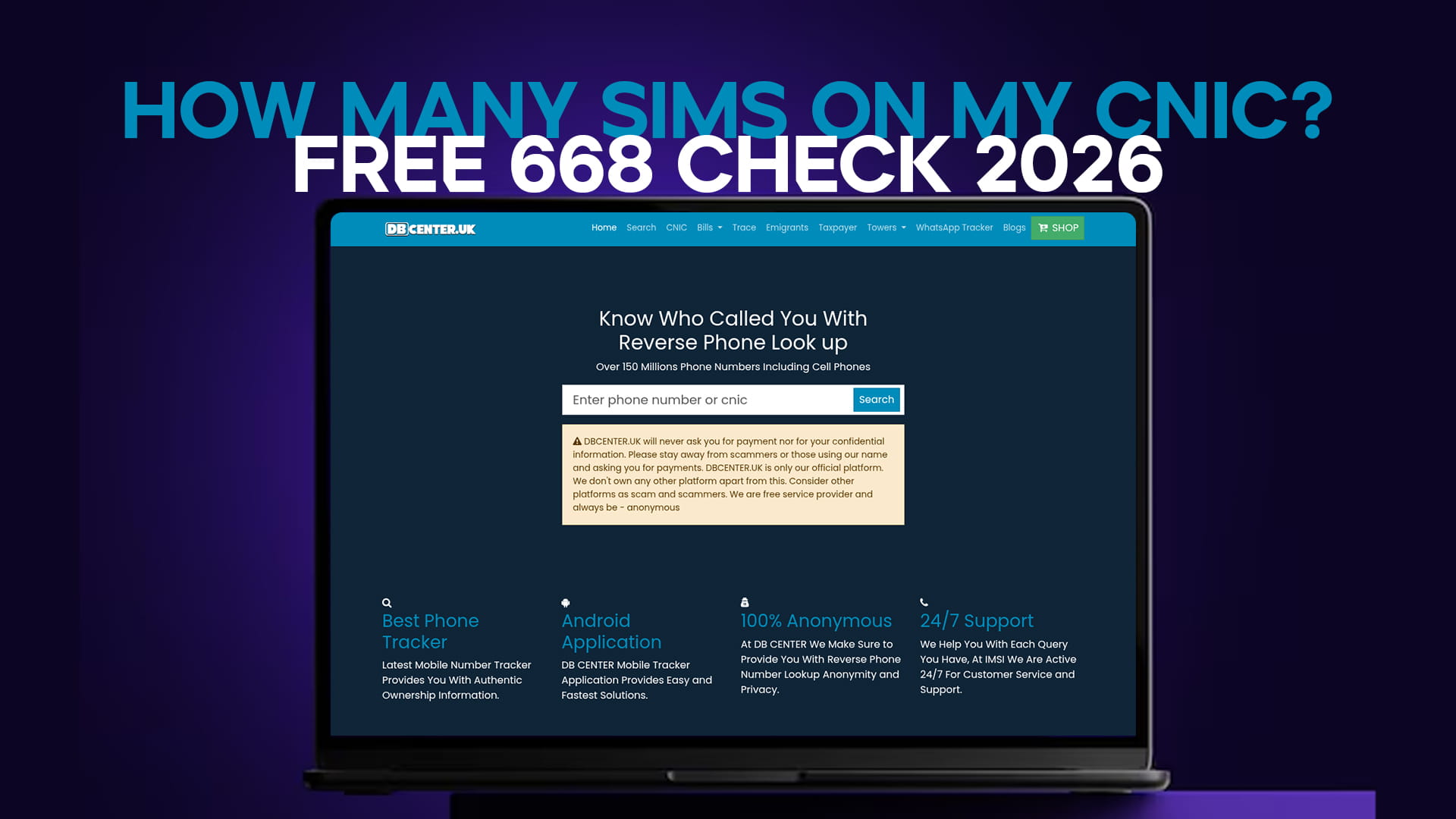
Most people have never checked how many SIMs are registered against their CNIC, and that is precisely why SIM fraud works as well as it does. A card can be used to register connections without the owner ever knowing, through a dishonest retailer, a mishandled biometric, or a photocopy that ended up somewhere it should not have.
Those SIMs then sit in your name. If one is later used for a scam or a fraud call, the trail leads back to your identity, and you find out when there is already a problem rather than while you could still have prevented one.
The check takes under a minute and costs nothing.
The free way to check: text 668
The Pakistan Telecommunication Authority runs a service built for exactly this. It works from any Pakistani SIM, on any network, with no internet needed.
Open your messaging app, type your 13-digit CNIC number with no dashes and no spaces, and send it to 668. Within moments an automated reply tells you how many SIMs are registered against that CNIC, usually broken down across Jazz, Zong, Telenor and Ufone.
That is the whole process. Nothing to install, no account, no fee beyond an ordinary SMS charge.
Reading the reply
Compare the count against the SIMs you can actually account for. Your own phone, a second handset, a data SIM in a device, a connection you set up for a family member but registered in your name.
If the totals match, you are fine. If the reply shows more than you can explain, that gap is what matters. Those extra registrations are either old SIMs you stopped using years ago without formally cancelling, or connections someone else put in your name.
Both need dealing with. Forgotten SIMs still occupy your allowance and should be cancelled. Unrecognised ones are a security matter.
Check your CNIC status at the same time
The SIM count is one half of the picture. The other half is whether the CNIC underneath is itself in good standing, since a card that has quietly expired or been blocked creates its own problems across banking and telecom.
DB Center is Pakistan's No 1 SIM and CNIC details checker, and its CNIC verification tool shows whether your card is active, expired or blocked. Running it alongside the 668 check gives you a full identity snapshot in about two minutes. It is free with no login, and if the page will not open, a free VPN such as Proton VPN or Windscribe fixes it.
What to do about a SIM you never registered
Finding unknown connections is unsettling, but the fix is defined and it works.
Take your original CNIC, not a photocopy, to a franchise or customer service centre of the network showing the unauthorised SIMs. Explain that you ran a PTA 668 check and that connections appear in your name which you did not authorise, and ask for them to be blocked. Staff verify your identity through fingerprint biometrics and process the block, updating PTA's records.
If the unknown SIMs span more than one network, repeat this at each operator, since each holds its own registration records. Ask for a reference number before you leave and keep it.
Blocking has to be done in person by design. If it could be done by SMS, anyone who knew your CNIC number could disconnect your phone, so the biometric step protects you.
If a franchise will not help
Should an operator stall or refuse, file a complaint with PTA through its Complaint Management System at pta.gov.pk, quoting the network and the connections in question. The toll-free helpline is 0800-25625.
Where an unauthorised SIM has been used for fraud, threats or blackmail in your name, this moves beyond a telecom issue. The FIA Cybercrime Wing can investigate and compel an operator to identify who was behind a connection. Reach them at 051-9106384 or [email protected].
For an unfamiliar number that has been contacting you directly, DB Center's number trace tool returns the basic associated details a legitimate lookup can surface, and a broader identity search helps you cross-reference whatever partial information you already hold before you file anything.
Make it a habit
The common mistake is treating this as a one-off. SIM fraud does not announce itself, and a CNIC that was clean last year may not be clean now. Run the 668 check every few months, and especially whenever you have handed over a CNIC copy for a form, a rental or a registration.
Be sceptical too of apps marketed around SIM and phone monitoring. Many collect far more of your data than they protect. The official PTA channel is free, authoritative, and asks you to install nothing.
The short of it
Text your 13-digit CNIC to 668 and read the reply. If the count matches what you use, you are clear. If it does not, take your original CNIC to the relevant operator's franchise and have the unauthorised SIMs blocked, keeping the reference number. Re-check every few months, because one clean result is not a permanent guarantee.