You get a call. The voice is calm and official. They say they're from your bank, or from PTA, or from the FIA, and there's a problem with your account or your SIM. They need you to confirm a few details, or read out a code, or move some money to a "safe" account before it's too late. There's urgency in their voice, just enough to stop you thinking clearly.
That's the whole game. Not technology. Pressure.
Phone scams in Pakistan have had a bad couple of years, and 2026 isn't looking gentler. PTA put out a nationwide alert about exactly these calls: fraudsters impersonating government bodies, banks, and telecom companies to pry personal data and money out of people. The numbers behind it are grim. The NCCIA, the agency now handling cybercrime, took in over 150,000 complaints in 2025, and the biggest single chunk, around 82,000 of them, was financial fraud. So if you've been getting these calls, you are very much not alone, and you are not stupid for almost falling for one. The people running these are good at it.
Let me walk you through how to see them coming and what to actually do about it.
The calls that are going around right now
Scams shift their costume but keep the same body underneath. Here are the ones doing the rounds.
The fake official call is the big one. Someone claims to be from PTA, the FIA, the NCCIA, your bank's fraud department, or a courier company. They've usually got a believable story: your SIM is about to be blocked, there's suspicious activity on your account, a parcel is stuck in customs. PTA has said this plainly, and it's worth burning into memory: no government body asks for sensitive details over a phone call. Not your CNIC, not your PIN, not an OTP. If someone official-sounding is asking, that's your answer right there.
Then there's the fake job, or "task," scam, which has exploded. It starts friendly. You get a WhatsApp message offering easy work, liking videos or rating products for money. They even pay you a small amount at first to build trust. Then comes the hook: send a deposit to "unlock" bigger tasks, and the money you've "earned" will be released along with it. People have written about losing a thousand rupees this way, then being pushed for three thousand more, then watching the whole thing evaporate. The fake screenshots of payments are part of the script.
Investment and trading scams run on the same fuel, just bigger. Slick fake platforms, screenshots of other people's "returns," promises of profit that no real investment could match. The NCCIA arrested people behind a fake trading scheme worth around twenty billion rupees operating out of Multan. That's the scale we're talking about.
OTP and SIM-swap fraud is the technical cousin. They trick you into reading out the one-time password your bank just texted, or they get a SIM issued on your number and use it to walk into your accounts. SIM-swap cases climbed sharply across 2024 and 2025, and the losses per case were not small.
And under all of it sits the plain old spam call: the relentless marketing, the robocalls, the numbers that ring once to make you call back. Less dangerous, more maddening, and still worth shutting down.
How to tell a scam from a real call
There's no single magic sign, but scams share a family resemblance once you know what to look for.
Urgency is the loudest tell. Real institutions don't usually demand you act in the next five minutes or lose everything. Scammers manufacture a ticking clock because panic switches off the part of your brain that asks sensible questions. The moment you feel rushed, that feeling is the warning.
Then there's the request itself. Anyone asking for your full CNIC, your card number, your PIN, your account password, or an OTP over the phone is, by definition, not someone you should be talking to. Banks don't ask. PTA doesn't ask. The NCCIA doesn't ask. The OTP especially. That code exists precisely so that only you can authorise a transaction, and the entire scam often hinges on getting you to hand it over.
Watch the payment direction too. If the "solution" to your problem involves you sending money, moving it to a "safe" account, or buying gift cards or mobile load, you're being robbed. No legitimate process resolves a fraud by having you transfer funds to a stranger.
Be sceptical of anything too generous. Guaranteed profits, prizes you didn't enter, jobs that pay well for tapping a screen. If the maths doesn't make sense, it's because it isn't real.
And trust the small wrongness. A caller who knows your name but mispronounces the bank. A "courier" who can't tell you what you supposedly ordered. A number that doesn't match the official UAN. These little snags are often the only crack you get, so pay attention to them.
What to do when a scam call comes in
When the call is happening, the best move is almost boringly simple: don't engage, and don't hand over anything.
Hang up. You owe a cold caller nothing, least of all your politeness. If part of you worries it might be genuine, fine, but don't continue on their terms. End the call and ring the institution back yourself, using the number printed on your bank card or the official website, never a number the caller gave you. Scammers will happily feed you a "head office" number that rings straight back to them.
Never read out a code, a PIN, or a password, no matter how convincing the reason. Treat your OTP like a key to your house, because that's roughly what it is.
If you've already given something away, move fast. Call your bank immediately and freeze the card or account. Change any passwords the scammer might now have. The hour after you realise is the hour that matters most.
How to report a scam call in Pakistan
Reporting feels like effort when you just want to forget it happened, but it's how these networks eventually get shut down. Here's where to send it.
For spam calls and messages, forward the offending number with a short description to 9000. That's PTA's spam-reporting shortcode, and it feeds their system for identifying and acting against repeat offenders.
For PTA complaints and guidance more broadly, the helpline is 0800-55055, and there's a complaint form on the PTA website.
For actual fraud, financial loss, blackmail, or online harassment, the right destination in 2026 is the NCCIA. The FIA Cyber Crime Wing used to be the place for this, but the National Cyber Crime Investigation Agency replaced it and now runs cybercrime investigations under the PECA law. You can call the NCCIA helpline on 1799 for guidance, or file a formal complaint online at complaint.nccia.gov.pk. When you file, bring everything you've got: screenshots, the number, transaction details, dates, any chat history. Evidence is what moves a complaint from a note in a file to an actual investigation.
One honest caveat. Calling the helpline for guidance is not the same as registering a formal case, and serious matters move faster with a proper written complaint and, where money or threats are involved, sometimes a lawyer. But reporting through the right channel is always better than staying silent, because silence is exactly what lets the same number work its way down a list of new victims.
Why older relatives get hit hardest
I want to spend a moment on this because it's where the real heartbreak tends to happen. Scammers love calling older people, and not because they're foolish. It's because they often grew up trusting that a caller claiming to be from the bank probably is from the bank, they're less likely to have heard about this week's specific trick, and they're frequently alone when the call comes, with nobody beside them to say "wait, that sounds wrong."
The fake-bank call is brutal on this group. A calm voice, an official-sounding problem, a request to "verify" an account by reading out a code, and a lifetime's savings can move in minutes. By the time anyone in the family hears about it, the money's gone and the shame has set in, which is its own cruelty, because the shame stops people reporting it.
If you've got older parents or grandparents, do them a real favour. Sit with them over tea and walk through it plainly. Tell them the one rule that covers almost everything: no real bank or government office will ever phone and ask for a CNIC, a PIN, or a code, so anyone who does is a fraud, and it's completely fine to just hang up. Give them permission to be "rude" to cold callers, because politeness is the lever scammers pull hardest. That single conversation protects them better than any app or filter.
How one scam actually unfolds
It's easier to spot the pattern when you've watched it move once, so here's a typical task scam from the inside.
It opens warmly. A WhatsApp message, often from an unknown international number, offers easy money for simple online tasks, liking videos or rating products. You're curious, you do a couple, and, to your surprise, a small payment really does land in your account. That little win is the entire trick. It switches off your suspicion, because surely a scam wouldn't pay you.
Then the tone shifts. To unlock higher-paying tasks, you need to "deposit" some money first, which you'll get back along with bigger earnings. You send a thousand. They show you a screenshot of your swelling balance, a balance that exists only on their screen. There's a "small problem" releasing it, so they need three thousand more. Maybe you pay, chasing the money already in. Maybe you stop. Either way, the balance never comes out, the screenshots were fake from the start, and the friendly "manager" goes quiet.
Seeing it laid out, the shape is obvious: a small real payment to build trust, then escalating deposits against fake proof. Once you recognise that shape, you'll spot the next one before it gets your money.
How DB Center can help you stay a step ahead
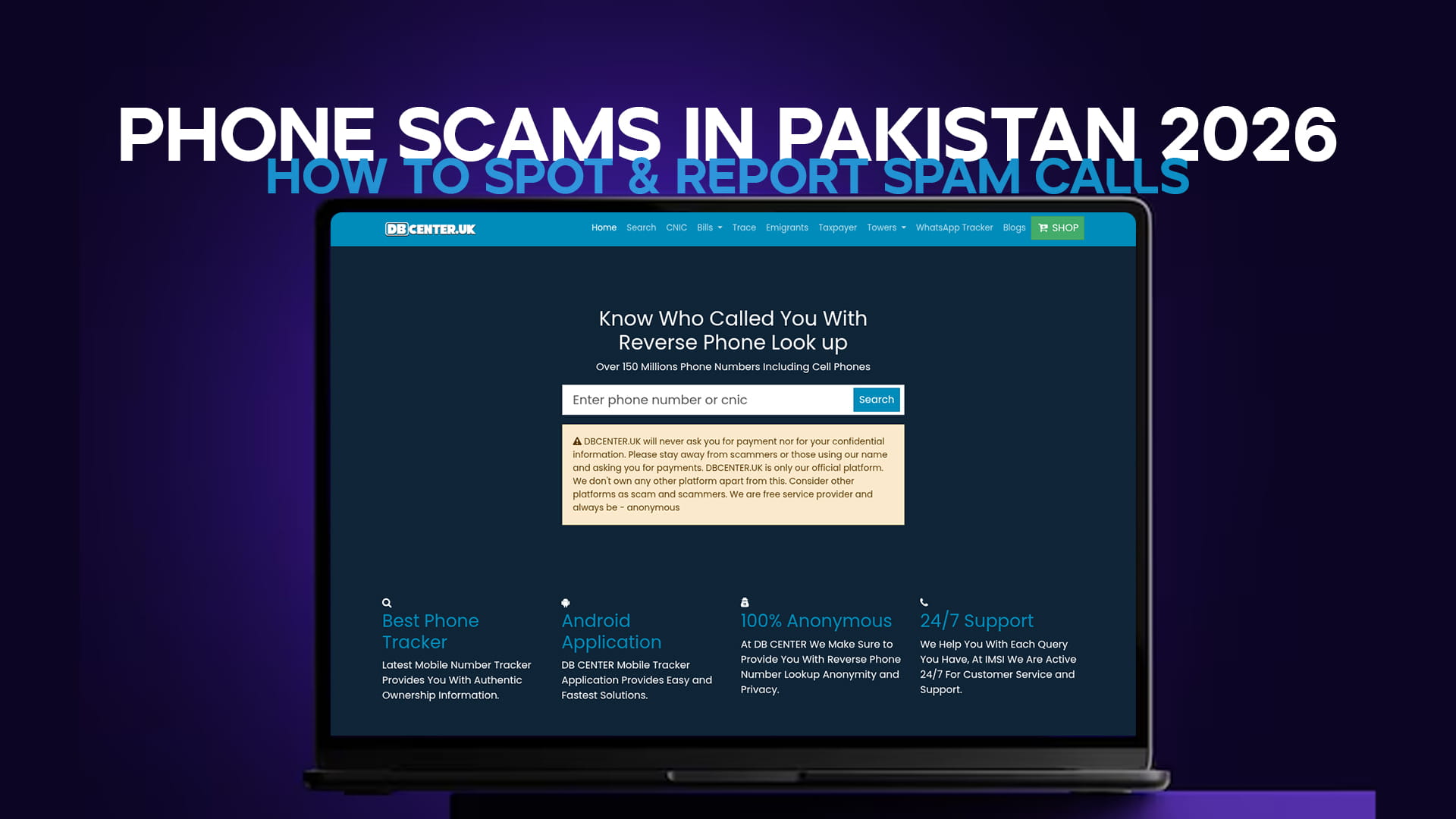
When an unknown number calls, a few seconds of checking changes the odds. DB Center gives you tools for exactly that moment. You can use the number search and trace features to get basic context on a number before you decide whether to answer, call back, or report it. If you want to make sure your own identity hasn't been quietly attached to SIMs you never bought, the CNIC checker and the free 668 SMS service are the place to start.
The point isn't to chase scammers down yourself. It's to give yourself a beat of information before you react, because scams live and die on your split-second decisions.
Building habits that scammers hate
You can't stop the calls from coming. What you can do is make yourself a bad target, and a few habits go a long way.
Decide, once and for all, that you will never share an OTP, PIN, or password over the phone. Make it a rule with no exceptions, so you don't have to negotiate with yourself in the moment a smooth-talking caller is leaning on you.
Check your CNIC's registered SIMs every couple of months by texting it to 668, so an unauthorised SIM, the kind used in swap fraud, can't sit on your name unnoticed.
Keep your CNIC photo off WhatsApp and email unless you've verified, in person, exactly who's asking and why. Fake job offers and prize schemes exist largely to collect those images.
Slow down when you feel rushed. That instinct alone, the deliberate pause when a call gets urgent, will save you from most of what's out there. Scammers are betting on speed. Refuse to give it to them.
And talk about this stuff with the people around you, especially older relatives, who get targeted hard and often don't hear about the latest tricks until it's too late. A two-minute conversation over chai about the fake-bank call is worth more than any app.
The bottom line
Phone scams in Pakistan aren't clever hacks. They're confidence tricks dressed up in official language, and they work by rushing you past your own good sense. No real bank, no real government agency, will ever phone you and ask for your CNIC, your PIN, or your OTP. The instant a caller does, you already have your answer.
Hang up. Call back on a number you trust. Report it to PTA on 9000 or 0800-55055, and take anything involving fraud or threats to the NCCIA on 1799 or complaint.nccia.gov.pk. None of it is complicated. It just asks you to stay calm at the exact moment someone is working very hard to make sure you don't.