Pakistan is one of the most mobile-connected countries in South Asia. With over 190 million active SIM cards in circulation and a population that depends heavily on mobile communication for business, family contact, and daily life, it is no surprise that phone number tracking and SIM location services have become one of the most searched topics in the country.
People across Pakistan are asking the same questions every day: Who is calling me from this unknown number? Which city is this number registered in? Which network does this SIM belong to? Is this caller genuine or a scammer trying to trick me?
These are real, valid concerns and they deserve real, reliable answers.
This article is your complete guide to understanding real-time SIM tracking in Pakistan, how live SIM location services work, what you can and cannot legally do with such tools, and how platforms like DB Center can help you identify any unknown caller quickly and safely. Whether you are a concerned parent, a business owner verifying contacts, or simply someone tired of receiving suspicious calls, this guide is written for you.
Understanding Real-Time SIM Tracking in Pakistan
Let us start with the basics. When people talk about real-time SIM tracking in Pakistan, they usually mean one of two things:
1. Finding the general location of a mobile number – This refers to identifying which city, region, or telecom zone a SIM was registered in. This kind of information is tied to the SIM registration data maintained by Pakistan's telecom operators and regulatory authorities.
2. Tracking the live GPS location of a phone – This means knowing exactly where a phone is at any given moment. This type of tracking requires either consent from the person being tracked, a court-authorized warrant, or specialized law enforcement tools.
It is critical to understand the difference between these two. The first type is perfectly legal and is what tools like DB Center are built for. The second type – live GPS surveillance of another person without their consent – is illegal in Pakistan under the Prevention of Electronic Crimes Act (PECA) 2016.
Responsible SIM tracking services focus on providing registered data, operator identification, and reverse phone lookup capabilities. They do not enable unauthorized real-time surveillance of individuals. Anyone who tells you otherwise is either misleading you or offering an illegal service.
With that important clarification in mind, let us explore what legitimate SIM tracking in Pakistan looks like and how it can genuinely help you in everyday life.
Why Millions of Pakistanis Search for SIM Tracking Services
The demand for SIM tracking and phone number lookup services in Pakistan is driven by very real and very common situations that people face every day. Here are the most frequent reasons people turn to these tools:
Dealing with Spam and Fraudulent Calls
Phone scams have become a serious problem in Pakistan. From fake bank representatives asking for your account details to lottery scams promising huge prizes, fraudulent callers are becoming more sophisticated. Before picking up or returning a call from an unknown number, many people now prefer to look it up first. A quick reverse phone lookup can reveal the operator, registered region, and sometimes the name linked to the number.
Business Verification
If you run a business and a potential client contacts you from an unknown number, being able to verify basic details about that contact gives you confidence before sharing sensitive information or entering into an agreement. SIM lookup tools help streamline this process.
Parental Monitoring and Child Safety
Parents across Pakistan are increasingly concerned about who is contacting their children through mobile phones. Knowing the details of an unknown number that frequently calls or messages your child can help you take appropriate action. With the right tools and open communication, parents can protect their children from harmful contacts.
Locating Missing Persons
In some situations, families try to locate a missing family member using their phone number. While real-time GPS tracking is not available without consent, identifying the operator and region of a number can at least give investigators a starting point.
Reconnecting with People
Sometimes you find an old phone number and want to verify if it still belongs to the same person. A phone lookup can help confirm this before you reach out.
Checking SIM Registrations Against Your CNIC
Many Pakistanis have discovered that their CNIC has been used to register SIM cards without their knowledge. This is a form of identity theft that can have serious consequences. Lookup tools help raise awareness when such misuse is detected.
How Real-Time SIM Location Works in Pakistan
To understand how SIM location data works, you need to understand how mobile networks operate in Pakistan.
Every mobile phone constantly communicates with the nearest cell tower of its registered network. These towers are spread across the country and managed by individual telecom operators like Jazz, Telenor, Zong, and Ufone. When a call is made or received, the network records which tower the phone is connected to. This data is available to telecom operators and, in certain cases, to law enforcement with proper legal authorization.
For regular users, this level of real-time location data is not directly accessible. However, what is accessible through tools like DB Center is the registered location information of the SIM – meaning the city or region where the SIM was originally registered. This is valuable information on its own because it gives you a strong indication of where the caller is likely located.
Here is a simple breakdown of what legitimate SIM tracking tools can and cannot tell you:
What You Can Find:
- The telecom operator (Jazz, Zong, Telenor, Ufone, SCO)
- The registered city or region of the SIM
- Whether the number is active
- The name associated with the account if available in a verified database
- The type of number (prepaid or postpaid in some cases)
What Requires Legal Authorization:
- Real-time GPS location of the phone
- Call logs and message records
- Account holder's full personal data from NADRA
DB Center focuses on the first category, providing fast and reliable reverse phone lookup results based on its database of over 150 million phone numbers.
DB Center – Reverse Phone Lookup for Pakistan and Beyond
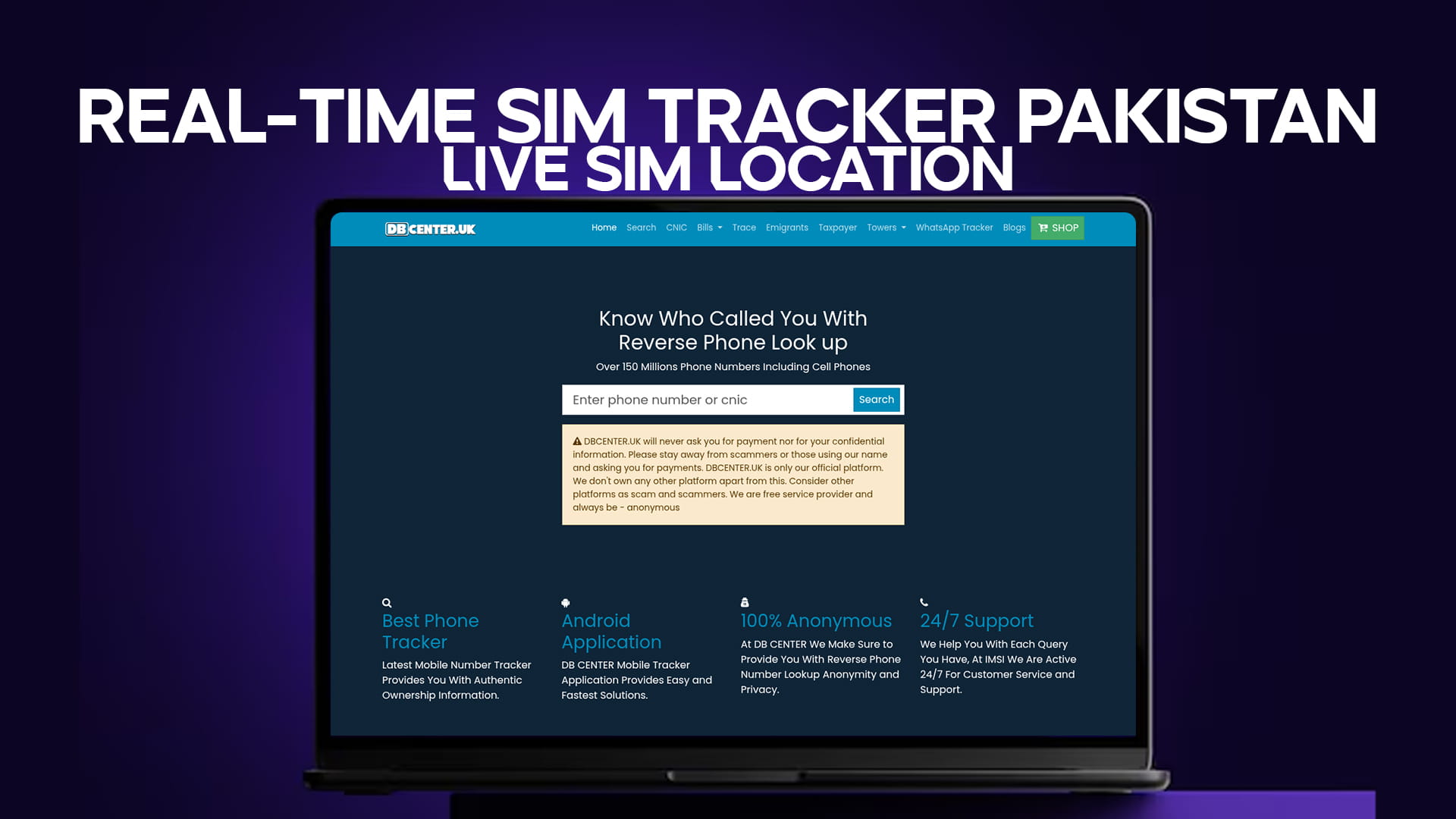
DB Center is one of the most comprehensive and reliable reverse phone lookup platforms available online. Its database contains over 150 million phone numbers, including cell phone numbers from Pakistan and across the world. This makes it an incredibly powerful tool for identifying unknown callers without any technical knowledge or complex registration process.
The platform is built around one simple but powerful idea: you should be able to know who called you. That is it. No complicated menus. No confusing dashboards. Just enter the number and get the information you need.
What Makes DB Center Different?
There are many phone lookup tools on the internet, but most of them are incomplete, outdated, or focused only on US or European numbers. DB Center stands out because:
- It covers cell phone numbers, which is essential in Pakistan where almost all communication happens on mobile devices rather than landlines.
- Its database is massive, with over 150 million numbers. This dramatically increases the chance that the number you are searching for is in the system.
- It is fast, delivering results within seconds without requiring you to sit through slow loading times or endless redirects.
- It is accessible to everyone, regardless of technical skills. If you can type a phone number into a search bar, you can use DB Center.
- It is a legitimate platform that respects privacy laws and does not offer unauthorized tracking or surveillance services.
Step-by-Step: How to Use DB Center for Pakistan SIM Lookup
If you have never used a reverse phone lookup tool before, here is a clear and simple guide on how to use DB Center to find information about a Pakistan mobile number.
Step 1: Open DB Center in Your Browser Launch any web browser on your phone or computer and navigate to the DB Center website. No app download is needed.
Step 2: Locate the Search Bar The homepage features a straightforward search interface. This is where you will enter the number you want to look up.
Step 3: Enter the Pakistan Mobile Number Type in the full mobile number. For Pakistan numbers, include the country dialing code (+92) if prompted, and replace the leading zero of the local number. For example, if the number is 0300-1234567, enter it as +923001234567 or as directed by the search format on the platform.
Step 4: Click Search Hit the search button. The system will scan its database of over 150 million numbers instantly.
Step 5: Review Your Results Within seconds, DB Center will return the available information linked to that number. You will typically see the telecom operator, the registered region, and any name information that is available in the database.
Step 6: Take Action Based on the results, you can decide whether to call back, block the number, report it as spam, or simply note down the information for future reference.
The entire process takes under a minute and can save you from a lot of trouble.
Pakistan's Telecom Landscape – Knowing Your Networks
One of the first things a reverse phone lookup will tell you is which network a SIM belongs to. In Pakistan, there are five main telecom operators. Knowing which operator a number comes from can already tell you quite a bit.
Jazz (Previously Mobilink) Jazz is the largest telecom operator in Pakistan and has been operating since the mid-1990s. It serves tens of millions of subscribers across urban and rural Pakistan. Jazz SIM numbers commonly begin with 0300, 0301, 0302, 0303, 0304, 0305, 0306, 0307, 0308, 0309, 0310, 0311, and 0321.
Telenor Pakistan Telenor entered the Pakistani market in 2005 and quickly grew to become one of the top networks in the country, known for strong data connectivity. Telenor numbers usually begin with 0340, 0341, 0342, 0343, 0344, 0345, and 0346.
Zong (CMPAK) Zong is owned by China Mobile International and has shown consistent growth in Pakistan, especially in remote and rural areas. Zong numbers typically begin with 0310, 0311, 0312, 0313, 0314, 0315, 0316, 0317, 0318, and 0319.
Ufone (PTML) Ufone is a subsidiary of Pakistan Telecommunication Company Limited (PTCL) and has been one of the most recognized brands in Pakistani mobile communication. Ufone numbers usually start with 0333, 0331, 0332, 0334, and 0335.
SCO (Special Communications Organization) SCO serves the regions of Azad Jammu and Kashmir and Gilgit-Baltistan, providing telecom services in some of the most geographically challenging parts of the country.
When you perform a lookup on DB Center, the platform will identify the network associated with the number, giving you an immediate and useful data point.
The Role of PTA and NADRA in SIM Registration
Pakistan has one of the most regulated SIM registration systems in the world. Every SIM card sold in the country must be biometrically verified and linked to a valid CNIC before it can be activated. This system was introduced to reduce anonymous SIM usage, which was being exploited for criminal activities.
The Pakistan Telecommunication Authority (PTA) oversees telecom regulation and enforces compliance among all operators. The National Database and Registration Authority (NADRA) maintains the biometric and identity records used during SIM registration.
Checking SIMs Registered to Your CNIC
Every Pakistani citizen can check how many SIM cards are currently registered in their name by sending their 13-digit CNIC number to 668 via SMS from any active mobile number. The response will list all SIMs linked to your identity.
This is a free service and one that every Pakistani should use regularly. If you spot a SIM you did not register yourself, it could be a sign of identity theft, and you should report it to PTA immediately through their official complaint portal.
This official system is great for checking your own SIM data. For looking up details about someone else's number or identifying an unknown caller, DB Center's reverse lookup tool is the more appropriate choice.
How to Protect Yourself from SIM Fraud in Pakistan
SIM fraud is a growing problem and it takes many different forms. Here are the most common types of SIM fraud happening in Pakistan today and what you can do to protect yourself.
SIM Swapping This happens when a fraudster convinces your telecom operator to transfer your number to a new SIM. Once they have your number, they can intercept OTPs and gain access to your bank accounts. Always make sure your network account has a strong security PIN and never share personal information with callers claiming to be from your telecom operator.
Fake SIM Registration Using stolen CNIC data, fraudsters register SIMs in other people's names. These SIMs are then used for criminal activities, leaving the innocent victim associated with illegal calls. Regularly checking your SIM registrations via the 668 SMS service can help you catch this early.
Phishing Calls Scammers call from unknown numbers posing as bank officials, government representatives, or telecom staff. They try to extract your personal details, OTP codes, or account passwords. Legitimate institutions never request this information over a call. Before engaging with an unknown caller, run a quick search on DB Center to see if the number has any red flags.
Prize and Lottery Scams This is one of the oldest tricks in the book but it still works on many people. The caller claims you have won a large sum of money and asks you to pay a processing fee to receive it. Do not fall for it. Use DB Center to verify the number and report it if it seems suspicious.
Impersonation Scams Some fraudsters pretend to be someone you know, claiming they are in trouble and need money urgently. Always verify the caller's identity through a secondary channel before transferring any money.
Legal Considerations for SIM Tracking in Pakistan
This is a section that every reader should take seriously before using any SIM tracking service.
Pakistan's Prevention of Electronic Crimes Act (PECA) 2016 is a comprehensive piece of legislation that governs digital activity in the country. Under PECA, unauthorized interception of communications, unauthorized access to data systems, and stalking individuals through digital means are all punishable offenses.
What Is Legal:
- Performing a reverse phone lookup on an unknown number for personal safety or verification
- Checking how many SIMs are registered to your own CNIC
- Using publicly available data to identify a caller
- Reporting suspicious numbers to PTA or FIA Cybercrime Wing
What Is Illegal:
- Tracking someone's real-time location without their knowledge or consent
- Hacking into telecom systems to access call records
- Using SIM data to stalk, harass, or threaten another person
- Sharing another person's private data obtained through unauthorized means
DB Center operates strictly within the boundaries of legal and ethical data use. It provides a reverse phone lookup service based on its verified database and does not facilitate any form of unauthorized surveillance or illegal data access.
Always use SIM tracking and phone lookup tools responsibly. These tools exist to help you stay safe, not to invade other people's privacy.
Tips for Getting the Most Out of DB Center
Whether you are a first-time user or a regular visitor, here are some tips to help you get the best results from DB Center:
Always Use the Full Number When entering a Pakistan mobile number, make sure you include all the digits. Missing even one digit will return inaccurate or no results.
Try Different Formats If your first search returns limited results, try entering the number in a slightly different format. Some databases respond better to numbers entered with country codes while others work better with local formats.
Note Down Repeated Unknown Callers If you keep receiving calls from the same number, jot it down and search it on DB Center. Over time, pattern recognition can help you identify whether it is a spam campaign or a genuine caller.
Use the Results to Inform Your Decisions The information you get from a reverse lookup is a tool to help you make better decisions. It is not a definitive verdict. Use the results alongside your own judgment.
Report Fraud Numbers If a number you looked up turns out to be associated with fraudulent activity, report it to the PTA or FIA Cybercrime Wing. You could be protecting others from falling into the same trap.
Final Thoughts
The subject of real-time SIM tracking and live SIM location in Pakistan is a nuanced one that sits at the intersection of technology, safety, and legal responsibility. There is a genuine and growing need for tools that help ordinary people identify unknown callers, protect themselves from fraud, and verify the contacts they interact with every day.
DB Center meets this need with a powerful, easy-to-use, and legally responsible platform. With over 150 million phone numbers in its database – including cell phones – it gives you the best possible chance of finding out who is calling you, no matter where in Pakistan the number is registered.
In a country where mobile phones are the lifeblood of communication, having access to a trusted reverse phone lookup tool is not just convenient. It is essential.
The next time an unknown number lights up your screen, do not guess. Do not ignore it. Take a moment to run it through DB Center and make an informed decision. Your safety, your peace of mind, and your privacy are worth that extra sixty seconds.
Stay smart. Stay safe. Trust DB Center.