Mobile phones have become an essential part of daily life in Pakistan. From making calls and sending messages to accessing banking apps and social media, everything runs through a SIM card. With over 190 million mobile subscribers in the country, Pakistan has one of the largest mobile user bases in the entire world.
But with such massive connectivity comes a serious challenge — misuse. Scam calls, fraud, harassment, identity theft, and criminal activities linked to unregistered or illegally registered SIM cards are growing problems in Pakistan. Every day, people receive calls from unknown numbers and wonder — who is this person? Is this a scammer? Is this someone using a fake identity?
That is where the ability to search SIM information online using a reliable check tool becomes incredibly valuable. Whether you are trying to identify an unknown caller, verify the owner of a mobile number, or check how many SIM cards are registered against a CNIC, having the right tools and knowledge can protect you and your loved ones.
In this article, we will cover everything you need to know about searching SIM information online in Pakistan. We will walk you through official government tools, trusted platforms like DB Center, and best practices for using SIM check tools responsibly and effectively.
What Is SIM Information and Why Does It Matter?
SIM stands for Subscriber Identity Module. It is the small chip inside your mobile phone that connects you to a mobile network. Every SIM card in Pakistan is registered under a name and a CNIC — Computerized National Identity Card — number. This registration is mandatory under Pakistani law and is enforced by the Pakistan Telecommunication Authority (PTA).
SIM information refers to the data associated with a particular mobile number or SIM card. This typically includes:
- The name of the person the SIM is registered under
- The CNIC number used during registration
- The network operator — Jazz, Telenor, Ufone, Zong, or SCOM
- The registration date of the SIM
- The status of the SIM — active, inactive, or blocked
- The number of SIMs registered under a specific CNIC
This information matters for several reasons. First, it helps establish accountability — if a SIM is used for criminal activity, it can be traced back to the registered owner. Second, it allows ordinary citizens to verify whether someone calling them is who they claim to be. Third, it helps prevent fraud by exposing illegally registered SIM cards.
In Pakistan, a single CNIC can have a maximum number of SIM cards registered under it. If that limit is exceeded — or if SIMs are registered without the owner's knowledge — it becomes a red flag that needs immediate investigation.
Why Pakistan Made SIM Registration Mandatory
Pakistan introduced mandatory biometric SIM registration in 2015 following a series of high-profile terrorist attacks and nationwide security concerns. Before this policy, SIM cards could be purchased and activated with minimal identity verification, making them easy tools for criminals to use anonymously.
Under the biometric registration system, every person buying a new SIM card must:
- Provide their CNIC number
- Verify their identity using fingerprint biometric scanning
- Match their fingerprint against NADRA's national database in real time
This system, jointly managed by PTA and NADRA, dramatically reduced the number of unregistered and fraudulently registered SIM cards in the country. However, the problem has not been completely eliminated. SIM fraud, illegal re-registration, and misuse of stolen CNICs to register SIMs still occur.
This is exactly why tools that allow citizens to search SIM information online in Pakistan are so important today.
How to Search SIM Information Online in Pakistan
There are several ways to check and search SIM information online in Pakistan. Here are the most reliable and widely used methods:
Method 1: PTA's SIM Information Check — SMS to 668
The easiest and most direct way to check how many SIM cards are registered against a specific CNIC is through PTA's official SMS service.
Here is how to use it:
- Open the SMS app on your phone
- Type the 13-digit CNIC number you want to check
- Send it to 668
- PTA will reply with a complete list of all SIM cards registered under that CNIC, including the mobile numbers and the network operator for each
This service is completely free and works on all Pakistani mobile networks — Jazz, Telenor, Ufone, Zong, and SCOM. It is available around the clock and provides instant results.
This method is especially useful for checking your own CNIC to confirm that no one has secretly registered SIM cards under your identity. If you find numbers you do not recognize, you can report them to PTA for deactivation.
Method 2: PTA's Official Website — Complaint and Verification Portal
PTA operates an official web portal where citizens can file complaints about illegal SIM registrations and check information about their registered numbers. Through this portal, you can:
- Report unauthorized SIM cards registered under your CNIC
- Request deactivation of SIM cards you did not authorize
- Get information about the number of SIMs allowed per CNIC
- Submit complaints about harassment or scam calls
The PTA portal also provides information about blocked and deactivated numbers, helping you stay informed about the status of any number you are researching.
Method 3: NADRA's Verisys and Identity Verification
Since SIM cards are registered using CNICs, and CNICs are managed by NADRA, there is a direct link between SIM information and NADRA's identity database. Authorized institutions use NADRA's Verisys system to cross-reference phone numbers with identity records in real time.
While this system is not directly accessible to ordinary citizens, it powers many of the verification checks done by banks, telecom companies, and government agencies behind the scenes. Understanding this connection helps you appreciate why SIM information is so tightly linked to national identity data.
Method 4: DB Center — Reverse Phone Lookup Tool
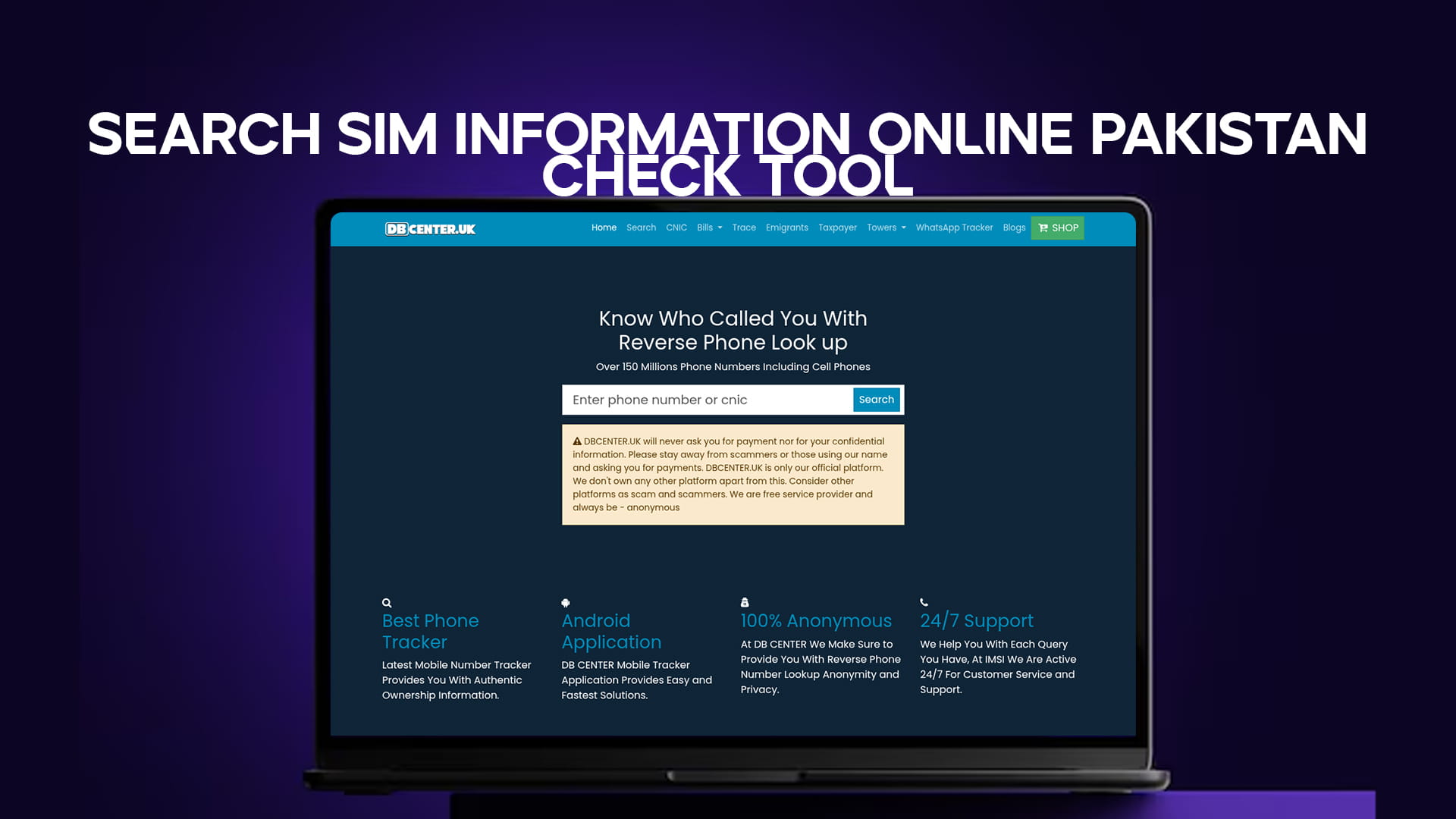
For individuals who want to search SIM information and find out who owns a specific mobile number, DB Center is one of the most powerful and user-friendly tools available. DB Center specializes in reverse phone lookups — you enter a phone number, and the platform searches its massive database to tell you who it belongs to.
DB Center's database contains over 150 million phone numbers, including cell phones. This makes it one of the most comprehensive reverse phone lookup resources available for Pakistani users.
Here is why DB Center is particularly valuable for SIM information searches:
- Speed — Results are returned almost instantly. You do not have to wait for an SMS reply or navigate complicated government portals.
- Coverage — With 150 million numbers in its database, DB Center covers an enormous range of Pakistani and international phone numbers.
- Ease of use — The platform is clean, simple, and requires no technical knowledge. Just enter a number and search.
- Comprehensive results — Beyond just a name, DB Center may provide additional details linked to the number, giving you a fuller picture of who you are dealing with.
For anyone who regularly receives calls from unknown numbers — whether for personal or professional reasons — DB Center is a tool worth bookmarking.
What Information Can You Find When You Search a SIM Number Online?
When you use tools like DB Center or PTA's services to search SIM information in Pakistan, here is the type of information you may be able to access:
Registered Owner's Name
The most basic and most sought-after piece of SIM information is the name of the person the SIM is registered under. Knowing this helps you quickly identify whether a caller is who they claim to be.
Network Operator
Knowing which mobile network a number belongs to — Jazz, Telenor, Ufone, Zong, or SCOM — can be useful in itself. It may give clues about the type of number (prepaid or postpaid) and can sometimes indicate the region the number was originally registered in.
SIM Registration Status
You can find out whether a SIM is currently active, inactive, or has been blocked. An inactive or blocked SIM that is still being used to make calls is an immediate red flag and should be reported.
Number of SIMs Under a CNIC
As mentioned earlier, you can check how many SIM cards are registered under a specific CNIC using PTA's 668 service. This is critical for detecting unauthorized registrations.
Location and Region Data
In some cases, SIM information databases may include data about the general geographic area associated with a number's registration — particularly for landlines and numbers with regional area codes.
Common Reasons People Search SIM Information in Pakistan
Understanding who needs SIM information and why helps explain why these check tools are so important. Here are the most common use cases:
Identifying Unknown or Suspicious Callers
This is by far the most common reason. Every day, millions of Pakistanis receive calls from numbers they do not recognize. While some of these are innocent — a wrong number, a delivery rider, or a new contact — others may be scammers, fraudsters, or even criminals. Searching the number through DB Center's reverse phone lookup instantly tells you who is behind the call.
Protecting Children and Elderly Family Members
Parents worry about who is calling their children. Elderly citizens are often targeted by phone scammers who pretend to be from banks or government agencies. Having a reliable SIM check tool allows family members to quickly verify the identity of callers and protect vulnerable loved ones.
Verifying Business Contacts
Before entering a business deal with someone you have not met in person, verifying their phone number through a SIM information search is a sensible precaution. It confirms that the number is registered under the name they provided, adding a layer of trust to the transaction.
Detecting Identity Theft
If your CNIC has been used without your consent to register SIM cards, this is a serious form of identity theft. Regularly checking what SIMs are registered under your CNIC using PTA's 668 service can help you detect this problem early and take swift action.
Investigating Harassment or Threats
If you are receiving harassing calls or threatening messages, searching the SIM information of the caller is often one of the first steps people take. It can help you identify the person and provide this information to law enforcement.
HR and Recruitment Verification
Human resources professionals and recruiters sometimes verify the contact numbers provided by job applicants. Cross-checking a number through a SIM lookup tool helps confirm that the contact details on a resume are genuine.
How DB Center Fits Into Pakistan's SIM Information Ecosystem
Pakistan has a well-established official system for SIM registration and verification, managed jointly by PTA and NADRA. But official systems, while reliable, are not always the fastest or most convenient for everyday users.
DB Center fills this gap by providing a fast, easy-to-use platform that complements official services. Think of it as a first stop when you receive an unknown call. Instead of sending an SMS to a government number and waiting for a response, you can simply open DB Center, type in the number, and get an instant result.
With its database of over 150 million phone numbers — including mobile phone numbers from across Pakistan — DB Center has the depth and breadth needed to provide meaningful results for a wide range of search queries. The platform is continuously updated, which means the information it provides reflects current registrations rather than outdated records.
DB Center is also designed with privacy in mind. It provides access to information that is in the public interest — helping people identify who is contacting them — without exposing sensitive private data. This balance between usefulness and privacy protection is what makes it a trusted tool for thousands of Pakistani users.
Tips for Using SIM Information Check Tools Responsibly
Searching SIM information online is a powerful capability, and like all powerful tools, it should be used responsibly. Here are some important guidelines to follow:
Use It for Protection, Not Surveillance
SIM information check tools are designed to help people protect themselves from scams, fraud, and harassment. They should never be used to spy on, stalk, or monitor another person without their knowledge or consent.
Report What You Find to Authorities
If you discover that your CNIC is being used to operate unauthorized SIM cards, do not just ignore it. Report the unauthorized numbers to PTA via their website or by contacting their helpline. You should also inform NADRA and, if necessary, file a complaint with the FIA Cyber Crime Wing.
Do Not Share Information Carelessly
If you find SIM information about a person for a legitimate reason, do not share that information with others unless it is necessary for a specific lawful purpose. Spreading personal information without a good reason can cause harm and may even be illegal under Pakistan's data protection laws.
Verify Through Multiple Sources
No single tool is 100% accurate 100% of the time. If the information you find through DB Center or PTA's service seems inconsistent with what you already know, cross-check it using another method before drawing any conclusions.
Keep Your Own Number Secure
Just as you search for information about others, remember that others can search for information about your number too. Be mindful of where you share your mobile number publicly and regularly check what information is associated with it.
The Future of SIM Information Verification in Pakistan
Pakistan's digital infrastructure continues to grow rapidly. The government, PTA, and NADRA are all investing in more advanced identity and SIM verification technologies. Here is what the future looks like:
Real-time integration — More platforms will soon be able to instantly cross-reference SIM data with NADRA's national identity database, making verification faster and more accurate than ever.
AI-powered fraud detection — Telecom operators and government agencies are increasingly using artificial intelligence to detect suspicious SIM usage patterns and flag potential fraud before it escalates.
Citizen-facing mobile apps — There are ongoing efforts to make SIM verification and identity management easier through dedicated government apps, reducing the reliance on SMS-based services.
Expanded coverage for DB Center — As databases like the one powering DB Center continue to grow and update, citizens will have access to even more comprehensive and current information about phone numbers and their registered owners.
Final Thoughts
Searching SIM information online in Pakistan using the right check tools is one of the most practical steps you can take to protect yourself in today's connected world. Whether you use PTA's free 668 SMS service, NADRA's official platforms, or trusted private tools like DB Center, the ability to find out who is behind a mobile number is a powerful form of personal protection.
DB Center stands out as a fast, reliable, and user-friendly option for reverse phone lookups in Pakistan. With a database of over 150 million phone numbers including cell phones, it gives you the information you need — quickly and without complicated procedures. Whether you are an individual trying to identify an unknown caller, a business verifying a contact, or a parent keeping your family safe, DB Center is a resource that delivers real value every single day.
Protect yourself. Verify who you are dealing with. And always use SIM information check tools wisely and responsibly.