Every day, millions of Pakistanis receive calls and messages from numbers they do not recognize. Some of these calls are harmless, perhaps a wrong number or an old friend using a new SIM. But many of them are not harmless at all. Scam calls, harassment, fake job offers, banking fraud, and identity theft through phone communication have become serious problems across the country.
In this environment, the ability to check SIM owner details online has become one of the most searched topics in Pakistan. People want to know who is behind a particular number before they respond, return a call, or make any kind of decision based on that communication. This need is completely understandable and entirely legitimate.
Pakistan has a robust telecom infrastructure with over 190 million mobile subscribers. Every single SIM card in the country is legally required to be registered with a valid CNIC (Computerized National Identity Card). This means every active number is officially linked to an identity. The question is, how can an ordinary citizen access this information when they need it?
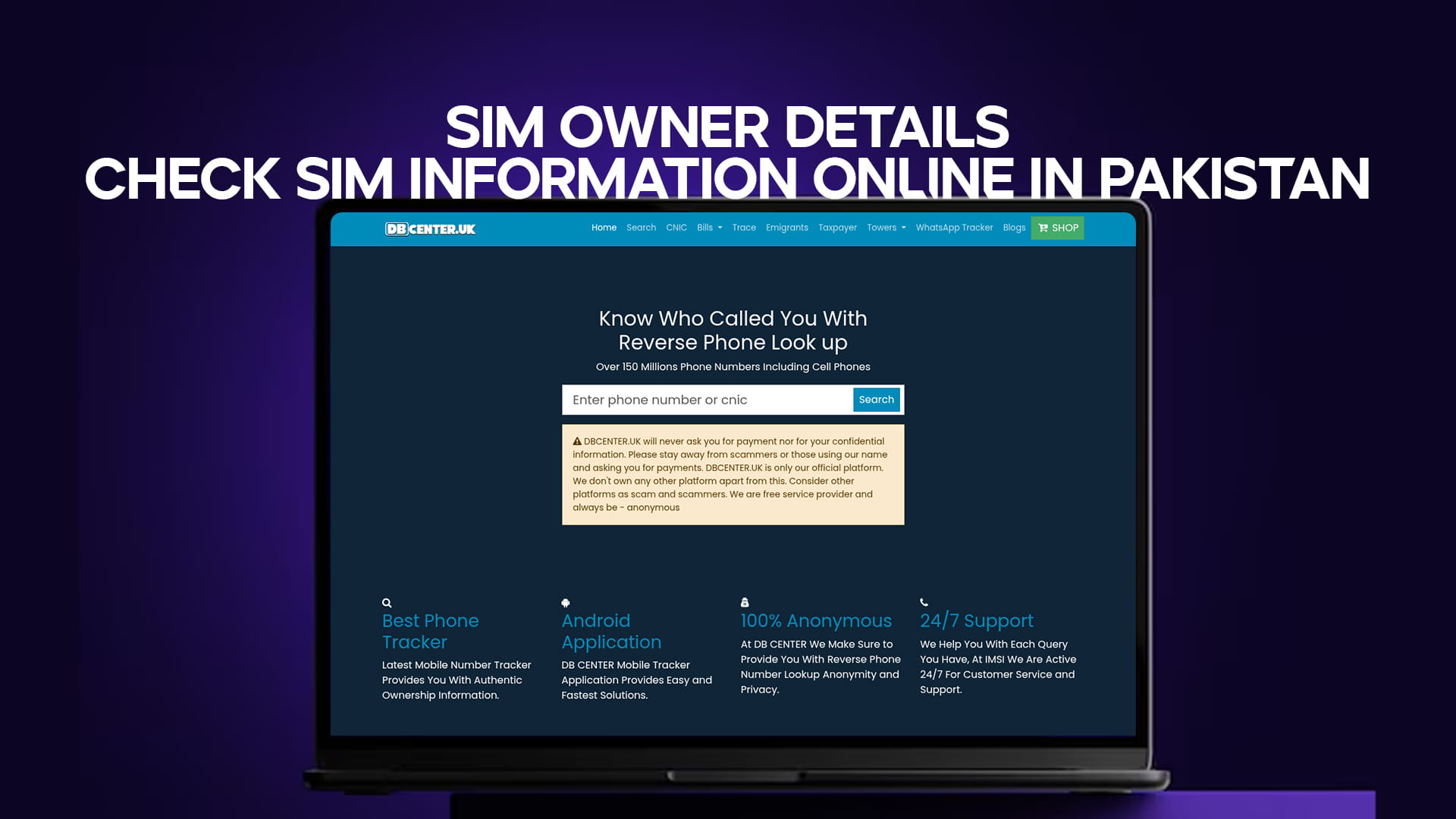
The answer lies in platforms like DB Center. DB Center is a leading reverse phone lookup service with a database of over 150 million phone numbers, including cell phones from across the world. It allows users to search unknown numbers, access publicly available information, and benefit from community-reported data to help identify callers and verify SIM information. In this comprehensive guide, we will explore everything you need to know about checking SIM owner details online in Pakistan and how DB Center can make the process simple, fast, and effective.
What Is a SIM Owner Detail Check?
A SIM owner detail check refers to the process of finding out who a particular SIM card or phone number belongs to. In Pakistan, because all SIMs are registered through NADRA biometric verification, every number theoretically has an owner linked to it through their national identity.
When people search for SIM owner details, they are typically trying to find out one or more of the following things:
- The name of the person who owns a particular mobile number
- Which telecom network the SIM belongs to (Jazz, Telenor, Zong, Ufone, or SCO)
- Whether a number has been flagged for suspicious or fraudulent activity
- The general location or region the number is registered in
- How many SIMs are currently registered under a specific CNIC number
It is important to understand from the outset that complete private identity records, including full CNIC details, address, and biometric data, are protected by law and cannot be legally accessed through any public platform. Legitimate services like DB Center only display publicly available information and community-reported data. Accessing or misusing private identity records without authorization is a criminal offense under Pakistan's Prevention of Electronic Crimes Act (PECA) 2016.
With that understanding in place, let us look at what can be legally and ethically accessed, and how.
SIM Registration in Pakistan: The Legal Foundation
To fully appreciate why SIM owner checks are both possible and important, it helps to understand the legal and regulatory structure behind SIM registration in Pakistan.
NADRA and Biometric Verification
Since 2015, Pakistan has required biometric verification for all SIM card registrations. This means that when someone buys a new SIM, their fingerprint must be verified against NADRA's national database in real time. A SIM cannot be issued if the fingerprints do not match or if the person does not have a valid CNIC.
This system was introduced to eliminate the practice of SIMs being registered under fake or borrowed identities, which had been a major tool for criminals, terrorists, and fraudsters. Today, Pakistan's biometric SIM registration system is considered one of the most advanced in South Asia.
PTA's Role in SIM Management
The Pakistan Telecommunication Authority regulates all telecom operators in the country and ensures compliance with SIM registration rules. PTA maintains oversight of how many SIMs are registered per CNIC, monitors blocked numbers, and handles complaints about misuse of phone numbers.
The Five SIM Limit Rule
PTA restricts the number of SIM cards that can be registered under a single CNIC to a maximum of five across all networks. This rule was put in place to prevent bulk SIM registrations that are often used for fraud, spam, and other harmful activities.
Understanding this framework helps explain why checking SIM information is not just a matter of curiosity. It is a matter of personal security. If someone is fraudulently using your CNIC to register SIMs, you could be held indirectly responsible for any criminal activity conducted using those numbers.
How to Check SIM Owner Details Using Official Methods
Pakistan provides several official and government-authorized methods for citizens to verify SIM registration information linked to their own CNIC. Here is a full breakdown:
Method 1: SMS to Short Code 668
This is the easiest and most widely used method. Here is how it works step by step:
Open your phone's messaging application. Type your 13-digit CNIC number exactly as it appears on your identity card, without any dashes or spaces. Send this message to the short code 668. Within a few seconds, you will receive a free reply SMS listing all SIM cards currently registered under your CNIC, including the network name and number for each.
This service works across all major networks and is available around the clock. It is completely free and requires no internet connection.
Method 2: PTA's Official Website
PTA also offers a web-based SIM information portal. To use it, visit the official PTA website and navigate to the SIM information section. You will be required to enter your CNIC and receive an OTP (One-Time Password) to verify your identity before results are displayed. This method gives you the same information as the SMS method but through a more structured online interface.
Method 3: NADRA's Pak Identity App
NADRA offers a mobile application called Pak Identity that allows citizens to access various identity-related services, including checking registration details. While its primary function is not SIM checking, it is useful for verifying your own CNIC status and ensuring your identity has not been compromised.
What to Do After Checking
If you discover SIMs registered under your CNIC that you did not apply for, take the following steps:
Note down the numbers that you did not register. Then search those numbers on DB Center to see if they have been used for fraudulent or suspicious activity. File an immediate complaint with PTA through their online portal. Report the matter to the FIA Cyber Crime Wing, which handles identity fraud cases. Visit your nearest telecom franchise with your original CNIC documents to have the unauthorized SIMs deactivated.
How DB Center Helps You Check SIM and Number Information
While official government methods help you check SIMs linked to your own CNIC, there are many situations where you need information about someone else's number. When a stranger calls you, when you receive suspicious messages, or when you need to verify a business contact, official government tools are not designed for that purpose. This is where DB Center becomes an invaluable resource.
Reverse Phone Lookup Explained
DB Center operates as a reverse phone lookup platform. Instead of searching for a number using a person's name, you start with the number and find information about it. DB Center searches through its database of over 150 million phone numbers and returns whatever publicly available or community-reported data it has on that number.
For Pakistani users, this can include the telecom network associated with the number, the general region or city the number originates from, the name linked to the number if available in public records, and most importantly, any reports or comments from other users who have received calls from that number.
Community Intelligence: The Most Powerful Feature
What makes DB Center stand out is its community-driven database. Every time a user receives a call from a number used for scams, spam marketing, harassment, or fraud, they can report it directly on the platform. These reports are visible to anyone who subsequently searches that number.
This means that over time, the most problematic numbers in Pakistan accumulate a track record of reports on DB Center. A scammer who has been calling people in Karachi, Lahore, and Islamabad will have reports from users across all these cities. When you search their number, you see all of these reports immediately. This kind of crowd-sourced intelligence is something no static database can replicate.
No Registration or Downloads Needed
One of the most appreciated aspects of DB Center is that it is completely web-based. You do not need to download an app, create an account, or provide any personal information to perform a search. Simply visit the platform from any browser, enter the number, and get your results. This is particularly important for privacy-conscious users who do not want to hand over their contact list to a third-party application.
Accessible from Any Device
Whether you are using a smartphone, tablet, or desktop computer, DB Center works seamlessly across all devices. In Pakistan, where a significant portion of internet users browse the web exclusively on mobile phones, this cross-device compatibility is a major practical advantage.
Identifying Pakistan's Telecom Networks from Number Prefixes
Before using a reverse lookup tool, it helps to understand what the prefix of a Pakistani number can tell you. Here is a simple reference guide:
Jazz, which was previously known as Mobilink and remains Pakistan's largest telecom network, uses number prefixes including 0300, 0301, 0302, 0303, 0304, and 0305.
Telenor Pakistan, the second-largest network, is associated with prefixes such as 0340, 0341, 0342, 0343, 0344, and 0345.
Zong, which is operated by China Mobile Pakistan and is known for its strong data network, uses prefixes like 0310, 0311, 0312, 0313, and 0314.
Ufone, operated under the Pakistan Telecommunication Company Limited umbrella, uses prefixes such as 0331, 0332, 0333, and 0334.
SCO, which is the Special Communication Organization serving Azad Kashmir and Gilgit-Baltistan, operates under separate regional prefixes specific to those areas.
Knowing the prefix does not tell you who owns the number, but it helps you know which network to report to if you need to flag the number for misuse. Combined with a DB Center search, this gives you a more complete picture.
Real-Life Situations Where Checking SIM Details Protects You
Let us look at some practical, real-world scenarios where being able to check SIM and number details makes a genuine difference in people's lives across Pakistan:
Protecting Yourself from Banking Fraud
Banking fraud through phone calls remains one of the most common and damaging scams in Pakistan. Callers pretend to be from your bank and ask for your account number, PIN, or OTP. Before sharing any information or even engaging with such a caller, searching their number on DB Center takes less than a minute and can save you from significant financial loss. If the number has been flagged by even one other user for banking fraud, that is more than enough reason to hang up and report it.
Verifying Online Marketplace Sellers and Buyers
Pakistan's online marketplace culture has exploded through platforms like OLX and various social media groups where people buy and sell goods. Transactions often begin with a phone call or message from a stranger. Before meeting someone in person or transferring money, searching their number on DB Center can reveal whether they have previously been reported for scams or deceptive behavior.
Filtering Job Scam Calls
Fake job offers are among the most emotionally manipulative scams targeting Pakistanis, particularly fresh graduates and job seekers. These calls promise high-paying jobs abroad or in major cities and often ask for processing fees or personal documents. A quick search on DB Center before engaging with such a caller can help you identify whether the number has been previously flagged as a job scam source.
Protecting Elderly Family Members
Many elderly Pakistanis are not tech-savvy and are particularly vulnerable to phone-based scams. Family members can use DB Center on their behalf to verify suspicious callers before any response is made. This is a simple and practical way to extend digital protection to older generations who may not know such tools exist.
Screening Rental and Property Inquiries
Landlords and property owners frequently receive calls from strangers about rental or purchase inquiries. Running a quick check on the caller's number through DB Center before sharing property addresses or meeting in person adds a sensible layer of screening to what is otherwise an inherently uncertain process.
What DB Center Can and Cannot Tell You
To use DB Center effectively and responsibly, it is important to understand its scope and limitations.
What DB Center can tell you:
DB Center can return the name linked to a number based on publicly available records. It can show you which telecom operator the number belongs to. It can display community-reported information including whether the number has been flagged for spam, fraud, or harassment. It can show the general geographic region associated with the number. It can show how many users have searched the same number, which in itself can be a red flag indicator.
What DB Center cannot tell you:
DB Center cannot provide access to private government identity records or full CNIC details. It cannot give you real-time location tracking of a caller. It cannot reveal information about numbers that have never been reported or entered into any public record. It should not be used as the sole basis for making serious legal or financial decisions without additional verification.
Using DB Center as a first line of information, combined with official channels and good judgment, gives you a well-rounded approach to phone number verification.
Tips for Using DB Center Effectively
To get the most accurate and useful results from DB Center, here are some practical tips:
Always enter the complete phone number including the country code or network prefix for the most accurate results. After reviewing the main search result, scroll down to read any community comments, as these often contain the most detailed and specific information about how a number has been used. If you have personally received a suspicious call from a number, take a moment to leave a report on DB Center. This only takes a minute and helps protect countless other people. Check the date and frequency of community reports. A number with multiple recent reports is far more concerning than one with a single report from several years ago. If the number returns no results, it may be a newly issued SIM or a number not yet in the database. Exercise caution and refrain from sharing personal information until you can verify the caller through other means.
The Broader Impact of Accessible SIM and Number Verification
At a societal level, the availability of tools that allow ordinary citizens to verify phone number information contributes to a safer and more trustworthy communication environment. In Pakistan, where institutional trust in formal complaint mechanisms can sometimes be slow to deliver results, community-powered platforms like DB Center provide an immediate, accessible, and practical alternative.
When millions of users contribute reports and search data, the platform becomes a living, breathing safety network. Scammers who target multiple victims end up documented on a shared public record. New users benefit from the experiences of thousands who came before them. This is digital safety in its most democratic form.
Conclusion
In a country as connected and fast-moving as Pakistan, the ability to check SIM owner details and verify phone number information online is not just a convenience. It is a genuine form of personal protection. As phone-based scams, SIM fraud, and identity misuse continue to grow, every Pakistani citizen deserves access to the tools that help them stay informed and safe.
DB Center provides exactly that. With a database of over 150 million phone numbers, a powerful community reporting system, and a simple web-based interface that requires no registration or downloads, it is one of the most practical and trustworthy platforms available for reverse phone lookup and number verification in Pakistan.
Whether you are trying to identify a mysterious caller, verify a business contact, check if your CNIC has been misused, or simply protect yourself and your family from the growing threat of phone fraud, DB Center is the platform to rely on. Use it wisely, contribute to its community database by reporting suspicious numbers, and take full advantage of the protection it offers.
The next time an unknown number appears on your screen, you have a choice. You can ignore it, guess, or take action. With DB Center, taking action takes less than a minute and could save you from a great deal of trouble.