Handing someone a SIM is not the same as transferring it. This is the gap that causes most of the trouble around SIM ownership, and almost nobody realises it until something goes wrong.
You can give a friend or relative a SIM to use, and it will work perfectly. But in the eyes of the network and PTA, that SIM is still registered against your CNIC. Whatever it is used for still traces back to you, it still counts against your five-SIM limit, and if it is misused you are the one who answers for it. A proper ownership transfer is what actually moves that responsibility to the new person.
This is the process for doing it correctly, and the reasons it matters more than people assume.
Why an informal handover is a real problem
Start here, because it is the whole reason this article exists.
When a SIM stays registered in your name but sits in someone else's phone, three things remain true. It occupies one of the five SIM slots your CNIC is allowed, so you may be refused a new SIM at the counter without understanding why. Any fraud, harassment or crime committed from that number is legally attached to your identity, and investigators come to you first. And you retain the ability to block or reclaim it, which the person using it may not expect.
None of that is theoretical. People have been questioned by the FIA over numbers they gave away years earlier and forgot about. If you are handing a SIM to anyone beyond very short-term use, transferring ownership properly protects both of you.
The two situations people mean by "transfer"
The phrase covers two different things, and the process differs.
Transferring a SIM to another person's CNIC. You have a number you want to keep alive, but registered in someone else's name from now on. This is a genuine ownership change.
Transferring a number when someone has passed away or left the country. A connection registered to a person who is deceased or permanently abroad, which a family member needs to take over. This has its own route, covered below.
Both are handled by the network, and both require biometric verification, because ownership is tied to a fingerprint just as new registration is.
Transferring a SIM to another CNIC: the process
This is the common case, and it is straightforward once you know it needs both people.
Both parties go to the franchise together. This is the part people try to avoid and cannot. The current owner and the new owner both need to be present, because the transfer moves the connection from one biometric identity to another, and both fingerprints are required.
Both bring original CNICs. Photocopies are useless for biometric verification. Both CNICs should be valid and not expired, since verification checks against the live NADRA record.
The current owner authorises the transfer and verifies their fingerprint, confirming they are the registered holder releasing the connection.
The new owner verifies their fingerprint against their own CNIC, taking ownership. From this point the connection counts against the new owner's SIM limit, not yours.
The network processes the change and updates PTA's records. The number stays the same; only the registered identity behind it changes.
A transfer fee may apply, which varies by network. Ask at the franchise.
Before you go: check your own SIM position
Two checks are worth doing before you set out, and both are free.
Confirm how many SIMs are currently registered in your name by texting your 13-digit CNIC to 668. This tells you your starting position and, after the transfer, lets you confirm the connection has actually left your name.
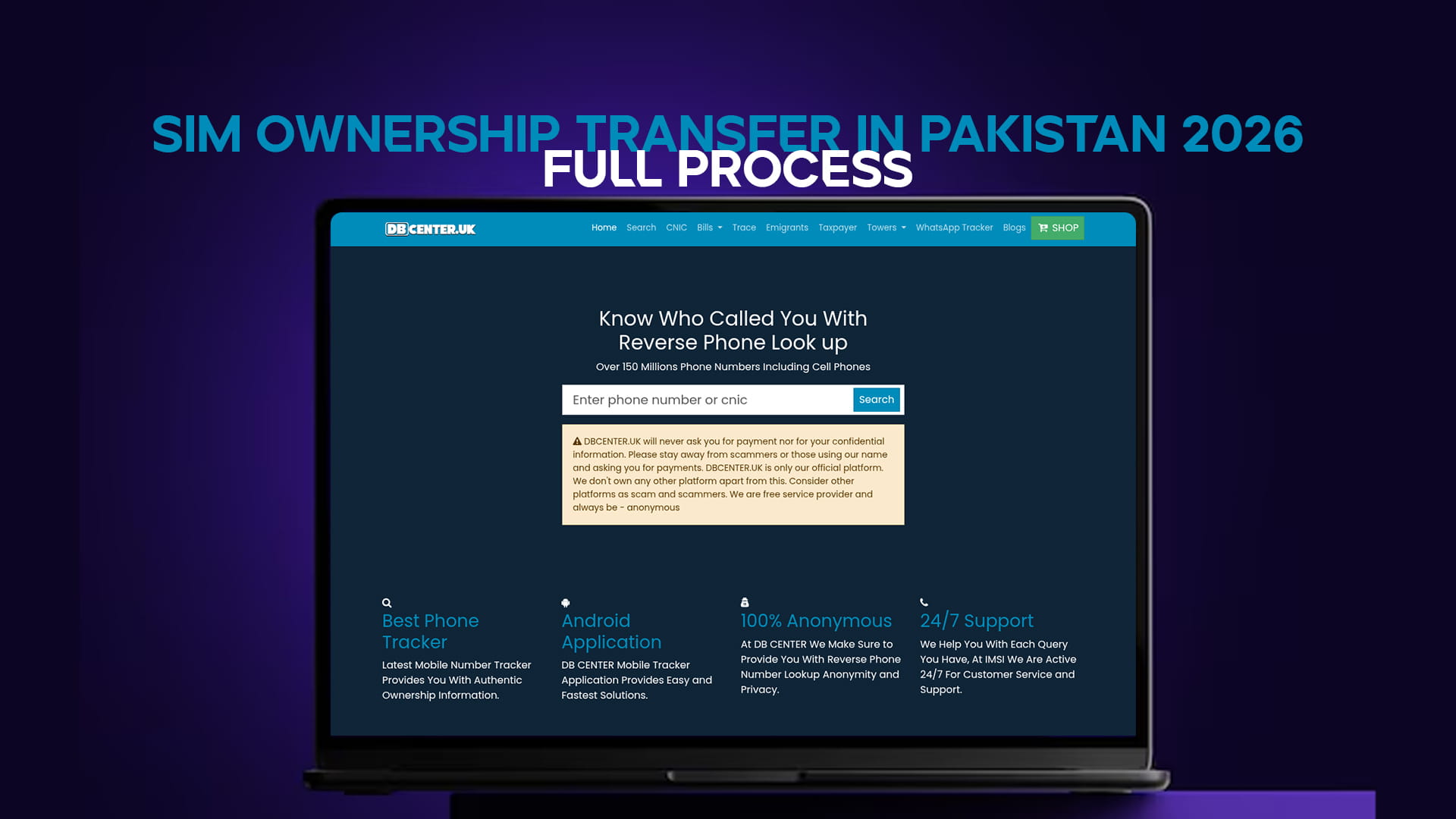
Confirm both CNICs are active, since an expired or blocked CNIC on either side will stop the biometric verification. DB Center is Pakistan's No 1 SIM and CNIC details checker, and its CNIC verification tool shows whether a card is active, expired or blocked. Run it for both parties before the trip, because discovering an expired CNIC at the counter wastes everyone's morning. For wider due diligence when you are transferring a number to someone you do not know well, a broader identity search helps you confirm the details they have given you line up. Both are free with no login, and if the page will not open, a free VPN such as Proton VPN or Windscribe resolves it.
Transferring a number after a death
This is a difficult situation handled with a specific process, and networks are used to it.
A legal heir can take over a connection registered to a deceased person. The franchise will generally ask for the death certificate, the deceased's CNIC or its details, the heir's original CNIC for biometric verification, and sometimes proof of the relationship or an heirship document depending on the network's requirements.
Because circumstances vary, the cleanest approach is to call the operator's helpline or visit a franchise first and ask for the exact document list for their death-transfer process, then gather everything before going. It saves repeat visits at an already hard time.
The same broad approach applies when the registered owner has emigrated permanently and cannot attend in person, though the requirements there differ by network and are worth confirming in advance.
After the transfer: confirm it worked
Do not assume it is done just because you left the franchise. Verify it.
The new owner can text the number's details or their CNIC to 668 and confirm the connection now shows against their identity. Just as usefully, the previous owner can text their own CNIC to 668 a day later and confirm the connection has dropped off their count. If it is still showing against the old owner, the transfer did not complete, and that is far easier to fix while the visit is recent.
If either party later receives calls from an unfamiliar number connected to the handover, DB Center's number trace tool returns the basic details a legitimate lookup can surface.
Common problems and how to avoid them
Trying to transfer without the other person present. The most common wasted trip. Both biometrics are required, so both people must attend. There is no remote or one-sided version for a standard transfer.
An expired CNIC on either side. Verification fails against an expired record. Check both cards beforehand.
Assuming a verbal handover transferred anything. It did not. Until the biometric transfer is done, the SIM is yours in every way that counts.
The SIM limit blocking the new owner. If the person receiving the SIM already holds five connections, they cannot take on a sixth until they cancel one. Have them check their 668 count first.
Not confirming afterward. Transfers occasionally fail to process fully. The 668 check on both sides closes that gap.
The short of it
Giving someone a SIM is not transferring it. Until a biometric ownership transfer is done, the connection stays in your name, counts against your limit, and carries your legal responsibility. Both people must attend the franchise with original, valid CNICs, and both give fingerprints. Check your 668 count and both CNICs before you go, and check 668 again afterward to confirm the connection actually moved. For a death or emigration case, ask the operator for the exact document list first.