An unknown number rings twice and cuts off. Or it sends a message asking you to "confirm your account." You stare at the screen and the same question shows up that shows up for millions of people in Pakistan every day: who is this, and what do they want?
I want to start with the part nobody selling you a "tracker" will tell you plainly. You can find out a fair amount about a Pakistani mobile number for free and without breaking any law. You cannot, as an ordinary person, type a stranger's number into a website and get their name, CNIC, and home address. The sites promising that are either lying about what they show or quietly collecting your data while you look. Once you accept that line in the sand, the rest of this gets a lot simpler.
So let's go through what actually works, what it gives you, and where the traps are.
First, get clear on what "trace" even means
People use the word "trace" to mean four completely different things, and mixing them up is exactly how the scammy websites hook you.
The first meaning is figuring out which network a number belongs to. Easy, legal, takes ten seconds.
The second is checking which SIMs are registered against your own identity card. Also easy, also legal, and probably the single most useful thing in this whole article.
The third is pulling a stranger's personal details from their number. This one is restricted to law enforcement working through proper channels. You and I don't get to do it, and we shouldn't want a world where anyone can.
The fourth is live GPS location, the spy-movie version where a red dot moves across a map. No public tool does this. Full stop. If a site or app claims it can show you where someone's phone is right now, close the tab.
Keep these four apart in your head and you'll never fall for the nonsense.
Method one: find the network with 667
Here's a small thing that trips people up. The old trick of reading the network off the first few digits doesn't work anymore. A 0300 number used to mean Jazz, a 0333 used to mean Ufone, and so on. Then Mobile Number Portability arrived and people started carrying their numbers between operators. That 0300 might be sitting on Zong now.
If you want the current network, the official Mobile Number Portability check sorts it out:
- Open your messages.
- Type the full number with the leading zero, like 03001234567.
- Send it to 667.
You'll get a reply telling you which operator currently runs that number. Normal SMS charges apply. It won't tell you who owns it, but knowing the network tells you whose helpline to call if the number is harassing you, and that's worth more than people assume.
Method two: check your own CNIC with 668
This is the one I wish more people did, and not just when an unknown number shows up. It tells you every SIM registered against your national identity card. Including any that someone activated on your CNIC without you ever knowing.
- Open your messages.
- Type your 13-digit CNIC number with no dashes and no spaces.
- Send it to 668 from any network.
Within about half a minute you get a reply listing the operators and how many SIMs sit under your CNIC. For a fuller, network-by-network picture you can use the PTA portal at cnic.sims.pk.
Why bother if nobody's bothering you? Because an unauthorised SIM on your CNIC is a quiet little time bomb. It can be used to intercept the one-time passwords your bank sends. It can be used to make scam calls that trace straight back to your name. If a crime gets committed on a SIM registered to you, guess who law enforcement comes to see first. Catching a strange registration early is the cheapest insurance you'll ever buy, and it costs nothing but the price of a text.
About that SIM limit
You'll see different numbers quoted everywhere, so let me be honest about the mess. PTA caps how many SIMs one CNIC can hold to cut down on fraud. The figure you'll see most often is five voice SIMs across all operators combined, with some 2026 guides adding a separate allowance of three data-only SIMs on top of that, for a total of eight. Other sources insist it's five per network. The rule has genuinely shifted over the years and the enforcement runs automatically through PTA's DIRBS system, blocking the newest SIMs once you cross the line.
Because the sources don't agree, don't take my number or anyone else's as gospel. Send your CNIC to 668, see what's actually registered, and if you want the official current limit, confirm it with PTA directly rather than a blog. That includes this one.
Method three: go through the operator
Every network in Pakistan lets you check basic SIM information through its own app, USSD codes, or a walk-in franchise. These are the right tools for confirming details about your own numbers or asking the operator to deal with a problem number.
If an unknown number is harassing you or trying to defraud you, ringing the operator's customer service and reporting it does more than any third-party site can. They can look into it from their side, which is the side that actually holds the records. Before you call, jot down the number, the date, and a one-line note of what happened. You'll need those details, and trying to remember them later is a waste of everyone's time.
Method four: report the number instead of chasing it
Honestly, if a number is spamming you, scamming you, or harassing you, reporting it beats trying to play detective.
Forward the offending number along with a short description to 9000, and you've reported it to PTA's spam system. For complaints and guidance, the PTA helpline is 0800-55055.
If there's fraud, financial loss, or online harassment involved, take it to the National Cyber Crime Investigation Agency, the NCCIA. This matters in 2026 because the old FIA Cyber Crime Wing no longer handles this. The NCCIA took over cybercrime investigations as an independent body, and its helpline is 1799, with online complaints accepted at complaint.nccia.gov.pk. They have the legal authority to trace a number to a real person. You don't, and that's the point.
Reporting also creates a paper trail. If the same number goes after someone else next week, your complaint is already part of the case.
Where DB Center fits in
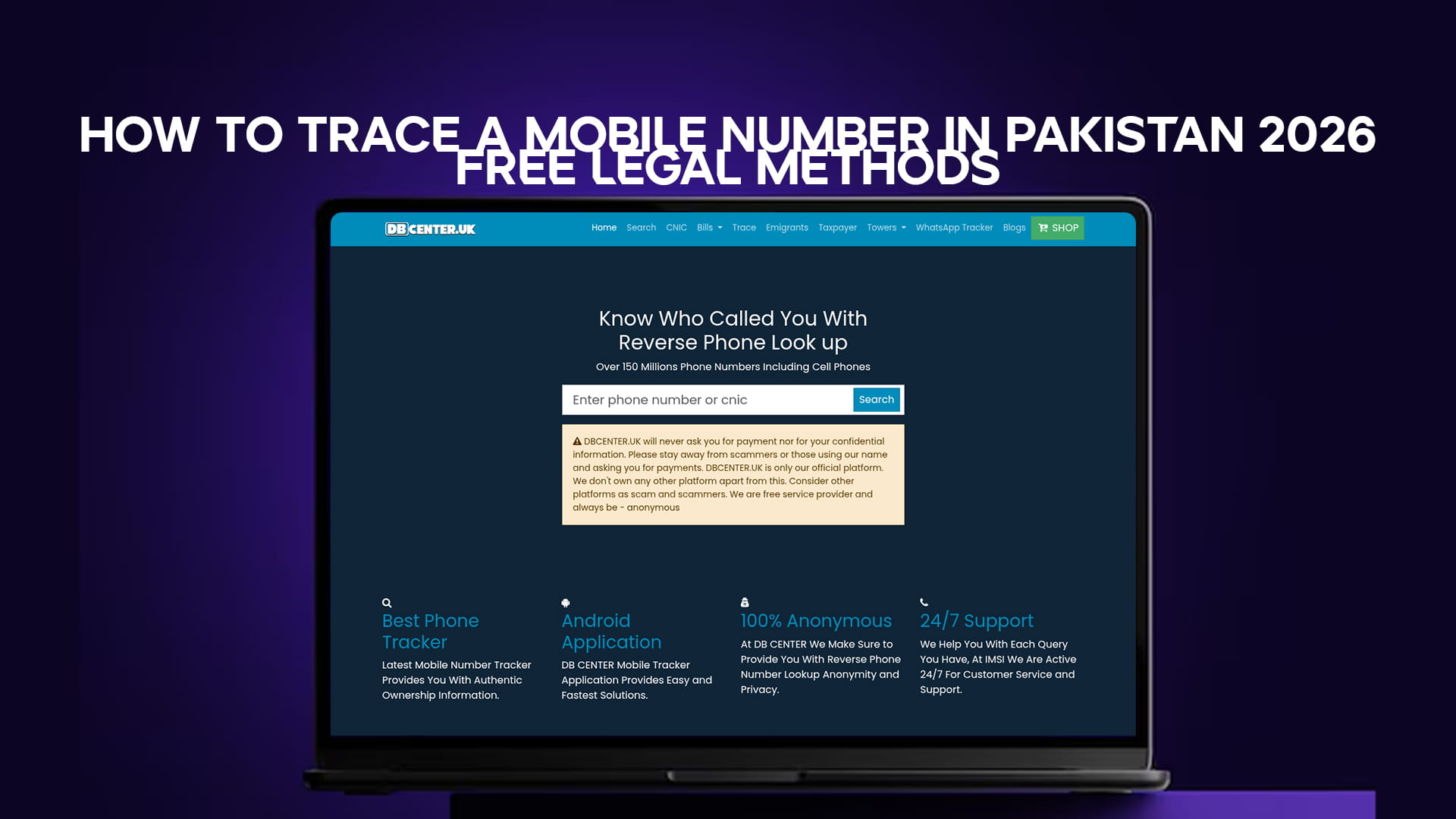
DB Center is built around these everyday moments. When a number you don't recognise lights up your phone, the tools on the site help you get your bearings quickly and legally.
The number search and trace tools help you check basic information about an unknown number so you can make a decision: call back, block, or report. The CNIC checker helps you review identity-linked records. And if you're worried about your own exposure, the smartest first move is still to text your CNIC to 668 and cross-check what comes back.
Use any of this the way you'd use a torch in a dark room. To see what's in front of you and stay safe, not to go through someone else's drawers. Digging into a stranger's private identity without a lawful reason isn't just rude, it's against the law in Pakistan, and it's the kind of thing that turns a victim into a defendant.
How to spot a fake number tracker before it bites you
The internet is stuffed with sites swearing they'll hand you the full name, CNIC, and address for any number you feed them. I'd treat every single one as guilty until proven innocent. A few tells give them away fast.
They ask for someone else's number. The legitimate, legal checks only ever want your own CNIC. The second a site asks you to enter a stranger's number to "reveal" them, you're looking at either a scam or a crime, and possibly both.
They promise live location. No legal public service tracks a phone's real-time position. That feature is bait, dangled to get you to install something.
They want payment. The real checks, 667 and 668 and cnic.sims.pk, are free. Anyone charging you a fee is not official, end of story.
They push you to install an unknown app. A random APK asking for access to your contacts and messages is one of the oldest tricks for spreading malware and harvesting phone books. Plenty of these "trackers" pull old leaked data from years ago and pass it off as live results, then sell the number and CNIC you typed in.
When you're unsure, fall back to PTA's own channels. They're the genuine source, and even the cleaner-looking third-party sites tend to admit, somewhere in the fine print, that you should verify everything against PTA anyway. That admission tells you where the real authority sits.
What you can actually learn, and what you can't
It helps to set expectations honestly, because the gap between what people hope to find and what's realistically available is where all the frustration lives.
Through the legal routes, here's what's genuinely within reach. You can confirm the current network behind a number. You can see how many SIMs sit on your own CNIC and on which operators. You can find out, through your operator, basic information about your own numbers. You can get a number reported and, if it's tied to a real crime, let the authorities pursue the ownership trail with the powers they're allowed to use.
Here's what's out of reach for an ordinary person, no matter what any website claims. You can't pull a stranger's name, CNIC, or address from their number. You can't see their call history or messages. You can't watch their location move on a map. You can't "hack" the number in any of the ways films have taught people to expect. These aren't temporary limitations waiting for the right app. They're deliberate protections, and on the days you're tempted to resent them, remember they're the same protections stopping a stranger from doing all of that to you.
There's a quiet upside to accepting the limits. Once you stop chasing the impossible version, you stop being a target for the scams that prey on exactly that hope. The person hunting for a magic tracker is the person most likely to install malware looking for one.
A real situation, start to finish
Picture the common case. A number you don't know calls twice, then sends a WhatsApp saying it's "delivery support" and asking you to confirm your address and pay a small clearance fee. You feel the prickle that something's off.
Here's the sane sequence. Don't pay anything, and don't share details. Text the number to 667 to see which network it's on. Maybe run it through the DB Center search for any basic context. If it smells like a scam, and a surprise fee almost always is, forward it to 9000 to report the spam, and if there's a real fraud attempt, note it for the NCCIA. Then block the number and move on with your day. Nowhere in that sequence did you need a magic tracker, and nowhere did you put yourself at risk. That's what a realistic, safe response looks like.
A quick word on why this keeps happening
It's worth sitting with the reason these searches are so common in the first place. SIM-based fraud in Pakistan has grown into a serious problem. Numbers registered on stolen CNIC copies get used for bank fraud, fake job offers, and harassment, and the person whose name is on the SIM often doesn't find out until something has already gone wrong. The hunger to "trace" an unknown number is really a hunger to feel less exposed.
The frustrating truth is that the most powerful tool here is also the most boring one. It isn't a slick tracker app. It's the thirty-second habit of texting your CNIC to 668 every couple of months and making sure every SIM on your name is one you actually recognise. That single habit catches the problem at the stage where you can still fix it cheaply, before an unauthorised SIM turns into a frozen bank account or a knock on the door.
The short version
You can identify a number's network with 667. You can audit the SIMs on your own CNIC with 668 or at cnic.sims.pk. You can lean on your operator's official channels for your own numbers, and you can report bad actors to PTA on 9000 or 0800-55055 and to the NCCIA on 1799. What you can't do, and shouldn't try to do through some random website, is conjure a stranger's identity out of their phone number.
Start today with the easy one. Text your CNIC to 668 and read the reply properly. It's the simplest piece of self-defence available to anyone with a phone in Pakistan, and most people have never done it once.