Somewhere right now, someone is typing "WhatsApp online tracker" into Google. Usually it's one of two people. Either a worried parent wanting to know what their kid is up to, or someone watching a particular green dot a little too closely, refreshing a chat to see "online" appear and disappear, reading meaning into the timing.
I get why these tools are tempting. The promise is intoxicating: full visibility into when someone is on WhatsApp, maybe even what they're saying. The reality is a lot smaller, a lot murkier, and in some cases a lot more illegal than the ads suggest. So let's have an honest conversation about what these trackers actually do, what they absolutely cannot do, and where you stand legally in Pakistan if you use one.
What a WhatsApp "tracker" really tracks
Start with the wall that everything crashes into: WhatsApp uses end-to-end encryption. That's not marketing fluff. It means messages are scrambled on the sender's phone and only unscrambled on the recipient's. Not even WhatsApp can read them in transit. So when a website promises to show you someone else's chats, understand that it is either lying or describing something that would require physically getting into the target's phone. No app reads encrypted WhatsApp messages from the outside. That door is welded shut.
So what do the legitimate "trackers" actually do? They watch one thing: online status. WhatsApp shows when a contact is online or when they were last seen, and these tools simply check that status over and over, around the clock, and log it. The result is a timeline: online at 11:04pm, offline at 11:40pm, online again at 1:15am. That's it. They're not reading anything. They're standing outside the house noting when the lights go on and off.
Some apps dress this up with extra features, time-on-WhatsApp summaries, notifications when a contact comes online, that sort of thing, but underneath it's the same trick: relentlessly polling the last-seen indicator.
Does that work? Technically, yes, when the app is real. The catch is that most of the ones flooding search results and app stores are not real. They're built to take your money, harvest your data, or push malware onto your phone. So the honest answer to "does it work" is: the underlying idea works, but most of the products selling it don't, and a fair number are actively dangerous to you, the person installing them.
The chat-reading promise is a scam, basically every time
Let me be blunt about this because it's where people get hurt. Any service claiming to show you another person's WhatsApp messages, without you ever touching their phone, is lying. The encryption makes it impossible from the outside, full stop.
These "read their chats for free" sites tend to follow a script. They ask you to enter the target's number. They run a fake "loading" animation to look busy. Then they hit you with a wall: complete a survey, pay a fee, verify you're human by installing an app, share the link with ten friends first. Every one of those is the actual product. There were never any chats. You were the mark the whole time, and you may have just handed over your own number, installed something nasty, or spammed your contacts on the scammers' behalf.
If you remember nothing else from this article, remember this: free WhatsApp chat readers are not a grey area. They're a con.
Now the harder question: is any of this legal in Pakistan?
This is where the worried-parent case and the suspicious-partner case split apart, so I'll take them separately.
The honest summary first. Monitoring your own activity is fine. Monitoring someone else's without their knowledge or consent moves into legally dangerous territory, and depending on what you do and how, it can break the law.
Pakistan's main cybercrime law is the Prevention of Electronic Crimes Act, PECA 2016, since amended. It deals with unauthorised access to information systems and data, and it takes privacy violations seriously. Accessing someone's device or accounts without authorisation, or capturing their data without consent, can carry heavy penalties. Reporting around PECA has cited fines reaching into the millions of rupees and the possibility of imprisonment for serious breaches. I'm not your lawyer and the specifics depend entirely on the facts, but the direction of the law is clear enough: secretly surveilling another adult is not a safe place to be standing.
Installing spyware on another adult's phone, the kind of app that reads their messages or records their screen, is the clearest line. That typically requires unauthorised access to their device, which is squarely the sort of thing PECA exists to punish. The fact that a shop will sell you such an app, or a website will offer it, does not make using it on someone else legal. Plenty of illegal things are easy to buy.
Even the milder online-status trackers sit in an uncomfortable spot. They use information WhatsApp shows publicly, your last-seen status, so the legal exposure is lower than outright spyware. But quietly logging another adult's sleep and activity patterns to monitor or control them is the kind of behaviour that, combined with harassment, can land you in real trouble, and it's a betrayal of trust regardless of what a court would say.
The parent question, handled honestly
Parents worried about a child's safety online are in a genuinely different situation, both legally and morally, and I don't want to flatten that. Looking after a minor in your care is not the same as spying on a partner.
But even here, I'd push back gently on the tracker approach. Secret surveillance of a teenager tends to backfire. Kids find out, trust collapses, and they get better at hiding rather than safer. Most child-safety experts land in the same place: the stronger protection is openness. Use the parental-control and screen-time tools built into the phone and the platform, set them up together where you can, and keep talking. A kid who feels they can come to you when something goes wrong online is far safer than one being watched by an app they've already learned to outsmart.
If there's a real safety emergency, grooming, exploitation, threats, that's not a tracker problem. That's a report-it-to-the-authorities problem, and the NCCIA, the agency now handling cybercrime in Pakistan, is the place for it, reachable on 1799 or at complaint.nccia.gov.pk.
The relationship question, handled honestly
I'll be straight with you, because the gentle version doesn't help anyone. If you're here because you want to track a partner's WhatsApp, the tracker is not your real problem.
These tools promise certainty and deliver torment. You'll watch the green dot, build stories out of timestamps, and feel worse, not better, no matter what the log says. "Online at 2am" tells you nothing about why, but your mind will happily invent a reason. People describe getting hooked on this, refreshing compulsively, and it corrodes the relationship from the inside whether or not anything was ever wrong.
And legally, you'd be wading into exactly the unauthorised-monitoring territory PECA frowns on. The risk isn't only to the relationship. It's to you.
The thing the tracker is standing in for is a conversation you don't want to have. I know that's not what you searched for. But no app has ever fixed what an honest talk was needed for, and a few have made it a great deal worse.
What you can do safely and legitimately
There are perfectly reasonable, fully legal ways to use this corner of the internet, and they're worth knowing.
You can monitor your own WhatsApp habits. If you want to know how much time you're sinking into the app, that's your data and your business, and a self-tracking tool is fine.
You can manage your own privacy, which is honestly the more useful move. WhatsApp lets you hide your last seen, your online status, and your read receipts in the privacy settings. If you don't want anyone running this exact trick on you, that's the off switch. Turn off "last seen" and the trackers watching you go blind.
And you can protect yourself from the scam versions by simply not installing them. No survey, no fee, no random APK promising to read someone's chats. The safest WhatsApp tracker is the privacy settings page, used on your own account.
Where DB Center fits
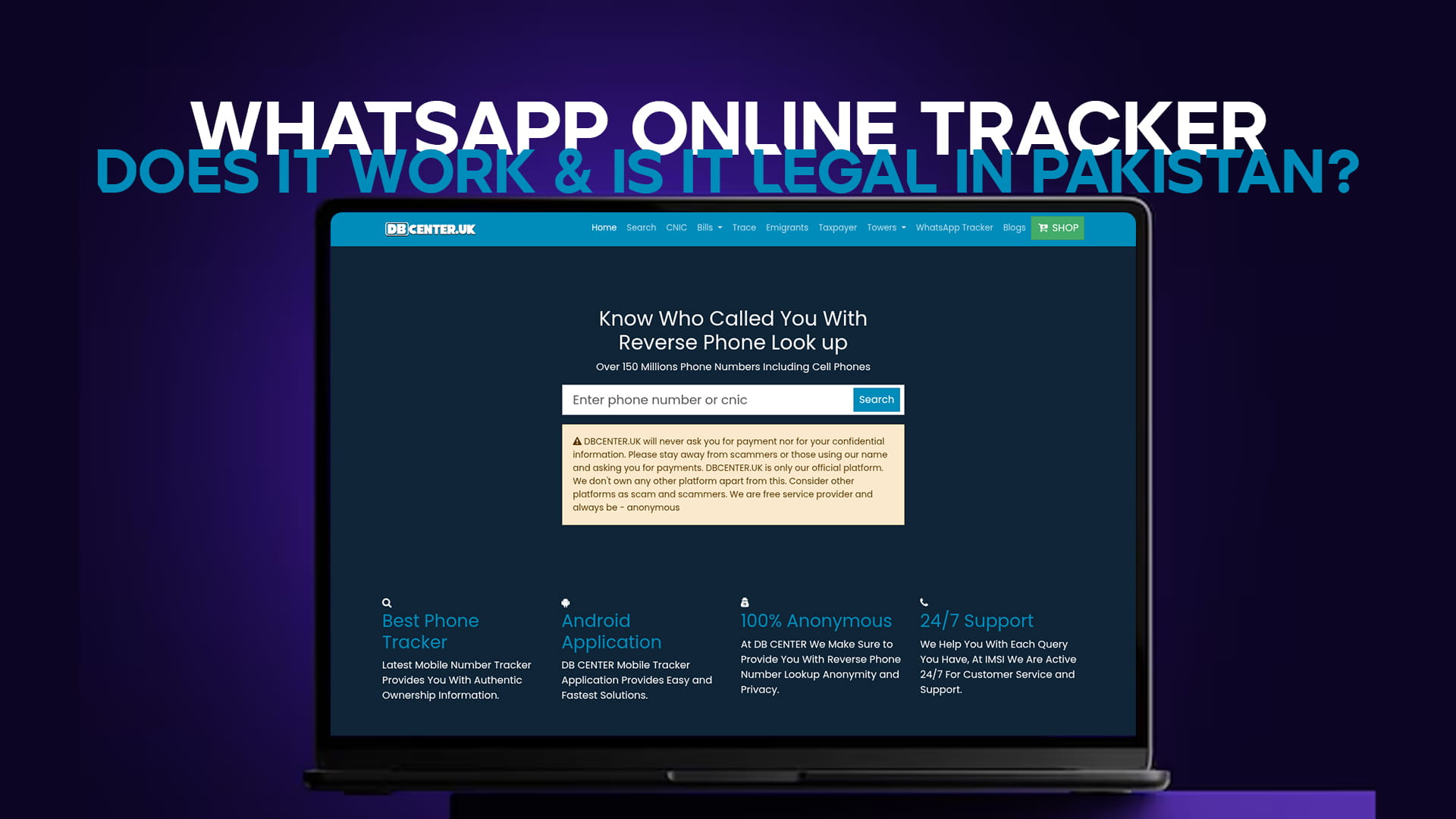
DB Center keeps its tools on the right side of this line. Its WhatsApp-related features are about your own usage and legitimate checks, not secretly reading anyone's messages, because that last thing isn't possible and isn't legal. If your real worry is an unknown number messaging you on WhatsApp, the number search and trace tools help you get context on who's contacting you so you can block or report them. That's the useful, lawful version of "tracking", knowing who's reaching out to you, rather than spying on someone else.
How to spot the fake tracker apps
Since most of what's marketed as a WhatsApp tracker is junk or worse, it helps to know the warning signs before you tap install. The tells are consistent once you've seen a few.
It promises to read chats. As covered, this is impossible from the outside, so the promise alone tells you it's a scam.
It demands a survey, a payment, or a "share with friends" step before showing results. That's the actual product. The hoops are how they make money off you, and there was never any real data waiting at the end.
It wants you to install an unknown APK from outside the official app stores, or it asks for sweeping permissions, your contacts, your messages, your storage. A status-checking tool has no honest reason to read your address book. When it asks anyway, it's usually there to copy your contacts and sell them, which is how people end up drowning in spam calls the day after installing one.
It has a flood of suspiciously glowing reviews and a vague developer with no real footprint. Polished promises, no accountability.
The safe instinct is simple. If a tool is trying hard to get into someone else's private world, it's either lying to you or using you, and often both. The only WhatsApp account you can safely and legally manage is your own.
The data you're risking is your own
Here's the irony people miss. You go looking for a tool to watch someone else, and the tool ends up watching you. These apps and sites frequently exist for one reason: to harvest the data of the people who install them. You hand over your number, your contacts, sometimes access to your messages, and you've become the product. The "target" you were curious about was never the point. You were.
That's worth sitting with before you type anyone's number into a tracker site. The most likely victim of a WhatsApp spy tool is the person who downloaded it.
The bottom line
So, does a WhatsApp online tracker work? The legitimate kind, the sort that logs when someone is online, technically does, though most products selling it are scams or malware and you should treat them accordingly. The kind that promises to read someone's actual chats does not work at all, because end-to-end encryption makes it impossible, and every site claiming otherwise is running a con.
Is it legal in Pakistan? Tracking yourself, yes. Adjusting your own privacy, absolutely. Secretly surveilling another adult, installing spyware on their phone, accessing their accounts without consent, that's where PECA 2016 comes in, and it is not a comfortable place to be.
If you came here out of worry, the better tools are duller than a tracker and far more effective: an honest conversation, your own privacy settings, the platform's built-in parental controls, and the proper authorities when there's a genuine threat. None of it has the thrill of secret surveillance. All of it leaves you in a better place.