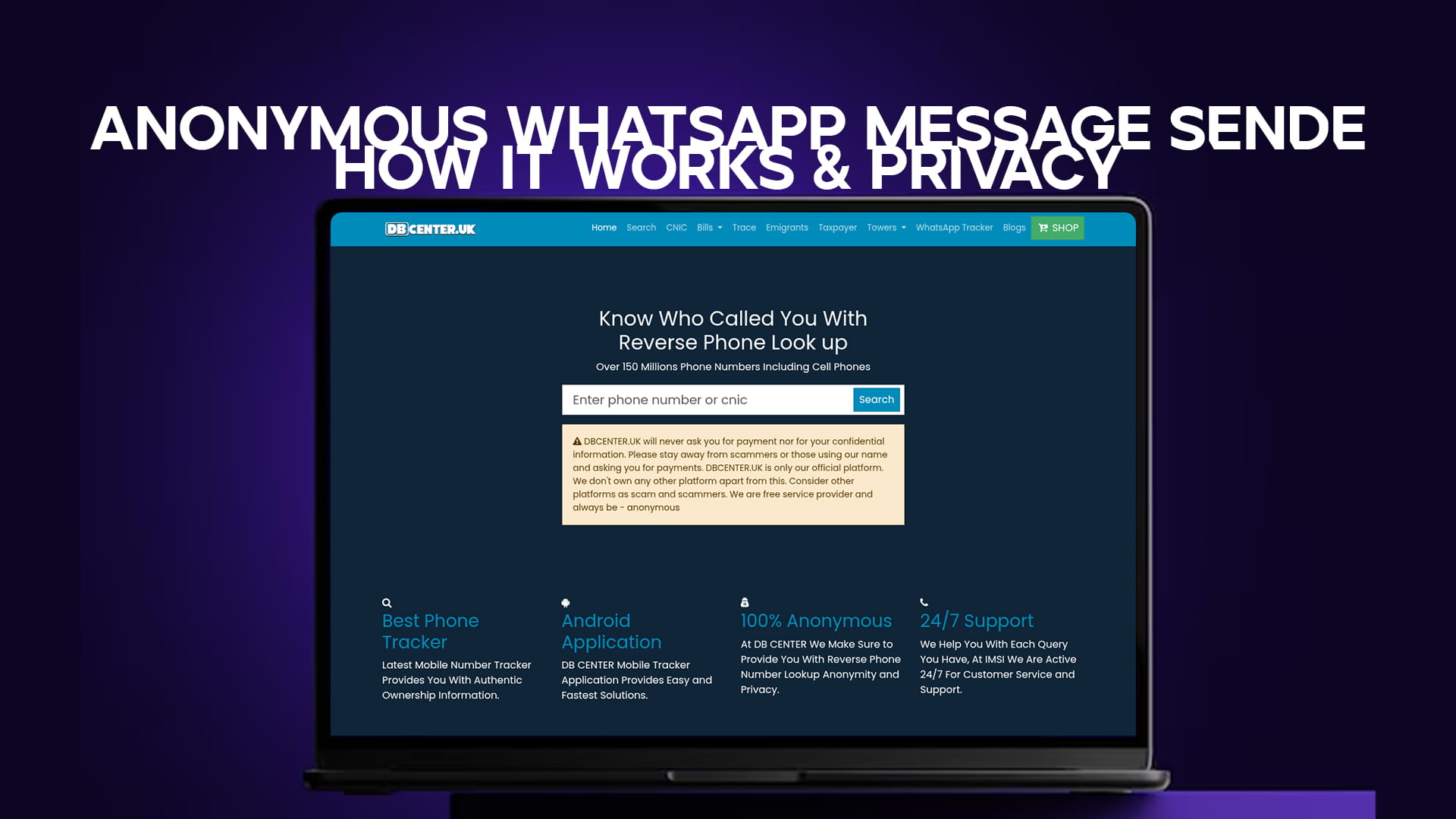
Search results and social feeds across Pakistan are full of services promising to send a WhatsApp or SMS message that arrives without your name or number attached. The pitch is always simple: type your message, enter the recipient, press send, and stay invisible. Tools such as DB Center's anonymous message sender sit in this category, and they are widely used for everything from harmless surprises to confessions people are too shy to make in their own name.
Before relying on one, it is worth understanding two things that the marketing rarely spells out. The first is how these services actually move a message from you to someone else. The second, and far more important, is who can still see that the message came from you — because the honest answer is almost never "nobody." This guide walks through both, plus the privacy exposure on each side and where the law in Pakistan draws its lines in 2026.
How These Services Work
There is no single technology behind anonymous messaging. Three broad approaches dominate, and they differ sharply in how much they really conceal.
Throwaway Sender Numbers
The most common method routes your message through a pool of temporary or rotating numbers controlled by the service. The recipient sees an unfamiliar number rather than yours, so to them the sender is unknown. What has actually happened is that the service inserted itself between you and the recipient, sending on your behalf from a number it owns. Your identity is hidden from the recipient, not from the service.
Gateway and Bulk Messaging
Other tools push messages through a messaging gateway, the same kind of infrastructure businesses use to send verification codes and alerts. The message lands from a generic business sender or short code that reveals nothing about you personally. Again, the concealment is one-directional: the gateway provider logs exactly who submitted the message and when.
"Open Chat" Links That Hide Nothing
A third category is the weakest, and unfortunately the one marketed most aggressively. These simply open a WhatsApp chat to a number you have not saved in your contacts, which some sites dress up as "anonymous." In reality, the moment the message is sent your own number is fully visible to the recipient, because the message travels through your own WhatsApp account. There is no anonymity here at all — only the absence of a saved contact name.
Knowing which of the three you are dealing with matters enormously, because the gap between what is advertised and what is delivered is widest in this last group.
Why "Anonymous" Is Mostly an Illusion
The central thing to understand is that anonymity, in this context, is largely a marketing word rather than a technical guarantee. Even when the person receiving the message cannot identify you, the service sitting in the middle almost always can.
These platforms keep logs as a routine part of operating. That typically includes the originating account or IP address, timestamps, the destination number, and frequently the full content of the message. None of that is visible to the recipient, but all of it exists on the provider's servers, often for an extended period. Reputable services say plainly in their terms that they will disclose this information when legally required, and the less reputable ones tend to retain just as much while saying less about it.
This is why genuine de-anonymisation is so achievable when it matters. If a recipient files a complaint, investigators do not need to break any encryption — they follow the metadata trail back through the service to the account or connection that submitted the message. The practical reality is that you are anonymous to the recipient, not to the system, and certainly not to anyone with the legal authority to ask the system for its records. People who assume otherwise are trusting a stranger's server far more than they realise.
The Privacy Risks Run in Both Directions
The exposure here is not only legal. It is a data-privacy problem whether you are the sender or the recipient.
Risks for the Sender
If you use one of these services, you are handing your message and your identifying details to an unknown third party whose security practices you cannot verify and whose business model you may not understand. Many free anonymous-message sites exist precisely to harvest that data — the free service is the bait, and your number, your message, and the identity of the person you contacted are the product. That information can be stored, sold, leaked in a breach, or handed over on request. You have no realistic way to get it back or confirm it was deleted.
Risks for the Recipient
On the receiving end, an unidentified sender is a well-worn channel for spam, scams, and phishing. Messages designed to look like they come from a stranger with nothing to lose are a classic delivery method for malicious links and fraud attempts. If you receive an anonymous message containing a link or a request for money or credentials, treating it with suspicion is simply sensible. If the messages become repetitive or threatening, that crosses from nuisance into something you can act on, as covered below.
The Legal Reality in Pakistan
This is the part most users skip, and it is the part that carries real consequences. Anonymity does not create immunity.
Using an anonymous sender to harass, threaten, defame, blackmail, or intimidate someone is an offence under the Prevention of Electronic Crimes Act (PECA) 2016, which deals specifically with cyberstalking, harassment, and the misuse of electronic communication. The supposed anonymity tends to evaporate the moment a complaint reaches the Federal Investigation Agency's Cybercrime Wing, because the service's logs point back to the sender. People in Pakistan have been traced and prosecuted for exactly this reason — the borrowed number gave them false confidence, while the records behind it gave investigators a direct route to their door.
The principle is straightforward: a message that would be unlawful sent from your own number does not become lawful because it travelled through someone else's. The medium changes; the offence does not.
If You Are Being Harassed by an Anonymous Sender
If you are on the receiving end of harassment from a hidden number, you have options. Block the number within WhatsApp and report the chat, which sends the offending account to WhatsApp for review. Keep screenshots, including the date and time, as a record. For anything threatening, defamatory, or persistent, you can file a complaint with the FIA Cybercrime Wing, which has the authority to compel the intermediary to reveal the source. Where the sender uses a normal number rather than a service, a number-lookup tool such as DB Center's trace tool can sometimes surface basic associated information, and a broader identity search may help you cross-reference what little you have, though the formal route through the FIA is what carries legal weight.
Anonymous Messaging Versus Other Privacy Tools
It helps to place anonymous senders alongside the wider category of WhatsApp privacy and tracking tools, because people often conflate them.
An anonymous sender hides the origin of a message you send. A different family of tools, such as WhatsApp activity monitors, claims to watch someone else's online status — you can read more about how those function and where they fail in the explainer on WhatsApp trackers. A broader still category, marketed as phone tracker tools, bundles location and activity monitoring together. The common thread across all of them is that the privacy they promise is often weaker than advertised, and the legal exposure for misusing them against another person is consistently underestimated. Treat any tool in this space with the assumption that it logs more than it claims and protects you less than it suggests.
Safer and More Honest Alternatives
There are narrow, legitimate reasons a person might want to obscure their number. Submitting a sensitive tip, reaching a business without exposing a personal line, or contacting someone in a situation where revealing your number could genuinely put you at risk are all real scenarios.
Even in those cases, there are better choices than a free anonymity gimmick. A dedicated secondary SIM or a separate number used only for non-personal contact gives you control and keeps your data in your own hands. A recognised business-messaging service, used within its terms, is transparent about who holds your information and why. For sensitive disclosures to an organisation, an official reporting channel or a reputable secure-messaging app offers far stronger and more honest privacy than a website that promises invisibility for free. The guiding question is simple: do you know who is holding your data, and under what terms? With most anonymous senders, the answer is no.
How to Protect Your Own Number
While you are thinking about anonymous messaging, it is worth tightening your own WhatsApp privacy so that you are harder to target. Inside WhatsApp, open Settings, then Privacy, and review who can see your last seen and online status, your profile photo, and your "about" information, restricting each to your contacts or to nobody as you prefer. Turn on two-step verification to protect the account itself. Be cautious with any link that arrives from an unknown sender, and never scan a QR code you did not initiate, since linked-device hijacking is one of the few ways an outsider can genuinely read your messages. These habits will not stop someone from sending you an anonymous message, but they shrink the amount of information any stranger can gather about you, and they close the doors that actually matter.
Common Questions asked by Users
Are anonymous WhatsApp message senders really anonymous? Only to the recipient, and not always even then. The service in the middle records the originating account or IP, the timestamp, the destination, and often the message itself. You are hidden from the person you message, not from the platform or from investigators who can request its logs.
Is it legal to send an anonymous message in Pakistan? Sending a harmless message is not itself a crime, but the anonymity offers no protection if the content crosses a line. Using an anonymous sender to harass, threaten, defame, or blackmail is an offence under PECA 2016, and the sender can be traced and prosecuted.
Can someone find out who sent an anonymous WhatsApp message? Through the service's own logs, yes. The recipient cannot usually identify the sender on their own, but the FIA Cybercrime Wing can compel the intermediary to disclose the source as part of an investigation.
What should I do if I am harassed by an anonymous sender? Block and report the number within WhatsApp, keep dated screenshots as evidence, and for anything threatening or persistent file a complaint with the FIA Cybercrime Wing, which has the authority to trace the source.
Are free anonymous message websites safe to use? Be cautious. Many exist to collect data, and you are handing them your message, your number, and the recipient's number with no way to verify how that information is stored or shared. A dedicated secondary number is a safer choice if you have a legitimate reason to keep your main number private.
Does WhatsApp itself offer an anonymous mode? No. WhatsApp ties every message to an account and a phone number by design. The privacy settings let you control who sees your last seen, photo, and status, but they do not let you send a message anonymously from your own account.
The Short Version
Anonymous WhatsApp senders hide your number from the recipient, but not from the service that carries the message, and not from investigators who can request its records. The anonymity is real only at the surface. If you have a genuine reason to protect your number, a dedicated secondary line or a transparent business service is safer than a free tool that quietly logs everything. And whatever the medium, a message that would be unlawful from your own number stays unlawful when it travels through someone else's — PECA 2016 applies regardless of how the message was sent.
If you are on the receiving end of harassment, you are not without options: block, report, keep records, and escalate to the FIA Cybercrime Wing, which can see straight through the supposed anonymity.