Identity matters. In Pakistan, no single document reflects your identity more completely or more officially than your CNIC — the Computerized National Identity Card. It is the document that connects you to the banking system, the property market, the telecom network, the tax authority, and the legal system all at once. It is, in the simplest possible terms, who you are on paper.
Because the CNIC carries so much weight in Pakistani life, questions around its ownership and verification come up constantly. A landlord wants to confirm a tenant is who they claim to be. An employer needs to verify a job applicant's identity before making a hiring decision. A business owner wants to make sure a transaction partner is genuine. A citizen wants to confirm that their own CNIC has not been used without their knowledge. And increasingly, ordinary people want to understand how CNIC ownership connects to phone numbers, SIM cards, and the rising tide of identity-based fraud happening across the country.
This article is your complete guide to understanding CNIC ownership details in Pakistan, how to check them instantly through the right channels, how to protect your own CNIC from misuse, and how DB Center's powerful reverse phone lookup service fits into the wider picture of identity safety and verification in Pakistan today.
Understanding CNIC Ownership in Pakistan
Before we talk about how to check CNIC ownership details, it is important to understand what CNIC ownership actually means and why it is such a critical concept in Pakistan's digital and social landscape.
Every Pakistani citizen aged eighteen and above is required by law to hold a CNIC issued by NADRA — the National Database and Registration Authority. NADRA is the government body responsible for managing Pakistan's national identity infrastructure. It maintains a central, biometrically verified database of every registered citizen.
When a CNIC is issued, the ownership of that card is linked to a single, verified individual. The card carries their legal name, date of birth, gender, father's or husband's name, permanent address, a unique 13-digit identification number, and biometric data including fingerprints and a photograph.
CNIC ownership, in practical terms, means that a specific person is legally and officially identified by that card and that number. When someone registers a SIM card, opens a bank account, purchases property, or performs dozens of other legal and financial actions, their CNIC ownership is what ties everything together.
The problem arises when CNIC ownership details fall into the wrong hands, or when someone's CNIC is used — without their knowledge or consent — to carry out transactions, register accounts, or commit fraud. This is why checking, verifying, and protecting CNIC ownership details has become such an important topic for millions of Pakistanis.
Why People Need to Check CNIC Ownership Details in Pakistan
The need to verify CNIC ownership arises in many different situations across Pakistani society. Here are the most common real-world scenarios:
Property Rental and Sales Transactions Pakistan's real estate market involves enormous sums of money, and fraud is unfortunately not uncommon. Landlords and property buyers regularly need to verify that the person they are dealing with is the genuine owner of a CNIC and not someone using a fake or borrowed identity. Checking CNIC ownership before signing agreements or transferring money is a basic but essential precaution.
Employment and HR Verification Responsible employers across Pakistan verify the CNIC details of job candidates before hiring. This confirms that the person is who they say they are, that their work history can be accurately checked, and that any future official dealings — such as tax registration, social security, or salary documentation — will be filed under the correct identity.
Financial and Banking Services Banks, microfinance institutions, and money transfer services all require CNIC verification before opening accounts or processing transactions. Checking that a CNIC number is valid and belongs to the person presenting it is a core part of financial compliance in Pakistan.
SIM Card Registration Verification In Pakistan, every mobile SIM card must be registered to a CNIC through biometric verification. If you want to confirm how many SIM cards are registered under a specific CNIC, or if you suspect someone has registered SIMs in your name, checking CNIC-linked registrations is essential. This kind of check can be done through PTA's official service.
Business Partnerships and Contracts Before entering into a formal business agreement, it is standard practice to verify the identity of the other party. Checking that their CNIC is valid and active provides a basic level of confidence that the person is genuine and traceable if any dispute arises later.
Online Marketplace Transactions Pakistan's booming online buying and selling ecosystem — through platforms like OLX, Facebook Marketplace, and Daraz — has brought with it a parallel rise in online transaction fraud. Buyers and sellers often want to verify each other's identity before committing to high-value transactions. CNIC verification combined with phone number checking through DB Center provides a practical two-layer approach to transaction safety.
Suspected Identity Theft Perhaps the most urgent reason to check CNIC ownership details is when you have reason to believe your own CNIC is being used without your consent. If your bank reports unusual activity, if you receive SIM registration messages you did not initiate, or if you find loans or accounts in your name that you did not open, verifying what is registered under your CNIC immediately is critical.
Official and Legitimate Ways to Check CNIC Ownership Details Instantly
It is absolutely important to be clear here: CNIC ownership details are protected personal data. Full access to another person's CNIC record without their consent or without legal authorization is not permitted under Pakistani law, including the Prevention of Electronic Crimes Act (PECA) 2016 and relevant NADRA regulations.
However, there are several official, legitimate, and free channels through which CNIC ownership details can be checked for genuine and lawful purposes. These are the only reliable and legal sources of CNIC verification data in Pakistan.
NADRA's Verisys Online Portal
Verisys is NADRA's official online identity verification platform. It is designed for authorized institutions — banks, telecom companies, businesses, and government departments — that need to verify the CNIC ownership of individuals they are dealing with.
Through Verisys, an authorized user can enter a CNIC number and receive confirmation of whether that number is valid, whether it is currently active, and whether the information provided by the individual matches the record in NADRA's database. This is the gold standard of CNIC ownership verification in Pakistan and the most reliable method available.
Individual citizens can also use NADRA's self-service features on its website to check the status of their own CNIC, track applications, and view registration records linked to their number.
SMS Verification Service
For quick, on-the-spot verification, NADRA offers a free SMS-based service that allows anyone with a mobile phone to confirm whether a CNIC number is registered and valid. To use this service, send a text message containing the CNIC number to NADRA's designated short code. The response will confirm whether the number is active in the national database.
This method is particularly useful for small businesses, shopkeepers, and individuals who need a fast confirmation during a transaction without needing to access the internet.
PTA SIM Registration Check
Since every Pakistani SIM card is tied to a CNIC through biometric registration, checking how many SIM cards are registered under a specific CNIC is one of the most practical ways to monitor CNIC ownership activity. The Pakistan Telecommunication Authority provides a free service for this purpose.
Citizens can send a message or use the PTA's designated portal to find out exactly how many SIM cards are currently registered under their CNIC number and which telecom operators issued them. If you find SIM cards you did not register, it is a clear indicator that your CNIC details have been compromised and that immediate action is needed.
NADRA e-Sahulat Centers
For citizens who prefer face-to-face assistance or who are not comfortable using online services independently, NADRA's nationwide network of e-Sahulat centers provides accessible, in-person support. Trained staff at these centers can help you check your CNIC status, identify what records are linked to your CNIC, and assist you in resolving any discrepancies or reporting suspected misuse.
e-Sahulat centers are found in cities, towns, and many rural areas across Pakistan, making this service accessible to citizens from all backgrounds and regions.
NADRA Regional Offices
For complex situations — such as correcting errors in CNIC records, reporting identity theft, or disputing registrations made in your name — visiting a NADRA regional office directly is the most thorough approach. NADRA staff can access the full depth of their database and take official action on your case, something that cannot be done remotely through SMS or online portals.
The 13-Digit CNIC Number Structure and What It Tells You
Understanding how Pakistani CNIC numbers are structured gives you useful context when checking or verifying them. Every CNIC number in Pakistan follows the format XXXXX-XXXXXXX-X, consisting of 13 digits divided into three groups.
The First Five Digits These represent the geographic division and registration area where the CNIC was issued. The first digit indicates the province, while the subsequent digits narrow down the district and registration zone. This means that by looking at the first few digits of a CNIC, you can identify which part of Pakistan the card was originally issued from.
The Middle Seven Digits These form a unique identifier assigned to the individual at the time of registration. This sequence is what distinguishes one citizen from every other citizen in the national database and cannot be duplicated.
The Final Digit The last digit is a gender indicator. Odd numbers represent male cardholders, while even numbers represent female cardholders. This simple check can be used to quickly verify whether a CNIC number matches the gender of the person presenting it.
Being familiar with this structure helps you spot obviously fake or malformed CNIC numbers immediately, which is a useful first line of defense in any verification situation.
How Phone Number Verification Complements CNIC Ownership Checks
Here is something that is critically important and often overlooked: CNIC ownership and phone number ownership are directly connected in Pakistan.
Every mobile SIM card in the country is biometrically registered to a CNIC. This means that when you check who owns a phone number, you are indirectly touching on the CNIC ownership question. The mobile number is one of the most accessible identifiers linked to a CNIC in everyday interactions.
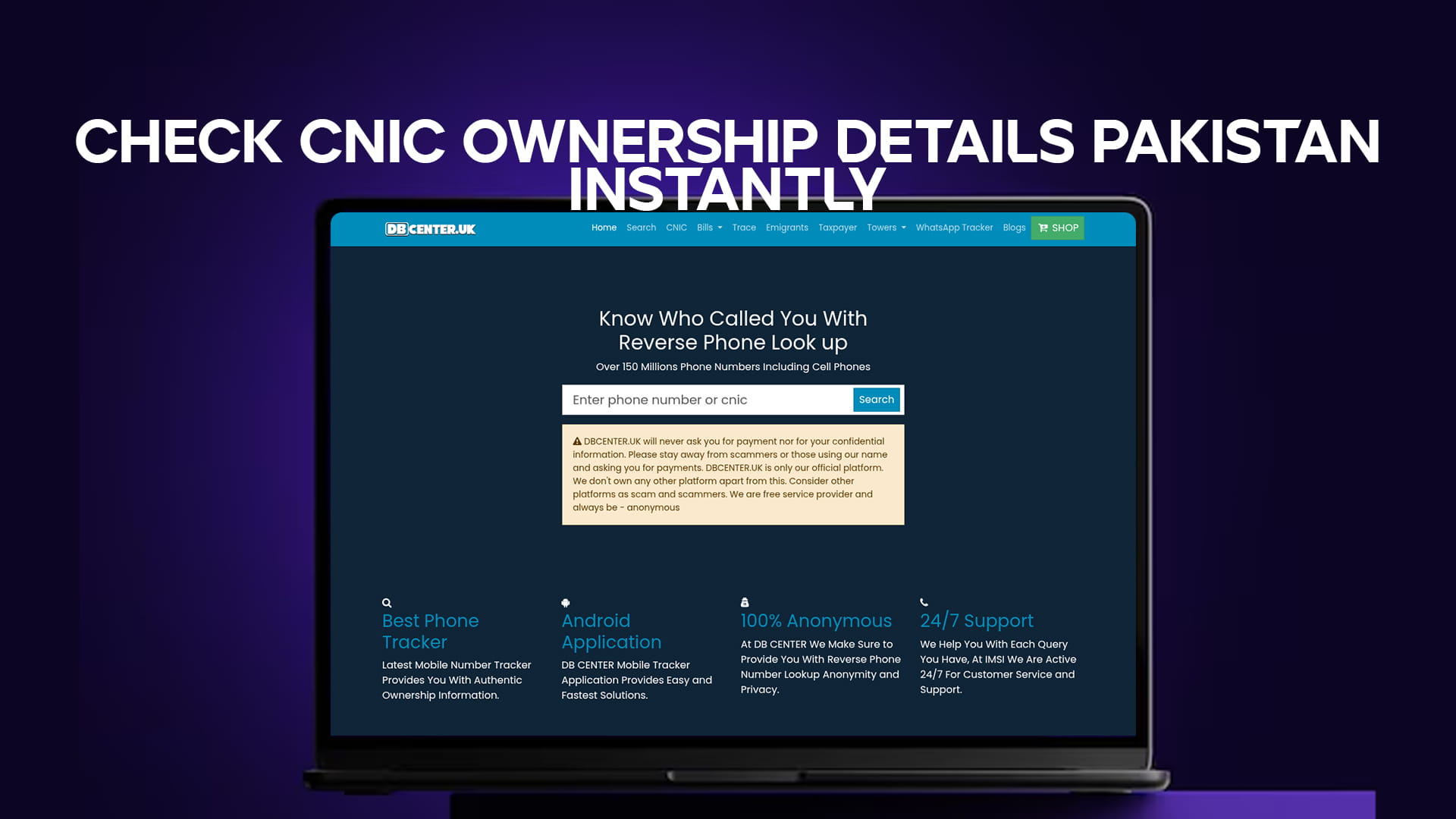
This is precisely where DB Center becomes a powerful and practical tool in the identity verification ecosystem. DB Center is a reverse phone lookup service with a database of over 150 million phone numbers, including mobile and cell phone numbers from Pakistan and around the world.
When you receive a call from an unknown Pakistani number and want to verify who is behind it, DB Center gives you instant, free access to community-reported information about that number. You can find out the name associated with the number, the mobile network it belongs to, the region it is linked to, and whether other users have flagged it for scam, fraud, or harassment activity.
Combining a phone number check through DB Center with a CNIC number check through NADRA's official channels gives you the most complete and reliable identity picture available for any individual you are trying to verify in Pakistan. One method does not replace the other — together, they provide a genuinely thorough verification approach.
Red Flags That Someone May Be Using a Fake or Borrowed CNIC
Whether you are a landlord, employer, lender, or private individual, knowing what to watch out for can save you from significant problems. Here are the most common red flags that suggest someone may be presenting false or borrowed CNIC details:
The Name Does Not Match the Face If the photograph on the CNIC does not resemble the person presenting it, that is an immediate concern. While people change in appearance over time, a significant discrepancy in age, gender, or features warrants further verification.
Hesitation When Asked for CNIC Details A genuine person who has nothing to hide will have no problem providing their CNIC number or allowing you to verify it. Excessive hesitation, vague responses, or attempts to avoid showing the actual card are warning signs.
The Number Format Is Wrong As explained earlier, every valid Pakistani CNIC has a specific 13-digit format with geographic and gender-specific coding. A number that does not follow this format is not a valid CNIC number.
The Card Looks Tampered With Physical CNICs issued by NADRA have security features including holograms, microprinting, and laser engraving. A card that looks printed on ordinary paper or shows signs of tampering is almost certainly a fake.
Mismatch Between CNIC Region Code and Claimed Origin If someone claims to be from Lahore but their CNIC number begins with a code corresponding to Balochistan, that inconsistency is worth probing further.
The Number Returns No Result on NADRA's SMS Service If you send a CNIC number to NADRA's verification service and receive no confirmation or an error response, the number may not be registered in the national database, which is a serious red flag.
Protecting Your Own CNIC Ownership Details
Awareness and prevention are far better than dealing with the aftermath of identity theft. Here is a comprehensive set of practical steps every Pakistani citizen should take to protect their CNIC ownership details:
Regularly Check SIM Registrations Under Your CNIC Make it a quarterly habit to check how many SIM cards are registered under your CNIC through PTA's service. If you find any unfamiliar registrations, report them to the telecom operator and PTA immediately.
Write the Purpose on All CNIC Photocopies Whenever you provide a photocopy of your CNIC for any purpose, handwrite the specific purpose directly on the copy before handing it over. For example, write "For hotel check-in only" or "For account opening at XYZ Bank." This simple step prevents the photocopy from being misused for any other purpose.
Never Share Your CNIC Number on Social Media It sounds obvious, but many people share photos of their CNIC on social media without realizing the risk. Your CNIC number, once publicly visible online, can be screenshot, shared, and used in ways you cannot control.
Do Not Respond to Calls Asking for CNIC Details As mentioned earlier, scammers frequently call Pakistani citizens pretending to be from NADRA, banks, telecom companies, or the FBR, asking for CNIC numbers, dates of birth, or other sensitive information. No legitimate institution requires you to confirm your CNIC number over a phone call you did not initiate. Hang up immediately if you receive such a call, and check the number on DB Center to see if it has been flagged by others.
Check Your Financial Accounts Regularly If someone obtains your CNIC details, one of their first moves may be to attempt to access or create financial accounts in your name. Regularly reviewing your bank accounts and checking with financial institutions about any accounts or credit applications linked to your identity can catch fraudulent activity early.
Apply for a Digital CNIC or NADRA Smart Card NADRA's Smart National Identity Card offers enhanced security features that make it harder to duplicate or tamper with. If you are still carrying an older card format, consider upgrading to the latest version for better security.
What to Do If Your CNIC Ownership Details Have Been Compromised
If you discover or strongly suspect that your CNIC ownership details have been used without your consent, time is critical. Here is the sequence of steps you should take:
First, check your SIM card registrations through PTA and block any unauthorized SIMs immediately. Second, visit your nearest NADRA office and report the suspected misuse so they can flag your CNIC in the national database. Third, contact your bank's fraud department and place additional security measures on your accounts. Fourth, file a formal complaint with the Federal Investigation Agency's Cyber Crime Wing, which handles identity theft cases.
Fifth — and this is where DB Center becomes relevant — if you have any phone numbers associated with the fraud, look them up on DB Center. Community reports linked to those numbers may provide valuable additional information about the fraudster's methods and previous targets. This information can strengthen your complaint to the authorities and help paint a fuller picture of how the fraud was carried out.
Building Responsible Identity Verification Habits
Pakistan is going through a period of rapid digital growth. More services are moving online, more transactions are happening through mobile platforms, and more personal data is being exchanged digitally every single day. In this environment, developing responsible identity verification habits is not optional — it is essential.
Make CNIC verification through NADRA's official channels a standard step in any significant transaction. Use PTA's SIM check service regularly. Be alert to scam calls and unknown numbers by using DB Center's free reverse phone lookup. Stay informed about the latest identity fraud tactics circulating in Pakistan.
These are not complicated or expensive steps. They are simple, accessible, and free habits that can protect you, your family, and your business from some of the most common and damaging forms of fraud happening in Pakistan today.
Final Thoughts
Checking CNIC ownership details in Pakistan instantly is entirely possible — when you use the right channels. NADRA's official verification services, the SMS-based check system, PTA's SIM registration portal, and in-person support through e-Sahulat centers and NADRA offices all provide legitimate, reliable, and free ways to verify CNIC ownership for genuine purposes.
Alongside these official tools, DB Center's reverse phone lookup service adds a powerful complementary layer of protection. By checking the phone numbers of unknown callers against a database of over 150 million numbers and reading real community reports from other users, you gain a level of insight that goes beyond what any single verification tool can offer on its own.
Your CNIC is your identity. Protect it actively, verify it responsibly, and use every legitimate tool available to you to stay safe in an increasingly connected Pakistan.