Pakistan runs on identity. Not in a philosophical sense — in a very practical, bureaucratic one. You cannot buy a SIM card without one. You cannot open a bank account, register a vehicle, get a passport, vote, or access most government services without presenting a valid CNIC and having it verified against NADRA's national records.
The Computerized National Identity Card is the backbone of civilian identity in Pakistan, and the 13-digit number printed on it connects a person to more official data points than most people realize. That connection is useful when everything is working as it should. It becomes a problem when someone's identity is stolen, their CNIC is misused, or they are dealing with a stranger whose claimed identity does not hold up to scrutiny.
This article is about what you can realistically find out about a CNIC owner in Pakistan, through what channels, using which tools — and where services like DB Center step in when official systems leave a gap.
Understanding Who Owns a CNIC and What That Means
Every valid CNIC in Pakistan belongs to a specific registered person. NADRA issues the card after a process that includes biometric enrollment — fingerprints, a photograph, and in some programs, iris scanning. The card is tied to one identity, and that identity is linked to a web of official records.
When people talk about finding "CNIC owner details," they typically mean one or more of the following:
- Confirming that a given 13-digit number is valid and belongs to the person claiming it
- Verifying the name registered against a CNIC number
- Checking whether a phone number in Pakistan is linked to a specific identity
- Confirming that a vehicle, property, or SIM registration matches the person presenting themselves
Each of these is a legitimate verification need. The way you go about it depends on which specific detail you are looking for and what your relationship to that information legally is.
The NADRA System — How It Stores Identity Records
NADRA was established in 2000 under Pakistan's Ministry of Interior. Before that, identity cards were issued by local district offices with no central digital registry and very limited verification capability. Fraud was common. Fake IDs were relatively easy to produce. Cross-referencing records across districts was practically impossible.
NADRA changed that by centralizing everything. Today, every CNIC is issued against a biometric record. The database holds:
- Full legal name in Urdu and English
- Father's name or husband's name
- Date and place of birth
- Gender
- Permanent home address and current address
- Photograph
- Fingerprint data
- Family linkages (parents, children, siblings registered in the same family tree)
- Linked records including passport, SIM registrations via PTA, and vehicle registration in integrated provinces
The 13-digit CNIC number reflects this structure. The first five digits encode province and district. The next seven are a unique personal identifier. The last digit is a check digit that encodes gender — odd for male, even for female.
This is a sophisticated system. And because it is sophisticated, access to it is controlled. You cannot simply open a website and search any CNIC number to get the full record. That level of access is restricted to authorized entities — banks, telecom companies, law enforcement, and government departments — that have formal agreements with NADRA.
What citizens can do is use the specific tools NADRA and other official bodies have made available for public use.
Official Methods to Find CNIC Owner Details
There are several legitimate, official routes for verifying CNIC owner information in Pakistan. Each has its purpose and its limits.
SMS Verification via NADRA — Send to 8009
The most direct method for confirming the ownership of a CNIC number. Send the 13-digit number as an SMS to 8009 from any Pakistani mobile network. NADRA's automated system will reply with whether the number is valid and the name registered against it.
This takes under a minute, costs a standard SMS fee, and works without internet access. For most everyday verification purposes — confirming someone's CNIC matches the name they gave you before a rental agreement, a transaction, or a service arrangement — this is sufficient.
What it tells you: the name of the registered owner and whether the number is valid.
What it does not tell you: address, date of birth, photograph, or any broader record details.
NADRA's Pak Identity App and Web Portal
NADRA's digital services at nadra.gov.pk and through the Pak Identity mobile app let citizens access and manage their own CNIC records. Through these platforms, you can:
- Check the status of a new or renewal CNIC application
- Update your registered address
- Apply for CNIC renewal
- Request a Family Registration Certificate (FRC)
- Make online payments for CNIC services
These tools are for managing your own identity records. They are not designed for searching other people's CNIC details, and the system is structured to prevent that kind of use.
PTA's SIM Registration Check — Send to 668
Every SIM card in Pakistan must be biometrically registered against a valid CNIC. PTA maintains a database that links phone numbers to the CNICs they are registered under. By sending an SMS to 668, you can retrieve a list of all SIM cards currently registered under your own CNIC.
This matters for two reasons. First, it tells you your phone number registrations are all accounted for. Second, if there are SIMs on that list that you did not register, it is an early warning sign of identity misuse. Someone may have used your CNIC details — whether through a stolen copy, a forged document, or data obtained through fraud — to activate SIM cards under your identity.
Finding an unknown SIM registered to your CNIC is a situation that requires immediate action: report it to your telecom carrier and to PTA, and consider filing a complaint with NADRA and the FIA Cybercrime Wing.
Vehicle Ownership Verification Through MTMIS (Punjab)
Punjab's Motor Transport Management Information System at mtmis.punjab.gov.pk lets anyone check vehicle ownership by registration number. The result includes the registered owner's name and CNIC number.
This is specifically useful for the second-hand vehicle market. Before buying a used car or motorcycle, entering its registration number tells you whether the person selling it is actually the registered owner. If the names do not match, that is a serious red flag — the vehicle may be stolen or the seller may not have legal title.
Sindh has an equivalent system through the Excise and Taxation portal, and other provinces have varying degrees of online accessibility for vehicle records.
e-Sahulat Centers for In-Person Assistance
For more complex verification needs, or for people in areas without reliable internet access, NADRA's e-Sahulat network provides a physical alternative. These centers can assist with identity verification, CNIC application assistance, and biometric services, and they are distributed across both urban and rural Pakistan.
When Official Channels Are Not Enough
The tools above cover formal identity verification well. But there is one common scenario they do not address: you have a phone number and you want to know who owns it.
This happens constantly in Pakistan. A call comes in from an unknown number. A stranger texts you about a transaction. A number keeps calling without leaving a message. Someone gave you a number claiming it was theirs and you want to verify it independently.
NADRA's systems are not built for this. PTA does not provide a public reverse lookup. Your telecom carrier cannot legally share subscriber information. The official infrastructure, designed to protect identity data from unauthorized access, also makes it difficult to trace an unknown number through legitimate channels.
This is the exact gap that reverse phone lookup services fill.
How DB Center Helps with Phone Number Lookups in Pakistan
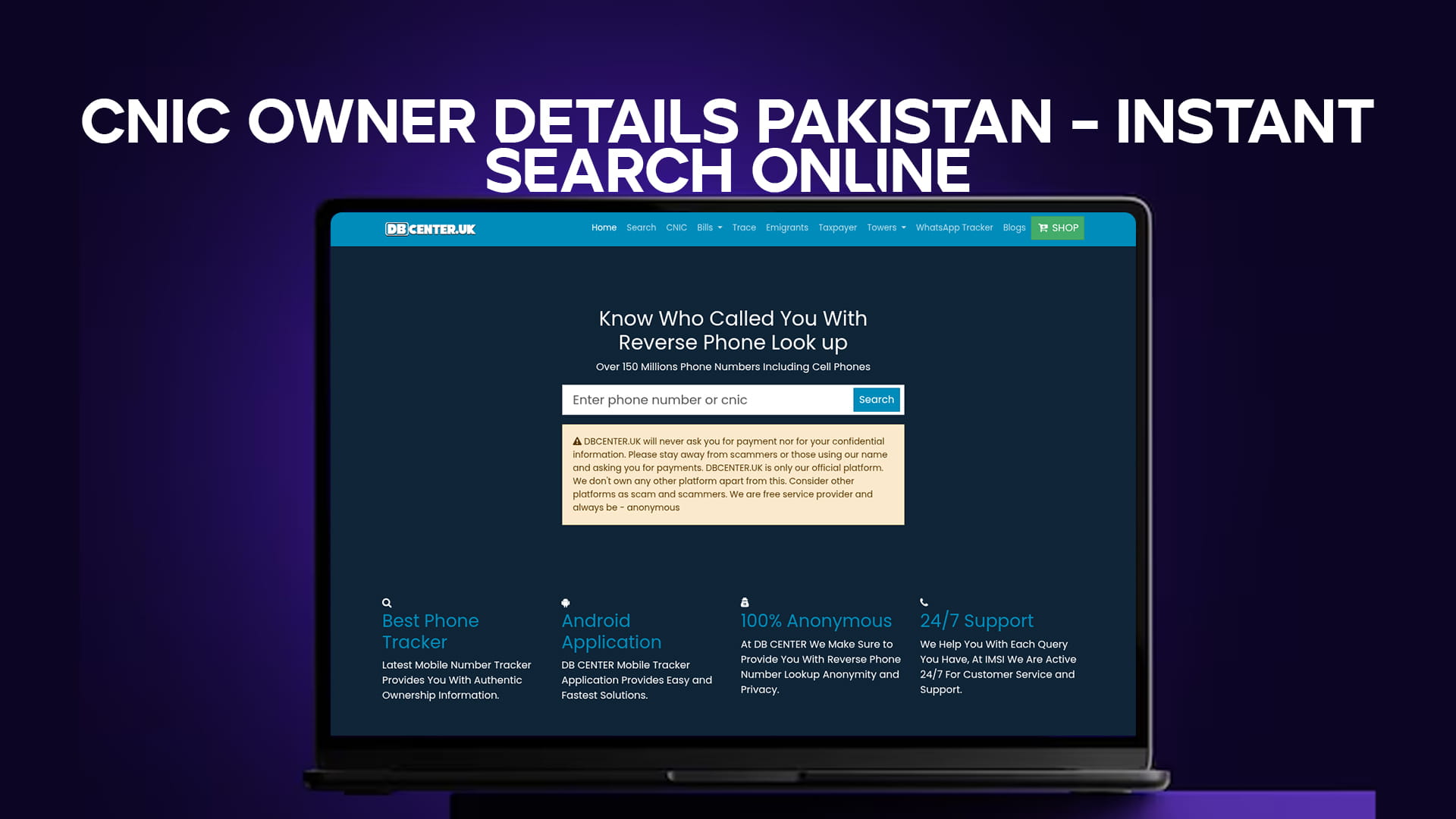
DB Center is a reverse phone lookup platform. Enter a phone number and the service searches its database of over 150 million numbers — including mobile phones — for any associated information. Results can include the name linked to the number, general location data, and user-submitted reports flagging the number as spam, a scam, a robocall, or harassment.
For Pakistani users, this is practically valuable in ways that go beyond simple curiosity.
Identifying unknown callers before responding. Instead of calling back a number you do not recognize — which confirms your number is active and may expose you to further contact — you check it first. If DB Center returns information suggesting the number belongs to a known scammer or telemarketer, you have the information you need without having engaged at all.
Cross-referencing claimed identities. Someone gives you their phone number along with their name as part of a transaction, an introduction, or a professional interaction. You check the number on DB Center. If the name in the database matches what they told you, the information is at least internally consistent. If a completely different name appears, that is a discrepancy worth clarifying before you proceed.
Screening contacts before meetings. Meeting a stranger for a transaction — buying something from an online listing, for example — carries a degree of risk. A quick number check on DB Center costs nothing and takes under a minute. If the number has been reported by other users as problematic, it is worth reconsidering the meeting.
Confirming business contacts. If someone calls claiming to represent a company or service, their number should ideally be consistent with what that company has publicly listed. Checking on DB Center can help confirm or raise questions about that claim.
The database size matters here. At 150 million numbers including cell phones, coverage is wide enough to return useful results for a significant proportion of Pakistani numbers. This is not a guarantee — not every number will return detailed results — but it is a meaningful first layer of checking.
The Legal Framework Around Searching CNIC Details
Pakistan has laws governing data access and use, and they apply directly to the question of how CNIC owner details can and cannot be searched.
The Prevention of Electronic Crimes Act (PECA) 2016 is the main piece of legislation covering digital identity and data. It criminalizes unauthorized access to computer systems, which includes any attempt to access NADRA's database without authorization. It also covers identity fraud, data theft, and using someone else's personal information to commit crime.
The NADRA Ordinance governs how NADRA can share its data. Authorized institutions — banks, telecoms, government departments — can access specific data through formal, contracted channels. Unauthorized sharing or accessing of that data falls outside the ordinance entirely and is potentially criminal.
PTA's regulations on subscriber data mean your telecom company cannot release information about who owns a phone number without a court order or formal legal process.
What this means in practice: using NADRA's official 8009 SMS service is legal. Using PTA's 668 check for your own CNIC is legal. Using DB Center for phone number lookups based on aggregated public and user-reported data is legal. Attempting to purchase scraped CNIC database files, paying for services that claim to provide full unauthorized NADRA record access, or using someone's CNIC information to commit fraud — all of these carry real legal risk and are not approaches worth considering.
The vast majority of legitimate identity verification needs in Pakistan can be met through the official tools and the reverse lookup capabilities that DB Center provides. Staying within those channels is not just legally safer — it is practically sufficient for most real-world situations.
Recognizing When Someone Else Is Using Your CNIC Details
The question of CNIC owner details goes both directions. You might want to check details about someone else, but you should also regularly check whether someone is using your own details without your knowledge.
Identity theft in Pakistan tends to follow specific patterns, and knowing them makes it easier to catch early.
Unauthorized SIM registrations are the most common form. A criminal gets hold of your CNIC number — through a data breach, a phishing call, a discarded CNIC copy, or a forged document — and registers one or more SIM cards under your identity. They use these SIMs for fraud while the records point to you. The 668 check catches this.
Loan applications in your name happen when someone with your CNIC details applies for a personal loan or mobile credit facility at a bank or fintech company. The first you hear of it may be a collection call or a credit bureau entry. Regularly checking your bank accounts for inquiries you did not initiate is a basic protection.
Fake job applications or business registrations use CNIC details to add a veneer of legitimacy to fraudulent applications. Businesses registered under a stolen CNIC can be used for tax fraud or criminal activity while the identity holder remains unaware.
Multiple fake identity documents — where someone physically counterfeits a CNIC with your number but their photograph — are less common since biometric verification became standard, but they still occur, particularly for lower-stakes document requests where full biometric scanning is not done.
If you suspect your CNIC is being misused in any of these ways, the steps are: check SIM registrations via PTA (668), contact NADRA directly, file a complaint with the FIA Cybercrime Wing, and alert your bank's fraud department.
Practical Tips for Everyday CNIC Verification
These are straightforward habits that reduce your exposure to identity fraud and help you verify others' identities more reliably.
Always cross-reference the name. When someone presents a CNIC, the name on the card should match the name they told you. Run the number through NADRA's 8009 service to confirm the name on record matches the card. A mismatch between the card and the database response means the card may have been altered.
Look at the CNIC format. A genuine CNIC has a 13-digit number in the format XXXXX-XXXXXXX-X. The card has an embedded hologram, a machine-readable zone at the bottom, and a digital chip on the back of the SNIC version. Photocopied cards and obviously poor-quality prints are immediate red flags.
Check the expiry date. CNICs expire after ten years. An expired CNIC is not necessarily fraudulent — people forget to renew — but it is worth noting, especially for high-stakes transactions.
For phone number verification, use DB Center. Especially before any transaction involving someone you met online or do not know personally, a reverse phone lookup takes minutes and can surface warning signs that save you significant trouble.
Do not accept CNIC verification as the only proof. A CNIC confirms an identity on record, but it does not guarantee that the person in front of you has a clean history with others. For high-value transactions, additional references, documented agreements, and paper trails offer protection that a CNIC check alone does not.
Where Identity Verification Is Heading in Pakistan
NADRA has been steadily expanding its digital verification infrastructure. The integration between NADRA, PTA, the banking sector, and provincial governments has grown deeper over the past decade, and it continues to develop.
Real-time biometric verification at bank counters and SIM activation points is already standard. Digital CNIC verification through mobile apps is expanding. Pakistan's move toward a more formal digital economy — driven by mobile banking growth, expanding fintech services, and e-commerce — is pushing demand for faster and more accessible identity verification tools.
For individuals, this means more official touchpoints where their identity is verified automatically. For businesses, it means growing access to verification APIs that make the process smoother than manual CNIC checks. For everyday situations — unknown callers, online transactions, informal hiring — tools like DB Center continue to fill the gap between the official infrastructure and the practical reality of how Pakistanis interact with strangers every day.
Bringing It All Together
Finding CNIC owner details in Pakistan is not a single process. It depends on what you are trying to confirm and what tools are appropriate for that purpose.
For formal identity verification — confirming a CNIC number is valid and the name matches — NADRA's 8009 SMS service is the right starting point. It is free, official, and takes under a minute.
For checking your own SIM registrations and making sure your CNIC has not been used to register unknown numbers, PTA's 668 service handles it directly.
For vehicle ownership verification before a purchase, provincial MTMIS portals provide publicly accessible records.
For identifying unknown phone numbers, checking suspicious callers, and adding a verification layer to contacts you met online, DB Center's reverse lookup database covers over 150 million numbers with results that often include names, locations, and user reports.
No single tool covers everything. Used together, these resources give Pakistani citizens meaningful protection and real ability to verify identities in everyday situations — which, in a country where phone-based fraud and identity misuse are genuine concerns, matters more than most people realize until it happens to them.