Every time someone applies for a bank loan in Pakistan, registers a SIM card, buys property, or casts a vote, their identity is confirmed against one system — NADRA's national database. That database sits behind every official transaction in the country. It holds the identity records of hundreds of millions of Pakistani citizens, organized around one central document: the Computerized National Identity Card, or CNIC.
Understanding how that database works, what information it contains, who can access it, and how ordinary citizens can verify identity-related details without breaking any laws — that is what this article is about.
It also covers why DB Center has become genuinely useful for Pakistanis dealing with a specific, everyday problem: unknown phone numbers, suspicious callers, and the need to quickly figure out who is on the other end of the line.
The Foundation: What Is Pakistan's CNIC Database?
Pakistan's national identity database is maintained by the National Database and Registration Authority, or NADRA. The agency was established in 2000 under the Ministry of Interior, and its primary job is to register every Pakistani citizen and create a verified, centralized record of their identity.
The CNIC database is not a single spreadsheet somewhere. It is a massive, multi-layered system that stores biometric data, personal records, family relationships, addresses, and historical identity information. Every CNIC issued in Pakistan is tied to a unique 13-digit number, and that number connects to a file that contains far more information than the card itself shows.
As of recent years, NADRA has registered well over 120 million CNICs. The agency also manages NICOP for overseas Pakistanis, Smart National Identity Cards (SNIC) with embedded chips, Bay Form registrations for children, and Family Registration Certificates (FRC). All of these feed into the same central identity infrastructure.
NADRA's database is one of the most advanced civil registration systems in the developing world. Biometric verification — fingerprints, facial photographs, and iris scanning in some programs — is built into the registration process. This means the system can confirm not just that a number exists but that the person presenting themselves matches the biometric record on file.
What Information Is Stored in the Database?
The data linked to a single CNIC number is more extensive than most people realize. At the card level, the information is:
- Full name in both Urdu and English
- Father's name or husband's name, depending on marital status
- Date of birth
- Place of birth
- Gender
- Permanent home address
- CNIC number
- Issue date and expiry date
- Photograph
Behind the card, NADRA's database also links to:
- Current and historical addresses
- Family tree data (parents, children, siblings registered under the same family)
- Passport records (if applicable)
- SIM card registrations through PTA integration
- Driving license data in some provinces
- Vehicle ownership records through MTMIS integration in Punjab
- Voter registration details
This depth of connected data is why CNIC verification matters so much in Pakistan. A CNIC number is not just a piece of identification — it is a thread that connects a person to dozens of official records across different government departments.
Who Can Access the CNIC Database?
This is where most people have a misunderstanding. NADRA's database is not publicly accessible. You cannot go to a website, type in a 13-digit number, and pull up someone's full identity record. That is not how the system works, and deliberately making it work that way would create massive privacy and security risks.
Access to NADRA's database is controlled and tiered. Different levels of access are granted to different types of entities.
Government agencies — including law enforcement, courts, tax authorities like FBR, and immigration — have varying levels of access depending on their legal mandate. FBR uses NADRA data for taxpayer identification. NADRA provides electoral rolls to ECP. Law enforcement can request identity verification through formal channels.
Financial institutions — banks, microfinance institutions, and insurance companies — have API-level access to NADRA's verification system under formal agreements. When a bank opens an account, it verifies your CNIC biometrically in real time. That verification goes through NADRA's secure interface.
Telecom companies — Jazz, Telenor, Ufone, Zong, and SCO — verify CNIC numbers through NADRA before activating any SIM card. This is a legal requirement under PTA's regulations.
Employers and businesses can request verification through NADRA's e-Sahulat network and licensed verification services, though they do not get raw database access — they get a confirmed match or rejection.
Individual citizens have access to their own records. You can update your details, check your registration status, and request a family registration certificate. You cannot access anyone else's full record.
So when someone says they want to "search the Pakistan CNIC database" to find owner details, the realistic options depend entirely on what you are actually trying to accomplish and what your legal relationship to that information is.
What Citizens Can Actually Check Online
Despite the access restrictions on the full database, there are several legitimate things you can check yourself, using official tools, without needing special authorization.
CNIC Number Validation via SMS
The simplest check. Send a 13-digit CNIC number to 8009 by SMS. NADRA's system will reply with whether the number is valid and the name registered against it. This is a basic validation — you will not get an address or full record, but you will know if the CNIC number is genuine and who it belongs to by name.
This is useful if someone gives you a CNIC number as proof of identity and you want to confirm it before accepting a payment, signing a rental agreement, or proceeding with any transaction.
NADRA Online Portal and Pak Identity App
Through NADRA's official website and the Pak Identity mobile app, citizens can check the status of their own CNIC applications, renew identity cards, update addresses, and download verification certificates. These are for your own records, not for checking other people's information.
SIM Registration Check via PTA
Every mobile SIM in Pakistan must be registered against a valid CNIC. The PTA lets you check how many SIMs are registered under your own CNIC number by sending an SMS to 668 from any number. The reply will list all active SIMs under your CNIC. If you find numbers you do not recognize, you can report them to PTA and your carrier immediately.
This matters because SIM fraud is real. Criminals sometimes use stolen or forged CNIC data to register SIM cards, then use those SIMs to run scams, receive OTPs for account access, or commit other crimes while appearing to operate under your identity.
Vehicle Verification in Punjab
Through the Punjab MTMIS portal (mtmis.punjab.gov.pk), you can check the ownership details of any registered vehicle in Punjab by entering its number plate. The system shows the registered owner's name and CNIC number, which can be cross-referenced with the person claiming to sell the vehicle. This is a legal, public-facing tool specifically designed to reduce car theft and fraudulent vehicle sales.
The Phone Number Problem — And Where DB Center Comes In
Here is a gap that official systems do not fully cover.
Pakistan has over 180 million active mobile subscribers. Phone-based fraud, scam calls, and harassment via unknown numbers are documented problems. Someone calls you claiming to be from your bank. Someone texts you about a prize you never entered. A number you do not recognize calls repeatedly.
What you want to know in those moments is simple: who does this number belong to?
NADRA does not have a consumer-facing tool for this. PTA does not either. Your telecom company will not give you a subscriber's personal information without a court order.
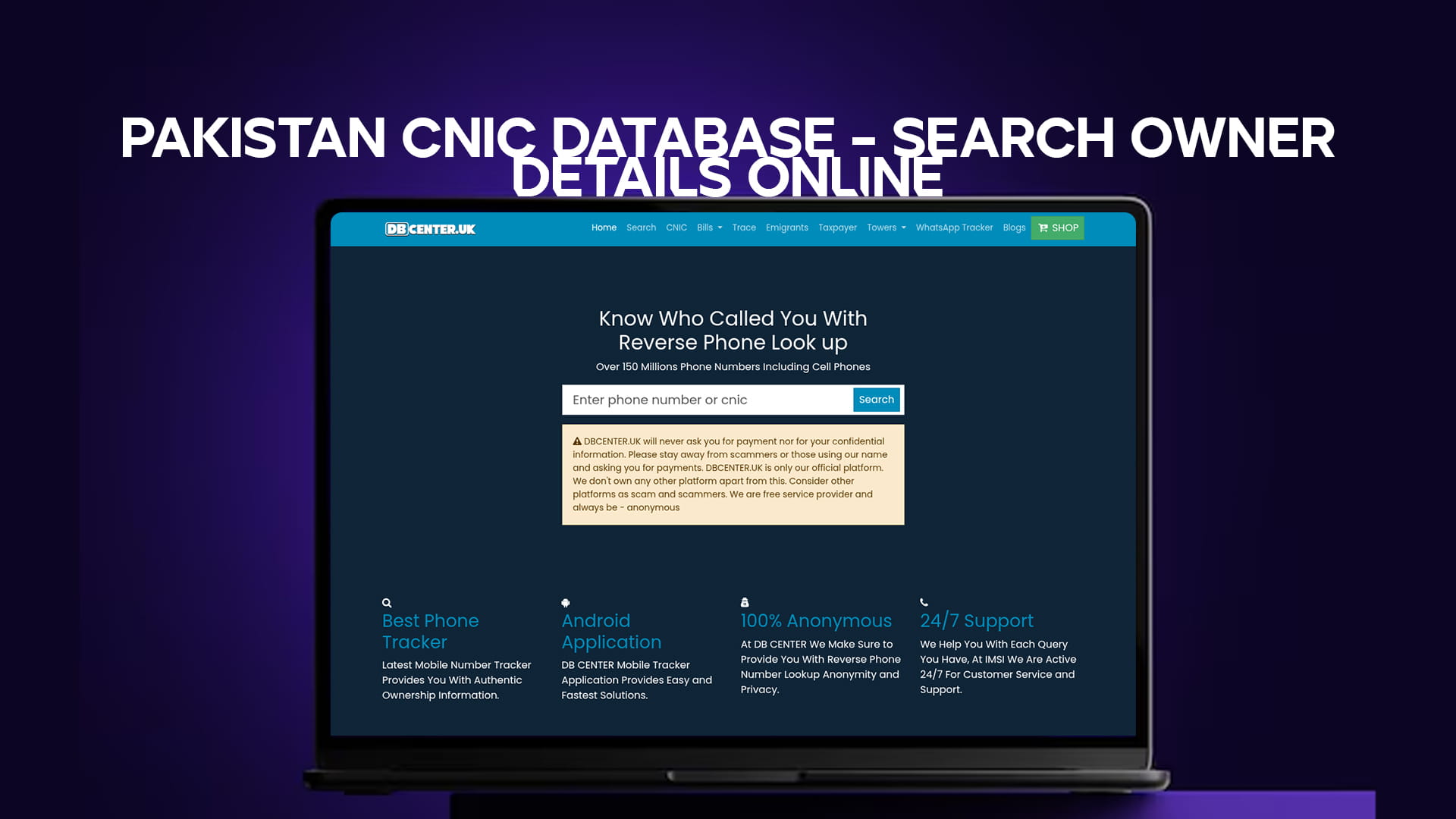
This is the problem that reverse phone lookup tools address. DB Center operates a searchable database of over 150 million phone numbers, including cell phones. When you enter a phone number into the search, the platform checks its database for any associated information — name, location, and user-generated reports about whether the number has been flagged as suspicious, a scammer, or spam.
Because Pakistan requires every SIM to be registered biometrically against a CNIC, the data trail that makes reverse lookup possible is more reliable here than in countries where SIM registration is not mandatory. The connection between a phone number and an identity exists; the question is whether that information has made its way into publicly accessible or reported sources that a database like DB Center can incorporate.
For Pakistani users, DB Center gives a practical tool for answering the "who called me?" question without needing to navigate official bureaucracy or wait for formal channels.
Common Reasons People Search for CNIC Owner Details
Understanding why people want CNIC information helps clarify what is reasonable and what crosses a line.
Pre-employment screening is probably the most common legitimate use case. Before hiring someone, especially for a position involving cash handling, access to private information, or working in a home, employers want to confirm the person's identity is genuine. The CNIC SMS check to 8009 covers the basic validation. More thorough background checks should go through authorized HR verification services that have formal NADRA agreements.
Rental agreements and property transactions come second. Landlords in Pakistan routinely ask for a CNIC copy before signing a rental agreement. Some go further and verify the number via NADRA. For property purchases, both parties are legally required to submit verified CNICs, and the registration process itself runs through NADRA's systems.
Online marketplace fraud prevention is a growing concern. Pakistan's e-commerce market has grown substantially, and with it, the number of scam sellers who collect payments and disappear. Buyers increasingly ask for CNIC details as a form of accountability. Whether this is enforceable is another matter, but the impulse is understandable.
Phone scam protection is the reverse side of the same coin. Instead of checking the identity of someone you plan to transact with, this is about identifying someone who has already approached you unexpectedly. DB Center fits here directly — if you have a suspicious number and want to know more before engaging, running it through a reverse lookup is a reasonable first step.
Reconnecting with lost contacts sometimes involves CNIC-related searches, though official channels are the right path for anything serious, such as finding a missing family member.
Protecting Your Own CNIC Information
The discussion of databases and searches cuts both ways. Just as you might want to find information about someone else, your information is also potentially accessible to others — and that means protecting it matters.
Be selective about who gets your CNIC copy. Every institution you submit it to is a potential point of exposure if they handle it carelessly. Only give your CNIC to entities you are required to give it to, or have genuine reason to trust.
Watch for phishing calls. A common tactic is a call claiming to be from your bank or NADRA, stating your CNIC is being "used in suspicious activity" and asking you to confirm your number and personal details to "secure your account." Banks and NADRA do not work this way. Never confirm personal information to an incoming caller, regardless of what they claim.
Check your SIM registrations. Use PTA's 668 service and confirm all SIMs under your CNIC are ones you actually own. If there are extras, report them immediately.
Monitor your credit and banking activity. If someone has your CNIC, they may try to apply for loans or financial products in your name. Unexplained credit inquiries or account applications are a warning sign.
Update your NADRA address record when you move. Outdated records can create complications and, in some cases, make it harder to prove fraud if documents are sent to a previous address.
Recognizing Database-Related Scams
Because people know that CNIC information is tied to major government databases, scammers specifically exploit this. There are several patterns to recognize.
"Your CNIC has been blocked" — A call or SMS stating that your CNIC has been suspended due to suspicious activity and you need to call a number or pay a fee to unblock it. NADRA does not communicate this way. If there were a genuine issue with your CNIC, you would be notified through official registered mail and asked to visit a NADRA office in person.
Fake NADRA verification websites — Websites that look like official NADRA portals but are designed to collect CNIC numbers and personal information. Always use nadra.gov.pk and no other domain for official NADRA services. Unofficial "CNIC check" sites should be treated with caution — they may be harvesting data.
"We found your CNIC in a criminal database" — A call from someone claiming to be from FIA, NAB, or a foreign agency stating your CNIC has been linked to money laundering or drugs and that you must cooperate immediately. This is always a scam. Real law enforcement does not initiate contact this way.
Social engineering through shared CNIC data — Someone who already has basic CNIC information about you (name, number, address) may use it to appear credible when calling, making you more likely to believe they are legitimate. The fact that they know your details does not mean they are who they claim to be.
Running an unknown caller's number through DB Center before engaging is a basic safety step. If the number comes back flagged by other users as a scammer, you have your answer without having to interact with them at all.
The Legal Side of Searching CNIC Information
Pakistan has real laws around data privacy and misuse of personal information, and they are worth knowing about.
The Prevention of Electronic Crimes Act (PECA) 2016 criminalizes unauthorized access to information systems, identity fraud, and data theft. Attempting to access NADRA's database without authorization is not just a terms-of-service violation — it is a criminal offence.
The Personal Data Protection Bill, which Pakistan has been working toward finalizing, will add further layers of protection around how personal data including CNIC details can be collected, stored, and shared.
What this means practically: using official NADRA channels for verification is legal and encouraged. Using DB Center for reverse phone lookups based on publicly reported and aggregated data is legitimate. Attempting to buy or access scraped CNIC database files, using unofficial tools that claim to give full CNIC records for a fee, or employing anyone's CNIC data to defraud them — all of these carry legal risk.
The distinction is between using information that exists in public channels for protective, verification purposes, versus trying to gain unauthorized access to protected government systems. One is a smart, practical approach to personal security. The other is a crime.
What Makes DB Center Useful for Pakistani Users Specifically
Beyond the general functionality of reverse phone lookup, DB Center has a specific advantage for Pakistani users: scale.
With over 150 million phone numbers in its database, including cell phones, the coverage is wide enough to return useful results for a significant portion of queries. In a country where nearly every adult has a registered SIM tied to a real identity, that coverage translates into real-world usefulness.
The platform does not require you to provide personal information to run a search. You enter the number, get the results. There is no sign-up requirement for basic lookups, and the interface is straightforward enough that anyone comfortable with basic internet use can search within seconds.
For businesses operating in Pakistan — small shops, e-commerce sellers, landlords, employers — it offers a quick, accessible first filter. Before proceeding with a transaction or a new contact, a fast lookup can surface warning signs that might otherwise only become obvious after something goes wrong.
Putting It All Together
Pakistan's CNIC database is one of the most comprehensive civil identity systems in South Asia. It holds the records of hundreds of millions of people, connects to dozens of government services, and underpins virtually every significant official transaction in the country.
Full access to that database is restricted to authorized entities, and for good reason. But citizens have several legitimate tools available — NADRA's SMS verification service, PTA's SIM check, provincial vehicle registries, and NADRA's own online portal — that cover the most common verification needs.
Where those official channels leave a gap, particularly around identifying unknown phone contacts and quickly checking who called you, tools like DB Center step in. With 150 million numbers in its reverse lookup database, it gives Pakistani users a practical resource for one of the most common security questions in everyday life.
Used alongside official channels, with awareness of the legal lines, and with the right understanding of what each tool is designed to do — the combination gives ordinary citizens a meaningful ability to protect themselves and verify the identities of people they interact with.
That is worth having in a country where the gap between knowing who is calling and not knowing can sometimes be the difference between staying safe and becoming a victim.