You have a missed call from a number you do not recognise. The instinct for most people is to either call back straight away or ignore it completely. Both of those choices are made without any information. And in Pakistan in 2026, making a phone call without knowing who is on the other end carries more risk than most people realise.
Calling back an unknown number is not always dangerous. Sometimes it is the right thing to do. The point is to know before you call, not after. A quick check using DB Center takes less than a minute and gives you enough information to make a confident decision. This guide walks you through exactly how to do that, what to look for, and what the results mean.
Why You Should Check a Number Before Calling Back
Most people in Pakistan have received a call from an unknown number and called back without thinking twice. Usually nothing bad happens. But the cases where something does go wrong are worth understanding.
Calling back a scammer confirms that your number is active and answered. Scam operations in Pakistan maintain large lists of phone numbers. When someone calls back, that number gets flagged as active and responsive, which means more calls in the future. You have essentially volunteered your number for further contact.
Some scams are specifically designed around missed calls. The caller rings once and hangs up, hoping you will call back. The return call connects to a premium rate number that charges you per minute. By the time you realise the call is going nowhere, you have already been billed.
Telemarketers use the same tactic. A missed call from a sales team gets returned by a curious person, and suddenly you are in a conversation you never asked to have.
None of this means every unknown number is a threat. The majority of missed calls in Pakistan come from entirely legitimate sources: delivery riders, doctors, schools, recruiters, tradespeople, or friends on new numbers. The goal is not to avoid all unknown calls. It is to know which ones are safe before you spend time and money on them.
The Right Way to Check a Number in Pakistan
There are several ways to check a number before calling back. Some are slower and less reliable. Some require giving up more personal data than the search is worth. Here is a breakdown of each option, starting with the most effective.
Using DB Center for Reverse Phone Lookup
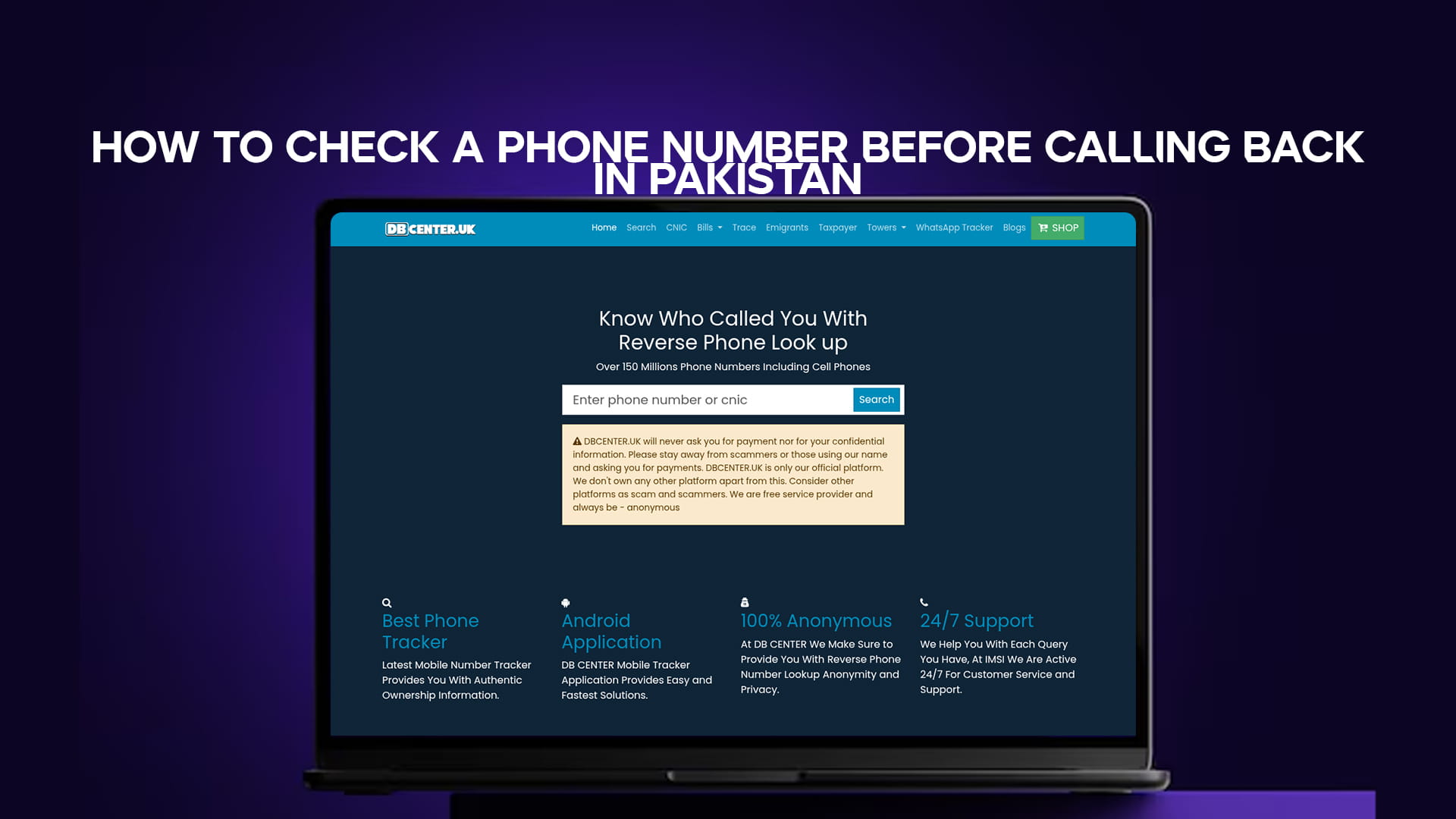
DB Center is a reverse phone lookup service with a database of over 150 million Pakistan phone numbers. That includes mobile numbers on all major networks and PTCL landlines across the country. It is web-based, meaning you use it through a browser without downloading anything or creating an account.
The process takes under a minute.
Open DB Center on your phone or computer. Type the full number into the search box exactly as it appeared on your screen. For Pakistani mobile numbers, use the full eleven-digit format starting with 03. For landlines, include the city code. You can also use the international format with +92 at the start if the number appeared that way.
Hit search and read the results. Depending on the number, you may see the registered name, the telecom operator, the city it is associated with, business details if it is a commercial line, and any reports left by other users who searched the same number previously.
That last part matters a lot. If a number has been flagged ten or fifteen times as a scam by other users in Pakistan, that information is right there in the results. You do not need to figure it out yourself.
Searching on Google
Typing a phone number directly into Google occasionally returns useful results. If the number belongs to a business that has listed it publicly on a website, a Google search will often find that listing. If the number has been reported on a consumer forum, a complaint board, or a news article, Google may surface that too.
The problem is inconsistency. Most private mobile numbers return nothing from a Google search. Business numbers sometimes come up, sometimes do not. The results depend entirely on whether the number was ever publicly posted somewhere that Google indexed. For a significant portion of Pakistani numbers, the answer is no.
Google works well as a secondary check after DB Center, not as a replacement for it.
Checking the Number Format First
Before running any search, looking at the number itself tells you a few things immediately. Pakistani mobile numbers are always eleven digits starting with 03. If the number on your screen is shorter, longer, or starts differently, it is either a landline, an international number, or a VoIP number routed through a non-standard format.
The first four digits of a mobile number tell you the network. Jazz and Warid numbers start with 0300 through 0304 and 0321 through 0323. Telenor uses 0340 through 0345. Zong numbers start with 0310 through 0312. Ufone covers 0331 through 0333.
If the number starts with a city code you do not recognise, it is a landline from a city you may not be familiar with. A quick search for Pakistani city codes will tell you which city the code belongs to.
None of this tells you who owns the number, but it helps you place it before you search.
Using Truecaller
Truecaller is widely used in Pakistan and identifies many callers in real time based on its community database. It works well for numbers that are already in its system and for calls where the identification happens before you pick up.
The tradeoff is that Truecaller requires you to install an app and upload your contact list to its servers. Your contacts' names and numbers become part of the database that other users draw from. Many people are comfortable with this arrangement. Others prefer not to share their contacts.
If you already use Truecaller, it is a solid first line of identification. If you do not use it and do not want to install it, DB Center covers a large portion of the same ground through a browser without requiring any data from you.
Reading DB Center Results Correctly
Getting results from a reverse phone lookup is one thing. Knowing what they mean is another. Here is how to interpret what you see.
A Name Appears in the Results
If DB Center returns a specific name for the number, that name is the registered owner of the number according to the data in the database. For business numbers, this is usually a company or brand name. For personal numbers, it is the name the SIM is registered under.
This does not mean the person calling you is definitely that person. SIMs in Pakistan are sometimes resold informally or used by someone other than the registered owner. But a name in the results is still useful information, especially if it matches a business or person you were expecting to hear from.
Operator Information Only
If the results show only the telecom operator and nothing else, the number is either new, unregistered under a searchable name, or simply not in the database with additional details. This is fairly common for mobile numbers registered in recent years. It does not mean the number is suspicious, just that the database does not have more on it.
In this case, scroll down to see if any community reports exist. Sometimes a number without a registered name still has multiple user reports attached to it.
Community Reports and Flags
User-submitted reports are often the most immediately useful part of a DB Center result. If a number has been searched before and previous users left comments or ratings, you will see those here. Comments like "this number called me asking for my bank details" or "fake job offer" tell you exactly what to expect if you call back.
A number with zero community reports and no name could be anything. A number with fifteen spam reports is a number you should block, not return.
Business Listing
If the number belongs to a registered business in Pakistan, DB Center often shows the business name and category. This is the cleanest result you can get. You can verify independently whether that business is real and whether you have a reason to speak with them.
Numbers That Are Worth Calling Back
Not every unknown number deserves suspicion. Knowing the common legitimate sources of unknown calls in Pakistan helps you make faster decisions.
Courier and delivery companies in Pakistan, including TCS, Leopards, Trax, and Daewoo Express, often call from individual rider or branch numbers rather than the main company helpline. If you are expecting a delivery, an unknown call is probably your rider.
Doctors, clinics, and hospitals frequently call from direct lines rather than the main reception number. If you have an upcoming appointment or recently had a test, an unknown call is likely a follow-up from the facility.
Recruiters and HR departments often call from personal office numbers. If you have recently applied for a job, an unknown call might be your first interview request.
Utility companies, including WAPDA, SNGPL, and PTCL, sometimes call from department-specific numbers to follow up on complaints or service requests.
In all these cases, checking the number first takes less time than the conversation itself and removes any uncertainty before you pick up or call back.
Numbers You Should Not Call Back Without Checking First
Some patterns in unknown calls are consistent enough that they are worth mentioning specifically.
Any number that called once and hung up immediately is worth checking before returning. This is a common pattern in both premium rate scams and lead-generation operations. The missed call is bait.
Numbers that called you multiple times in a short period without leaving a voicemail are worth treating with more caution than a single call. Legitimate callers who genuinely need to reach you usually leave a message or send a text.
Numbers with unusual formats, such as very short numbers, numbers starting with 080 or 090, or numbers with a country code you do not recognise, deserve a search before anything else. Premium rate numbers in Pakistan often use specific prefixes, and international scammers sometimes spoof local numbers to disguise foreign origins.
If you searched a number and found community reports flagging it as a scam, the right move is to block it, not call back to confirm the reports for yourself.
After the Check: What to Do with the Information
Once you have run the search and read the results, your next step should be clear.
If the results show a legitimate business or match what you were expecting, call back. You already know who you are calling.
If the results show a flagged scam number, block it on your phone. On Android, tap the number in your recent calls list and look for the block option. On iPhone, go to the recent call, tap the information icon, and scroll to find the block option. Both systems let you report spam numbers too.
If the results are unclear and you are still unsure, send a text first. Something as simple as "I missed a call from this number, who is this?" tells you more than calling back blind. Legitimate callers respond. Scammers usually do not, or they respond with a script designed to keep you on the line.
If you received a scam call, report the number on DB Center. Your report becomes part of the community database that other users in Pakistan will see when they search the same number. It takes a minute and directly helps the next person who gets a call from the same scammer.
For serious fraud attempts, particularly calls involving impersonation of banks, NADRA, or FBR, you can file a complaint with the Pakistan Telecommunication Authority through their online portal or by calling their helpline. Keeping a record of the date, time, and number involved makes the complaint more useful.
Building a Habit Around Phone Safety
Checking a number before calling back does not need to feel like a complicated security procedure. Once you do it a few times, it takes under a minute and becomes automatic.
The practical habit is simple. Missed call from an unknown number. Open DB Center. Search the number. Read what comes back. Decide. That sequence replaces the two bad options most people default to, which are calling back without any information or ignoring calls entirely and potentially missing something that matters.
Pakistan's phone network is enormous. Scammers operate at scale and rely on most people not checking. When you check a number before calling back, you are not just protecting yourself. You are contributing to a database that makes those scammers slightly less effective against the next person too.
DB Center covers over 150 million Pakistani numbers. The number that just called you is probably in there. The search is free, fast, and requires nothing from you except the digits on your screen.
A Quick Reference: Checking a Number Step by Step
For anyone who wants a fast summary of the process without reading the full guide, here it is in plain steps.
Write down the full number as it appears on your phone. Open DB Center in your browser. Enter the number in the search box and run the search. Check the results for a name, operator details, location, and community reports. If the results show a legitimate source, call back. If the results show spam or scam flags, block the number. If you confirmed a scam, leave a report so other users see it too.
That is the whole process. Thirty seconds of checking is worth more than five minutes of a conversation you should never have had.