Your phone rings. You stare at the screen for a moment and decide not to answer. An hour later, you get a WhatsApp message from the same number. Then another call. The number is not in your contacts, the messages are vague, and something about the whole thing feels off.
Most people in Pakistan have been in exactly this situation. And most of them do the same thing — they either ignore it, block the number, or cautiously engage without actually knowing who they are dealing with.
There is a better option.
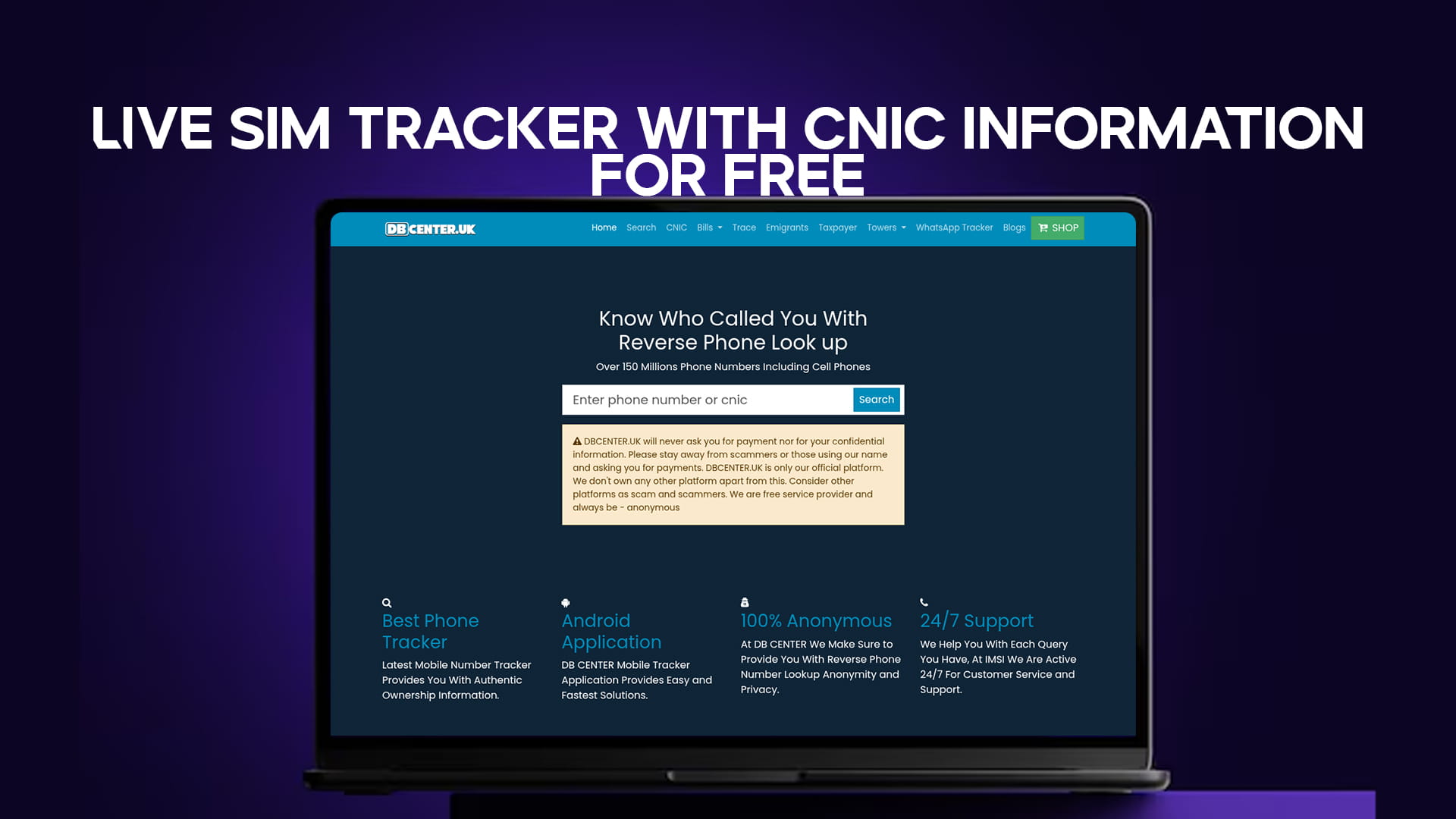
Tools that let you look up SIM ownership and cross-reference CNIC-linked information for free have changed the way people approach unknown numbers. DB Center, with its reverse phone lookup database covering over 150 million numbers including cell phones, is one of the most practical tools available for this purpose. You enter a number, you see what is publicly known about it, and you make an informed decision.
This article explains what SIM verification and CNIC information lookup actually involves, how the process works, what you can realistically expect to find, and how to use these tools properly to protect yourself without crossing any lines.
Understanding What "SIM Tracking" Actually Means for Ordinary Users
The phrase "SIM tracker" means different things in different contexts, and it is worth being clear about the distinction upfront.
For law enforcement agencies working within a legal framework, SIM tracking can involve real-time location data obtained through a court order and cooperation from telecom operators. This is a formal, authorized process that requires judicial oversight. It is not something available to members of the general public, and any website claiming to offer real-time GPS location of a person through their SIM number to ordinary users is not telling the truth about what it actually does.
For ordinary users — which is what this article addresses — SIM tracking means something entirely different and entirely legitimate. It means verifying who owns a mobile number, what CNIC that SIM is registered against, which network it belongs to, and what publicly available information or community-reported data exists about how that number has been used.
This is consumer-level identification and verification. It is the same principle as looking up a business in a directory before deciding whether to return their call. DB Center is built for exactly this purpose: giving you enough information about a number to make a smart decision about how to handle it.
Why CNIC-Linked SIM Information Matters
In Pakistan, the connection between a SIM card and a CNIC is not just administrative. It is the backbone of mobile accountability.
Every SIM sold in Pakistan is supposed to be registered against the buyer's Computerized National Identity Card — a 13-digit unique identifier issued by NADRA. This requirement was put in place by PTA to ensure that every active mobile number could be traced to a real, identifiable person. The goal was to reduce anonymous fraud, track criminal activity conducted over mobile networks, and give citizens a way to verify the identity behind a number if needed.
In practice, this system works well when everyone follows the rules. The problem is that the rules are not always followed. CNICs get photocopied during routine transactions — at hotels, rental agreements, job applications, even photocopying shops — and those copies sometimes end up in the hands of people who use them to register SIMs without the original owner's knowledge. When that happens, the fraudulent SIM is linked to an innocent person's CNIC, creating liability and confusion that can take time to sort out.
This is why CNIC-linked SIM information is valuable to look up. If you know what SIMs are linked to your CNIC, you can catch unauthorized registrations early. If you receive a call from a number and want to check its background, knowing what CNIC-linked data is publicly available about it helps you assess the risk of engaging.
How DB Center Handles SIM and CNIC Information Lookup
DB Center is a reverse phone lookup platform with a database of over 150 million numbers. The core function is simple: you enter a phone number, the system searches its database, and it returns whatever publicly available information is associated with that number.
For Pakistani users, this process is particularly relevant because of how deeply mobile numbers are embedded in everyday life. A number someone gives you could be their personal SIM, a business line, a recently obtained number with little history, or a number that has already been flagged by other users for suspicious behavior. DB Center's database helps distinguish between these possibilities.
Here is what the lookup process typically shows.
Carrier and network identification confirms which telecom operator the number belongs to — Jazz, Telenor, Ufone, Zong, or SCOM. This basic information tells you whether the number is a legitimate Pakistani mobile number and which network registered it.
Name and registration data appears when the number is linked to publicly available records or has been submitted through community reporting by other users. Not every number will have this, but a significant portion of the numbers in DB Center's database do carry some level of identity information.
Community-submitted reports are among the most valuable outputs. When users receive calls or messages from a number and want to document the experience, they can submit a report. If a number has been used in scam campaigns, for harassment, or for telemarketing without consent, those reports accumulate and become visible to anyone who searches that number later. This crowd-sourced layer makes the database significantly more current and relevant than one relying only on static records.
Scam and spam flags appear automatically when enough reports have been filed against a number. These provide a quick signal that tells you whether engaging with the number carries a known risk.
The combination of these data types gives Pakistani users a practical, free tool for verifying the background of any number they encounter.
Using PTA's Official Services Alongside DB Center
DB Center is not the only resource available to Pakistani users. PTA provides its own official service that addresses a specific and important slice of SIM verification: checking what is registered under your own CNIC.
The service works by sending a blank SMS to 668 from any active mobile number. Within a short time, you receive a reply listing all SIM cards currently registered against your CNIC across all networks in Pakistan. This is the most direct way to find out whether your identity has been misused to register SIMs without your knowledge.
If the list includes numbers you did not activate, you should report them immediately. For each network, there are specific channels to flag unauthorized registrations. PTA also maintains a consumer helpline for escalated complaints. Getting fraudulent SIMs blocked early matters — a SIM registered under your CNIC and used for criminal activity creates a legal and reputational problem that is far harder to deal with after the fact.
Where PTA's service has limits is in the reverse direction. It tells you about SIMs linked to your own CNIC. It does not help you look up who owns a number you received a call from, or check what CNIC information is publicly associated with an unknown number. That is the gap DB Center fills. Together, the two resources cover the most important aspects of SIM-related verification for ordinary Pakistani users.
What Free SIM Lookup Tells You — and What It Does Not
Setting realistic expectations is important when using any lookup tool, free or otherwise.
A free reverse phone lookup through DB Center will typically return carrier information, any name or identity data available in public records, community reports, and scam or spam flags. For many numbers — especially those involved in known fraud campaigns — this is enough information to make a clear and confident decision.
For some numbers, particularly newly registered or rarely reported ones, the results may be limited. A number that has never been searched before, has no community reports, and does not appear in any public directory will return minimal data. That in itself is somewhat informative — a number with absolutely no history is at least not a known scammer — but it does not confirm the caller's identity either.
What free lookup tools do not offer — and what you should be skeptical of any platform claiming to provide for free — is real-time location data, private telecom records, or information that would require a court order to access legitimately. Any website claiming to show you the live GPS location of a SIM card owner for free, without legal authorization, is either fabricating results or operating in a way that raises serious legal concerns. That kind of tracking is not available through consumer tools and should not be.
DB Center's scope is transparent: it is a reverse phone lookup service. It identifies, it verifies, and it aggregates community knowledge. That is both its purpose and its strength.
The Most Common Reasons Pakistanis Look Up SIM and CNIC Information
The demand for SIM and CNIC information lookup is not abstract. It comes from specific, recurring situations that millions of Pakistanis face regularly. Understanding those situations helps clarify why these tools are worth knowing about.
Missed calls from unknown numbers are the most common trigger. Calling back an unknown number without checking it first carries risk. If the number belongs to a fraud operation, even a brief callback can result in being charged for a premium rate call or being engaged in a conversation designed to extract personal information. A quick lookup before calling back is simple insurance.
WhatsApp messages from strangers generate the second largest share of lookups. Whether it is a business contact you cannot verify, a romantic approach from an unknown number, or a message containing a link you are not sure about, looking up the sender's number before engaging is a reasonable first step.
Business verification is a growing use case. Small business owners increasingly check the mobile numbers of new customers, suppliers, or contractors before entering into financial agreements. A number with scam reports or no verifiable history is a reason to ask more questions before committing to anything.
Harassment and nuisance calls drive a significant portion of lookups as well. When a number calls repeatedly, especially at odd hours, knowing whether it is a known issue that other people have also reported helps you decide whether to simply block it or escalate the matter.
Protecting elderly family members is another practical use. Older Pakistanis are disproportionately targeted by phone fraud because they tend to be more trusting of official-sounding callers. Family members who help manage communications for older relatives often use lookup tools to vet numbers before deciding whether a call or message deserves a response.
How to Protect Your CNIC from Unauthorized SIM Registration
Prevention is always better than response, so alongside knowing how to verify numbers, it helps to know how to reduce the chances of your CNIC being misused in the first place.
Limit unnecessary photocopies of your ID. Every time you hand over a copy of your CNIC, you are potentially creating a document that someone could use to register a SIM or open an account in your name. Where a photocopy is genuinely necessary, write the purpose on it: "For hotel check-in only" or "For tenancy agreement only." This does not make misuse impossible but it does create a paper trail and deters casual misuse.
Check your CNIC registrations every few months. Sending to 668 takes seconds. Doing it every two or three months means that if unauthorized SIMs have been registered under your name, you catch them relatively quickly rather than finding out after significant damage has been done.
Report unauthorized numbers immediately. If the 668 check shows SIMs you did not activate, do not wait. Contact the relevant network operator directly, request that the SIM be blocked, and file a complaint with PTA. Keep a record of your complaint for your own protection.
Use strong verification on mobile financial accounts. If your mobile number is linked to a banking app, mobile wallet, or any financial service, make sure two-factor authentication is set up in a way that would not be compromised by a SIM swap. Some services allow authentication through an app-based method rather than SMS — use that option where available.
Be skeptical of requests for your CNIC number over the phone. Legitimate organizations that need to verify your CNIC will typically do so through formal channels, not by calling you and asking you to read the number out loud. If someone calls claiming to represent a bank, telecom company, or government office and asks for your CNIC details, hang up and call the organization back on their official number.
Why Free Access to These Tools Is Important
There is a real argument to be made for free access to SIM verification and reverse lookup tools, beyond just convenience.
Fraud disproportionately affects people with less digital literacy and fewer resources. The people most likely to fall for an impersonation scam or a WhatsApp fraud scheme are not necessarily naive — they are often simply less familiar with the verification tools that exist and unable to pay for premium services even when they know about them.
Free tools lower that barrier. When checking a number costs nothing and takes thirty seconds, the protective benefit extends to people who would not otherwise have access to paid verification services. This democratization of information is genuinely significant in a country with the scale and mobile penetration of Pakistan.
DB Center offers its reverse phone lookup at no cost to the user. That is not incidental — it is what makes the tool useful at scale. A protection tool that only rich or tech-savvy people use does not meaningfully reduce fraud across the population. A free tool that millions of people can use on a basic smartphone changes the dynamic.
Tips for Getting the Most Out of DB Center
A few practical suggestions help you use the platform more effectively.
Always include the country code when searching. For Pakistan, that is +92 followed by the remainder of the number. Searching without the country code can produce incorrect or empty results if the database requires full international format.
Read community reports carefully. The label "scam" or "spam" gives you a quick signal, but reading the actual reports tells you more. Some numbers are flagged for aggressive telemarketing, others for impersonation fraud, and others for outright criminal schemes. The nature of the reports helps you calibrate your response.
Search before you call back. The most effective use of a lookup tool is before engagement, not after. If you search a number before calling back and find that it has been flagged, you have avoided the risk entirely. If you search it after already engaging, you may already have given the caller information you cannot take back.
Submit your own reports. If a number calls you with a suspicious pitch, a scam attempt, or persistent harassment, file a report after looking it up. Your report helps everyone who receives a call from that number in the future. This is how the database stays current and useful.
Final Thoughts
SIM ownership verification and CNIC information lookup are not exotic technical processes reserved for investigators or cybersecurity professionals. They are practical, everyday tools that help ordinary people in Pakistan answer one simple question: who is behind this number?
DB Center makes that question answerable for free, with a database large enough to return useful results for a significant portion of the numbers people actually encounter. Over 150 million numbers, community-driven reports, scam flags, and carrier data combine to give Pakistani users a clear and accessible way to verify unknown callers and protect themselves from phone-based fraud.
The process is free. The information is practical. The habit of checking before engaging is one worth building — and with a tool like DB Center, it is easier to build than most people expect.