There are more active SIM cards in Pakistan than there are adults. As of 2026, the country has crossed 195 million mobile connections spread across Jazz, Telenor, Zong, Ufone, and a handful of smaller operators. That is an enormous number of phones, and a significant portion of them call people who have no idea who is on the other end.
Whether you are trying to identify a missed call, verify a contact before a business deal, check a number that has been bothering you, or simply confirm that a person is who they say they are, searching a Pakistan mobile number is something millions of people need to do every day.
This is the complete guide to doing it properly in 2026. It covers how mobile number search works in Pakistan, what tools are available, what results actually mean, and how to get the most useful information from a search in the shortest amount of time.
How Mobile Number Search Works in Pakistan
Mobile number search, also called reverse phone lookup, works by matching a phone number against a database of records. When you enter a number, the service searches its database and returns whatever information is linked to that number in its records.
The quality of results depends entirely on the size and freshness of the database being searched. A service with five million records will miss numbers that a service with 150 million records finds easily. A database that has not been updated in years will return outdated names and locations.
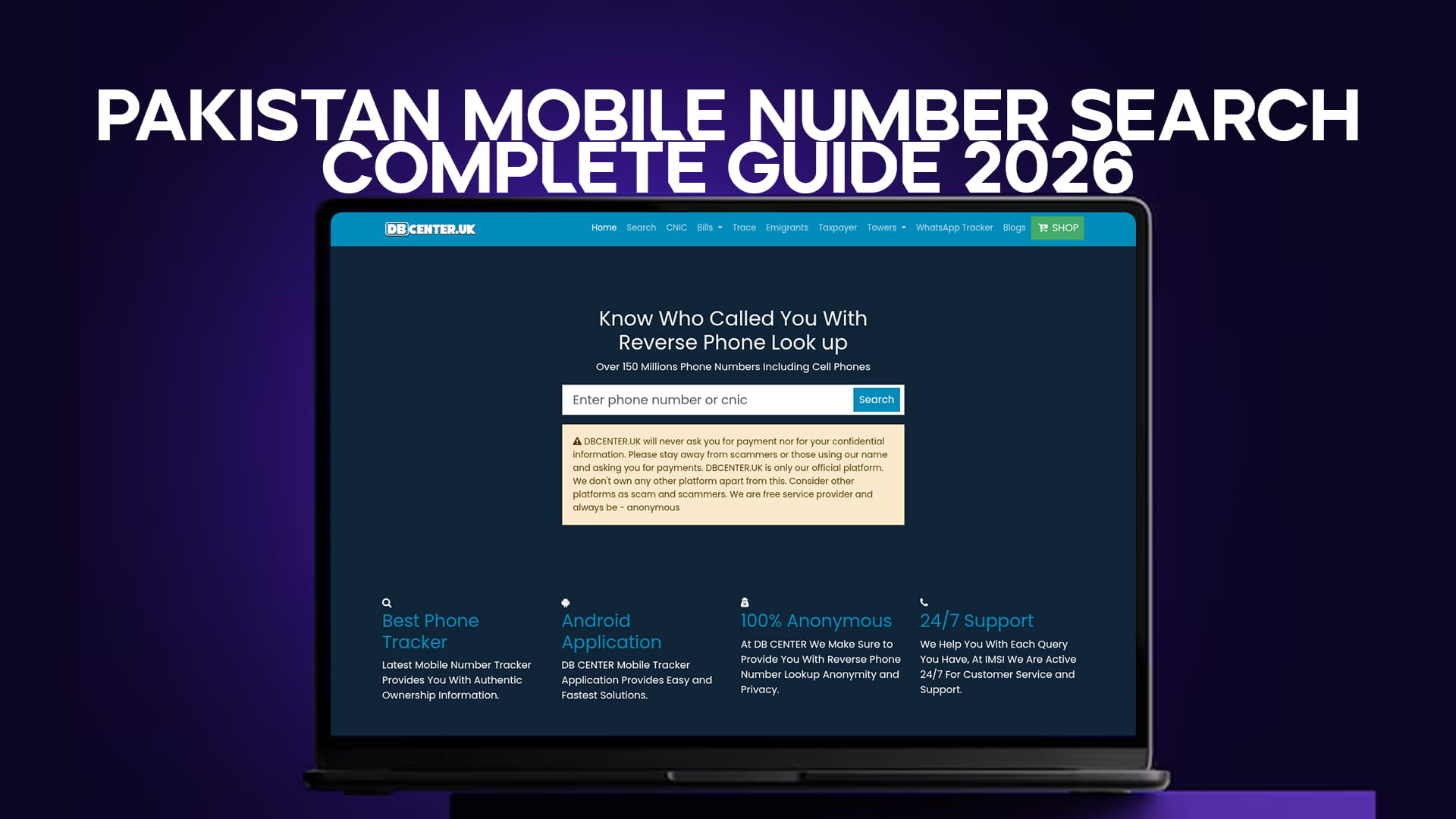
DB Center maintains a database of over 150 million Pakistan phone numbers. That includes mobile numbers registered on all major networks, PTCL landlines, and numbers associated with businesses and organisations across the country. The database is updated regularly, which means searches return current information rather than records from several years ago.
The search itself does not require any technical knowledge. You enter a number, run the search, and read the results. No account is needed. Nothing needs to be installed. The entire process happens through a browser on your phone or computer.
Pakistan's Mobile Network Structure in 2026
Understanding how Pakistan's mobile networks are organised helps you read search results more accurately and gives you useful context before you even run a search.
Pakistan currently has four major mobile operators.
Jazz is the largest network by subscriber count. It was formed through the merger of Mobilink and Warid and operates under a single brand. Jazz numbers use the following prefixes: 0300, 0301, 0302, 0303, 0304, 0305, 0306, 0307, 0308, 0309, 0321, 0322, 0323, 0324, and 0325.
Telenor Pakistan is the second largest operator. Telenor numbers use prefixes starting with 0340, 0341, 0342, 0343, 0344, and 0345.
Zong, owned by China Mobile, is Pakistan's largest network by data usage. Zong numbers start with 0310, 0311, 0312, 0313, 0314, and 0315.
Ufone, owned by PTCL, primarily serves urban and semi-urban markets. Ufone numbers start with 0331, 0332, 0333, 0334, and 0335.
PTCL handles landline services. Landline numbers use city codes followed by subscriber numbers. Common city codes include 021 for Karachi, 042 for Lahore, 051 for Islamabad and Rawalpindi, 041 for Faisalabad, 091 for Peshawar, 061 for Multan, and 081 for Quetta.
When DB Center returns results for a number, the operator is always identified. Knowing the prefix already told you the network before you searched, but having it confirmed in the results adds certainty and sometimes additional context about where the number was originally registered.
What You Can Find Through a Pakistan Mobile Number Search
Search results vary depending on the number and what information is available in the database. Here is a complete breakdown of what a search on DB Center can return.
Owner Name
For numbers that are linked to a registered name, the owner's name appears in the results. This is most reliable for business numbers and landlines, which are more consistently registered under traceable names. For personal mobile numbers, the name shown is whoever registered the SIM, which in Pakistan requires a CNIC under regulations introduced by PTA. This means most Pakistani mobile numbers have a real registered name behind them, though the name shown may not always match the person currently using the number if the SIM has changed hands.
Network Operator
Every search result identifies the telecom network the number belongs to. This is reliable even when other details are unavailable.
City or Region
For landline numbers, the city is immediately clear from the city code. For mobile numbers, DB Center shows a city or region when that information is available in the records.
Business Details
If the number belongs to a registered business, the business name and category are shown. This covers banks, hospitals, courier companies, real estate agencies, schools, restaurants, government offices, and other organisations that have publicly listed their contact numbers.
Spam and Scam Reports
User-submitted reports are attached to numbers that have been searched before and flagged by other users. If a number has been reported multiple times as a scammer, telemarketer, or harasser, those reports appear alongside the standard results. This community-sourced layer adds real-world intelligence that no static database alone can provide.
SIM Registration Status
In some cases, DB Center can show whether a number is active or inactive, and whether it is registered under a valid CNIC. Pakistan's SIM verification system, which requires biometric registration at authorised outlets, means that most numbers in the country are tied to a real identity on record with PTA.
Step-by-Step: How to Search a Pakistan Mobile Number
The process is direct and takes under a minute from start to finish.
Step One: Copy the Number Accurately
Write down or copy the full number exactly as it appeared. Include every digit. Pakistani mobile numbers are always eleven digits starting with 03. If the number appeared with a country code (+92), that is fine too. Both formats work on DB Center.
Do not add or remove digits. A single wrong number produces completely different results or no results at all.
Step Two: Open DB Center
Open your browser and go to DB Center. The search box is prominently placed on the main page. You do not need to navigate anywhere else.
Step Three: Enter the Number and Search
Type the number into the search box. You can use the local format (03xx xxxxxxx) or the international format (+92 3xx xxxxxxx). Hit search.
Step Four: Read the Full Results Page
Do not just look at the first piece of information that appears. Read the entire results page. The name and operator are usually at the top, but community reports and additional details are further down. Those reports are often the most useful part of the result, especially for numbers with no registered name.
Step Five: Use the Information to Decide
Once you have the full picture, your next step is clear. Call back, ignore, block, or report. The decision is yours, but you are making it with information rather than guessing.
Common Reasons People Search Pakistan Mobile Numbers
Understanding why people run these searches helps illustrate how broadly useful the tool is beyond just identifying scam calls.
Missed Calls
The most common reason. An unknown number called and you missed it. A search tells you whether it is worth returning before you spend time on it.
Verifying a Contact Before a Meeting
Someone contacted you through an app, a marketplace, or a referral and gave you a number. Before meeting them in person or sending money, a quick search confirms whether the number checks out.
Checking a Number That Keeps Calling
A number has called you three times this week. You have not answered. A search tells you whether it is a persistent telemarketer, a genuine caller who really needs to reach you, or something more concerning.
Business Due Diligence
You received a business inquiry from an unknown number. Before investing time in a potential deal, checking the number confirms whether it belongs to a legitimate business or has been flagged by other users.
Verifying Job Applicants
An employer or HR department received a CV with a contact number. Searching the number confirms whether it matches the applicant's stated location and background, or whether it has been flagged in connection with fraud.
Protecting Elderly Family Members
Older people in Pakistan are frequently targeted by phone scammers. Family members who suspect a relative has been contacted by a scammer can search the number to confirm and then take action.
Online Marketplace Safety
Buyers and sellers on platforms like OLX exchange numbers with strangers. Running a quick search before meeting someone in person or completing a transaction adds a meaningful layer of safety.
Pakistan's SIM Registration System and What It Means for Number Search
Pakistan introduced compulsory biometric SIM registration several years ago. Under this system, every SIM card must be registered against a valid CNIC using biometric verification at an authorised retailer. No SIM can be legally activated without this process.
The practical effect is that almost every active Pakistani mobile number is linked to a real person's national identity record. This is very different from countries where anonymous SIMs are freely available.
For mobile number search, this means that registered names in databases like DB Center are more likely to be accurate than in many other countries. A name returned in search results corresponds to the CNIC holder who activated that SIM, even if the SIM has since been used by someone else.
PTA has also imposed SIM limits. Pakistani citizens are generally allowed a limited number of active SIMs per CNIC. This reduces the scale of anonymous number rotation that scammers rely on in other markets, though it does not eliminate the problem entirely since SIMs do get sold informally and fraudulent registrations do occur.
What this means for you as a searcher is that name results from Pakistani number searches tend to be more reliable than in markets where SIM registration is voluntary or unenforced.
How to Handle Different Search Outcomes
Every search produces one of a handful of possible outcomes. Here is exactly what to do with each one.
Clear Business Name in Results
You now know who called you. If it is a business you recognise or have a reason to deal with, call back. If it is a business you have no connection to and it is a sales or marketing operation, ignore or block it.
Personal Name with No Spam Reports
The number belongs to a named individual with a clean record in the database. This could be someone you know on a new number, a legitimate contact, or a stranger with a clean number who has a genuine reason to reach you. Sending a text asking who is calling is a safe first step.
No Name, Operator Only
The number is in the database but without additional details. Check whether there are any community reports. If there are none and no red flags, you are dealing with a genuinely unknown quantity. A brief text is safer than calling back immediately.
Multiple Spam or Scam Reports
Block the number. Do not call back. Do not engage. If the reports describe a specific type of fraud and the call matches that description, report it yourself to add to the warning for future users.
Number Not Found
Very new numbers, recently ported numbers, and some VoIP numbers may not appear in the database at all. In this case, rely on the number format itself for clues and treat the call with standard caution. A text before calling back is always the safer approach when results are unavailable.
Protecting Your Own Number While Searching Others
Using a reverse phone lookup service responsibly means understanding that your own number exists in databases too. Here is how to think about that.
Your Pakistani mobile number, registered under your CNIC, is part of public and semi-public records. It may appear in business directories if you have ever listed it publicly, in community databases if others have searched and reported it, and in operator records that feed into services like DB Center.
If you want to reduce the visibility of your personal number, avoid listing it publicly on social media profiles, classified ad listings, and business directories unless it is specifically a business number intended for public contact. Using a separate number for public-facing activities and keeping your personal number more private reduces the volume of unsolicited contact you receive over time.
This does not affect your ability to search other numbers. The two things are independent.
Why DB Center Is the Right Tool for Pakistan Number Search
Several tools exist for looking up phone numbers. Most of them are built primarily for US or European numbers and treat Pakistan as an afterthought, if they cover it at all.
DB Center is built around Pakistani numbers specifically. The database holds over 150 million records including mobile numbers on all major networks and landlines across the country. Coverage extends beyond the major cities to include numbers from smaller cities and rural areas that international services frequently miss.
The service runs through a browser without requiring an app download or contact list upload. Searches are fast. Results are clearly presented. Community reports from other Pakistani users add a layer of current, practical intelligence that purely database-driven results cannot match on their own.
For anyone in Pakistan who needs to search a mobile number, whether for a missed call, a business verification, a safety check, or any other purpose, DB Center provides the most direct path from a number on a screen to a clear, useful answer.
Final Word
Pakistan's mobile landscape is large, active, and constantly changing. New numbers come into circulation every day. Scam operations adapt their tactics regularly. Legitimate businesses and individuals call from numbers that are not saved in anyone's contacts.
Navigating that landscape without a reliable search tool means making decisions based on nothing. With DB Center and its database of over 150 million Pakistan numbers, you have a resource that turns an unknown number into a known one in under a minute.
Search before you call back. Verify before you meet. Check before you pay. Those three habits, backed by a reliable number search tool, make every interaction that starts with an unknown number significantly safer.