Not long ago, if you got a call from an unknown number in Pakistan, your only real option was to call back and hope for the best. That was a gamble. Sometimes it was fine. Sometimes it was not.
The situation has changed. Pakistan's SIM database has grown more structured over the years, and public-facing tools have caught up. Today, if you have a number and you want to know who it belongs to — their name, their carrier, whether others have flagged it — you can find that out in under a minute.
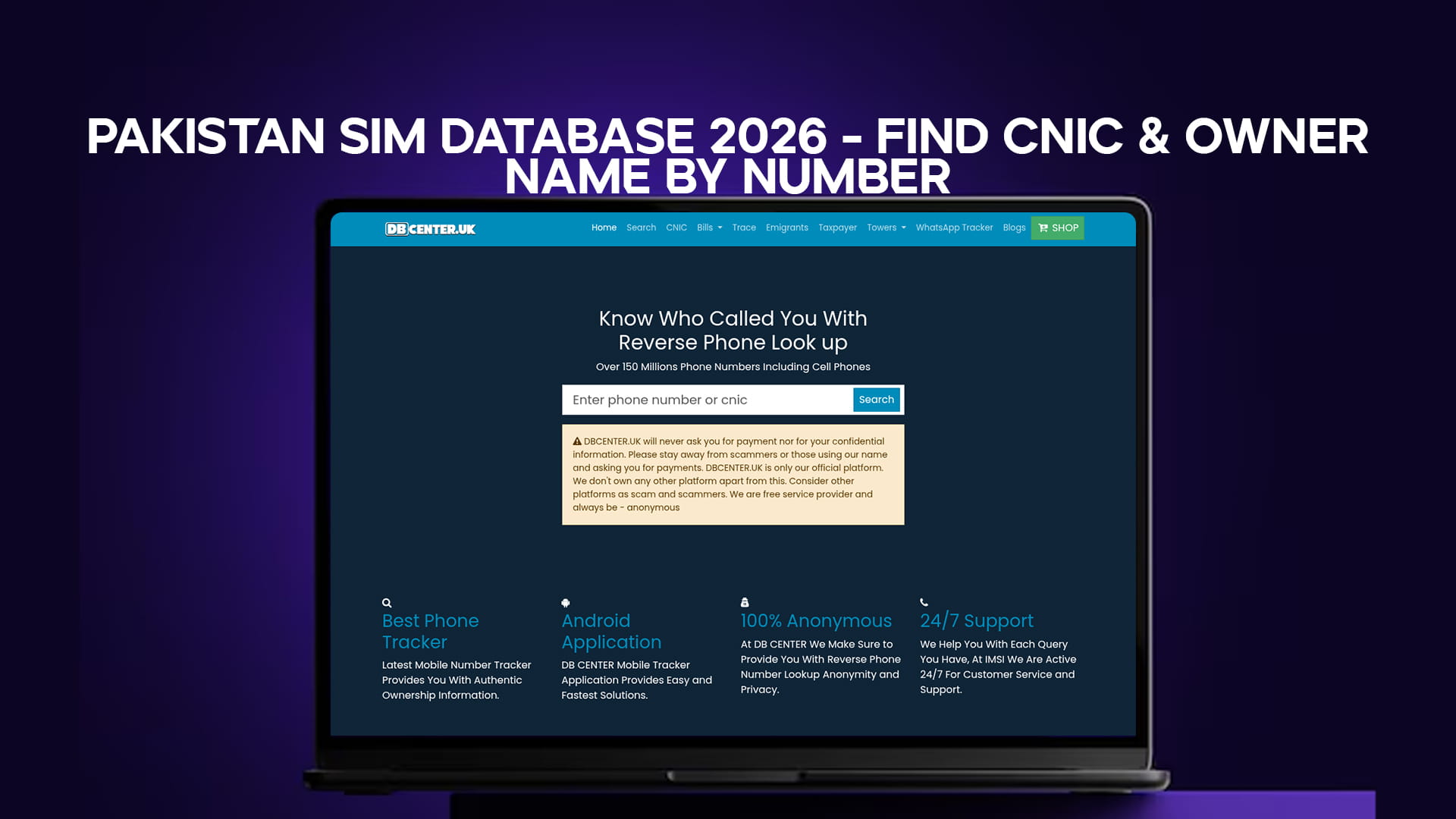
DB Center is one of the tools making that possible. It is a reverse phone lookup service with over 150 million phone numbers in its database, covering cell phones and landlines across multiple countries including Pakistan. You type in a number, it tells you what it knows. No account needed. No fees.
This article covers everything about checking SIM owner details and CNIC-linked information in Pakistan in 2026 — how the system works, what tools you can use, what you can realistically expect to find, and why any of this matters.
The Pakistan SIM Database: What It Actually Is
People use the phrase "Pakistan SIM database" loosely. It is worth being clear about what it refers to and what it does not.
The real, official SIM registration database is maintained by Pakistan's telecom operators in coordination with the Pakistan Telecommunication Authority (PTA) and NADRA — the National Database and Registration Authority. Every SIM card sold in Pakistan since biometric verification became mandatory must be registered using the buyer's thumbprint, matched against their CNIC record. That data sits with the carrier and, in a regulatory sense, with the PTA.
That official database is not publicly searchable. The government does not give citizens a portal to type in someone's CNIC and pull up all their registered numbers, or vice versa. What it does offer is a limited self-check: if you send your own CNIC number to 668 via SMS, you get a reply showing how many SIMs are registered under your identity across all networks. That is for your own records. It does not help you identify a stranger who just called you.
What people usually mean when they search for "Pakistan SIM database" online is a reverse lookup tool — a service that takes a phone number as input and returns information about who that number belongs to. That is a different thing, and it is where services like DB Center come in.
DB Center pulls from a large compiled database of phone numbers and associated data. For Pakistani numbers, this includes information sourced from carrier records, public registrations, and community-submitted reports. When you search a number, the results reflect what is in that database at the time of the search.
Why People Search for CNIC and Owner Details by Number
There is a long list of reasons someone would want to find the name or CNIC linked to a Pakistan phone number. Most of them are completely ordinary.
Missed calls. You woke up to three missed calls from a number you do not have saved. You want to know if it is worth calling back before you do.
Online transactions. You are buying a used item from someone on a classifieds platform. They gave you a WhatsApp number. You want to verify the person is real before handing over cash.
Loan and investment fraud. Financial scams are common in Pakistan and they almost always arrive via phone. Someone promising returns on an investment, offering a quick loan, or asking you to transfer money to claim a prize. Running the number takes 30 seconds.
Harassment. Repeated calls, late-night calls, threatening messages. You want to know who is behind the number before deciding whether to go to the police.
Business verification. A vendor or contractor gives you a contact number. You want to make sure it matches who they say they are before signing an agreement or making a payment.
Family checks. Parents want to know who their child has been getting calls from. A spouse notices an unfamiliar number appearing repeatedly. These situations happen in real life and lookup tools address them directly.
Overseas contact. The Pakistani diaspora in the UK, the Gulf, the US, and elsewhere regularly receive calls from Pakistan numbers. Some are legitimate — family, doctors, official agencies. Some are not. A free reverse lookup helps sort one from the other quickly.
None of these scenarios requires advanced technical knowledge. They just require a tool that works and is easy to use.
How DB Center Works for Pakistani Numbers
DB Center is straightforward. The homepage has a single search bar. You enter the number you want to look up and the system runs it against the database.
For Pakistani numbers, there is one formatting step to keep in mind. Pakistan's country code is +92. Mobile numbers in Pakistan start with 03 when dialled domestically. When searching internationally — or when using a tool like DB Center — you drop the leading zero and add +92 instead.
So a number like 0345-1234567 becomes +923451234567.
DB Center accepts both formats, so you do not need to stress too much about this. But if your first search returns nothing, try the other format before concluding the number is not in the database.
Once you search, the results typically include:
- The name associated with the number, if available
- The mobile network operator (Jazz, Telenor, Zong, Ufone, SCOM)
- The country and general region
- Whether the number has been flagged by other users as spam, fraud, or harassment
- The number type — mobile, landline, or VoIP
Not every number returns a name. Some are newer numbers, some are registered under details that have not yet made it into the compiled database, and some are VoIP numbers with limited attached information. But a large proportion of Pakistani numbers return at least partial results, and the community flag data alone is often enough to answer the key question: is this number safe to engage with?
Pakistani Mobile Number Prefixes and What They Tell You
One thing DB Center surfaces is the carrier associated with a number. Knowing the carrier from the prefix is useful background, especially when you are trying to verify whether a number makes sense for the context it appeared in.
Here is a quick reference for Pakistani mobile prefixes:
Jazz (formerly Mobilink): 0300, 0301, 0302, 0303, 0320, 0321, 0322, 0323, 0330, 0331, 0332, 0333
Telenor Pakistan: 0340, 0341, 0342, 0343, 0344, 0345, 0346
Zong (China Mobile Pakistan): 0310, 0311, 0312, 0313, 0314, 0315
Ufone: 0333 (shared range), 0334, 0335, 0336, 0337
SCOM (Special Communications Organization): 0350, 0351, 0352 — these serve Azad Kashmir and Gilgit-Baltistan
This matters in practice. If someone claims to be calling from a major corporation's customer service team and the number prefix belongs to a personal SIM range rather than a registered business line, that is a flag worth noting. Businesses with legitimate operations typically use landlines or dedicated corporate numbers, not standard 03xx mobile SIMs.
What CNIC Has to Do With SIM Registration
CNIC stands for Computerised National Identity Card. It is Pakistan's national ID system, administered by NADRA. Every Pakistani adult is issued a CNIC with a unique 13-digit number.
When the PTA made biometric SIM verification mandatory, it tied every SIM registration to a CNIC. The process works like this: a person visits a SIM retailer, scans their thumb, that print is matched against NADRA's database, and if it matches the CNIC presented, the SIM is registered under that identity. From that point, the mobile number is officially linked to that person's CNIC.
The PTA caps how many SIMs can be registered under one CNIC. That cap has been adjusted over the years but the intent is consistent — stop people from buying dozens of SIMs to use in scam operations.
For the ordinary user, the CNIC-SIM link means that most Pakistani numbers trace back to a real, verifiable identity. The challenge is that public tools — including DB Center — do not directly expose CNIC numbers. That data is protected for privacy and security reasons. What you can find through a reverse lookup is the name, carrier, and community reputation of a number. The full CNIC link sits in government and carrier databases that are not publicly searchable.
That said, if you are a victim of phone fraud and you report it formally to the FIA Cybercrime Wing or the PTA, those authorities do have the ability to trace a number back to its registered CNIC. The legal process exists. It just is not something a regular person can do through a public tool.
Step-by-Step: Searching a Pakistan Number on DB Center
If you have never used a reverse phone lookup tool before, here is exactly how the process works on DB Center.
Step 1: Open DB Center in your browser. The site loads quickly and the homepage is clean. The search bar is the first thing you see.
Step 2: Enter the phone number. Type the Pakistani number you want to look up. Use the international format: +92 followed by the number without its leading zero. For example, if the number is 0312-9876543, you enter +923129876543.
Step 3: Hit search. The system checks the number against its database. This usually takes a few seconds.
Step 4: Review the results. The results page shows you the name (if available), carrier, region, number type, and any community flags or comments left by other users who have encountered that number.
Step 5: Read the user reports. This is the part people sometimes skip but should not. Community reports often tell you more than the database entry. If 20 users have flagged a number as a scam call in the last six months, that is current and relevant information.
Step 6: Decide what to do. Block the number, call back, ignore it, or report it — the decision is yours. DB Center gives you the information. What you do with it is up to you.
The whole process from step one to step six takes under two minutes for most searches.
How Scammers Use Pakistani SIMs and How to Spot Them
Phone fraud in Pakistan runs on a few predictable patterns. Once you know them, they are easier to spot.
The prize scam. You receive a call or text saying you have won a prize — a car, a cash amount, a phone. To claim it, you need to pay a processing fee or share your bank details. No legitimate prize scheme requires you to pay anything upfront. Ever.
The government impersonator. Someone calls claiming to be from NADRA, the PTA, or the Federal Board of Revenue. They say your CNIC is being suspended, your SIM is being deactivated, or you owe unpaid taxes. They want you to verify your details — meaning they want your personal information. Real government agencies do not make unsolicited calls demanding verification.
The family emergency call. A caller claims to be a relative or a person helping a relative who has been in an accident or arrested. They need money sent urgently. The emotional pressure is the mechanism. If you cannot verify the caller's identity, call the relative directly on a number you already have before doing anything else.
The job offer. A message or call offers a work-from-home job, overseas employment, or a freelance contract. The caller asks for a registration fee or for your bank account details. Legitimate employers do not collect fees from applicants.
The loan shark call. A text or call offers an instant loan with minimal documentation. The interest terms are hidden until later and the "registration fee" is collected upfront. These operations are unlicensed and often predatory.
In all these cases, running the number through DB Center before responding can save you from making a costly mistake. If the number is flagged, you have your answer. If it is clean, you are at least better informed.
Reporting a Fraudulent Number in Pakistan
If you receive a scam call or fraudulent message, you do not have to just block and move on. There are real channels for reporting it.
PTA complaint portal. The Pakistan Telecommunication Authority takes complaints about fraudulent and nuisance calls. You can file a complaint on their website or through their helpline. Provide the number, describe what happened, and include any screenshots or records you have. The PTA can deactivate SIMs involved in verified fraud.
FIA Cybercrime Wing. For more serious cases — financial fraud, threats, blackmail — the Federal Investigation Agency's Cybercrime Wing is the right authority. They accept online complaints and have the power to trace numbers back to their registered CNIC holders and prosecute offenders.
DB Center community report. Even if you do not want to file a formal complaint, flagging the number on DB Center helps. It adds to the community record and protects future users who search that number.
Your mobile carrier. Jazz, Telenor, Zong, and Ufone all have spam and abuse reporting channels. Contact their customer support with the number and details of what happened. Carriers can flag or block numbers at their end.
Keeping a record matters in all of these. Note the date and time of the call, save any messages, and screenshot anything relevant before you report.
Privacy Considerations When Using Lookup Tools
Using a reverse phone lookup is legal. Looking up a number someone used to contact you is not a privacy violation — they called you, and you are trying to find out who they are. That is a reasonable thing to do.
Where the line sits is in how you use the information. Finding out a name and carrier to decide whether to call back is fine. Using the information to stalk, harass, or harm someone is not, and it is illegal regardless of what tools you used to get the information.
DB Center does not give out home addresses or precise location data, which limits the misuse potential. The information it returns — name, carrier, community flags — is useful for safety and verification purposes without enabling the kind of detailed surveillance that would raise genuine concerns.
If you are concerned about your own number appearing in a database, most lookup services have a process for requesting removal. Contact the platform directly with your number and they will typically process the opt-out within a reasonable timeframe.
Why 2026 Is a Different Landscape for Phone Lookups
A few years ago, finding reliable information about a Pakistani phone number through a public tool was genuinely difficult. The databases were thin, the tools were clunky, and the community data barely existed.
In 2026, that has shifted. More numbers are in public-facing databases. Community reporting has matured — millions of users have flagged spam and fraud numbers over the years, and that accumulated data is now genuinely useful. Tools like DB Center have had time to grow their coverage and improve their accuracy.
Pakistan's own telecom landscape has also shifted. The SIM consolidation effort by the PTA — which deactivated millions of unverified SIMs in the years before biometric registration became fully enforced — cleaned up the registry significantly. Most active numbers now have real registration data behind them, which means more meaningful results when you run a lookup.
The result is that in 2026, a reverse phone lookup for a Pakistani number is much more likely to return useful information than it would have been five years ago.
Final Thoughts
Phone numbers in Pakistan are tied to real identities. The regulatory framework exists. The data exists. And the tools to access it — at least in a public, privacy-respecting way — have gotten significantly better.
DB Center sits at a useful point in that landscape. It is free. It covers over 150 million numbers. It works for Pakistani mobile numbers, including the full range of carriers. And the community reporting layer means the tool gets more useful over time, not less.
If you have a number you cannot identify, running it through DB Center is the first and fastest step. It will not always return a full name and CNIC — no public tool does — but it will tell you what is known, what has been reported, and what carrier the number belongs to. For most situations, that is enough to make a decision.
Unknown numbers are not going away. But you do not have to stay in the dark about them.