A missed call from a number you have never seen. A WhatsApp message from someone who claims to know you but whose number is not saved anywhere in your phone. A business contact who gave you a mobile number that does not quite add up. These are ordinary experiences for people living in Pakistan today, and they raise the same straightforward question every time: who is this person, and is this number real?
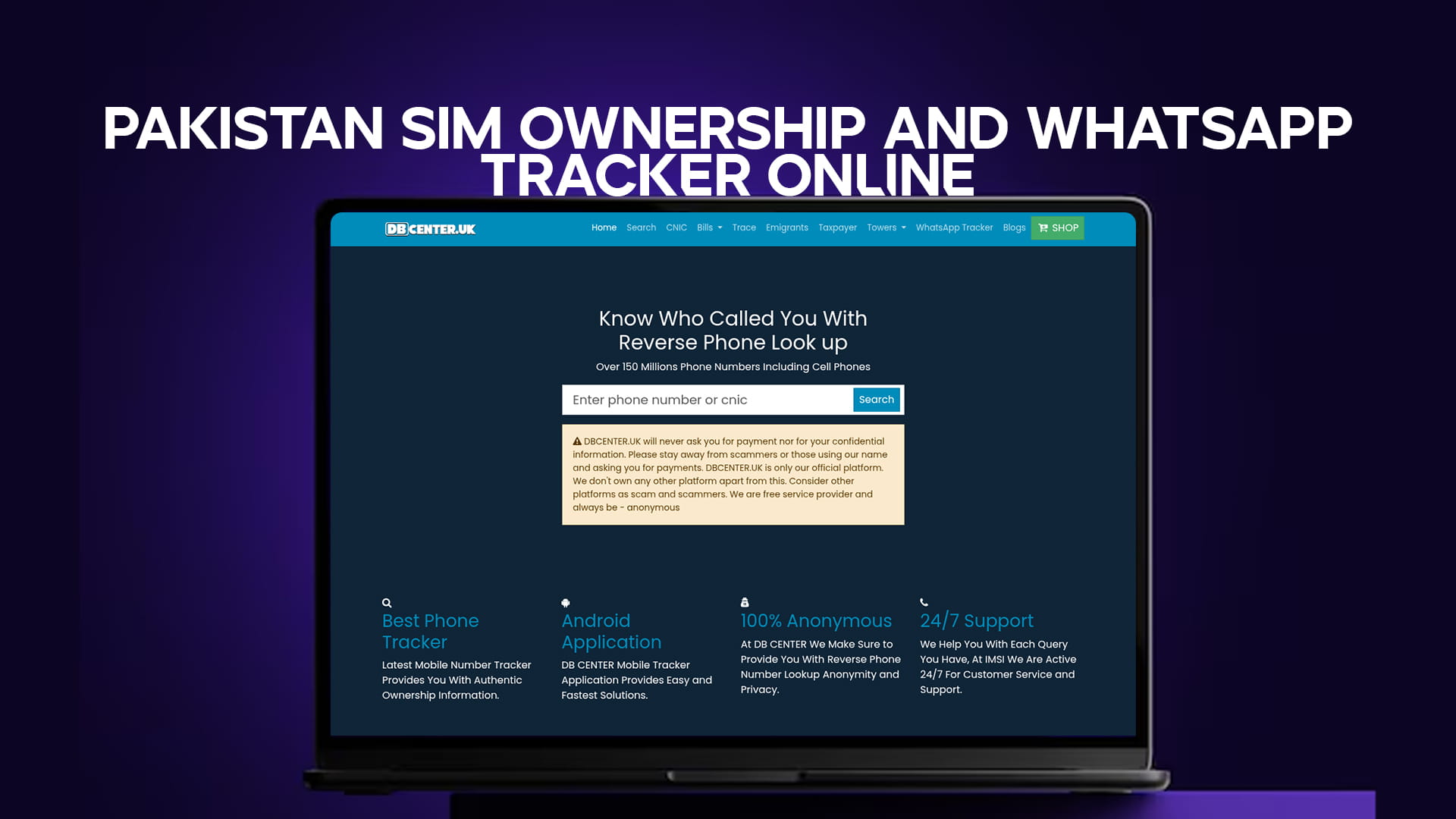
For a long time, answering that question required either knowing the right people or going through formal channels that most individuals would never bother with. Today, that has changed. Online reverse phone lookup tools — particularly DB Center has made it possible to verify SIM ownership, check the background of a WhatsApp number, and find out who has been calling you, all from your phone in under a minute.
This article covers how Pakistan SIM ownership checking and WhatsApp number verification actually works, why the need for these tools has grown so dramatically, and how DB Center's database of over 150 million phone numbers gives Pakistani users one of the most reliable ways to look up unknown numbers online.
The Scale of Pakistan's Mobile Communication Landscape
To understand why SIM ownership verification matters so much in Pakistan, start with scale.
Pakistan has well over 190 million mobile subscribers. The country runs on mobile communication in a way that makes many Western countries look comparatively old-fashioned. People use mobile numbers not just to call and text but to manage banking, run businesses, apply for government services, receive salaries, and maintain their entire social network. WhatsApp, in particular, has become the default communication channel for everything from family groups to business negotiations.
That level of mobile dependence creates opportunity on both ends. For legitimate users, it means unparalleled access and convenience. For fraudsters, it means a massive pool of potential targets who trust mobile communication deeply and use it constantly.
The numbers reflect this reality. Phone-based fraud, scam calls, WhatsApp impersonation, and SIM-related identity theft have all increased significantly in recent years. PTA and the Federal Investigation Agency (FIA) regularly issue warnings about new fraud schemes spreading through mobile networks. The response from ordinary citizens has been a growing demand for tools that let them verify numbers quickly and independently.
DB Center is one of those tools. It gives users access to a database of over 150 million phone numbers — including cell phones — and makes the process of reverse lookup fast, simple, and accessible to anyone with an internet connection.
What SIM Ownership Verification Actually Involves
SIM ownership verification means confirming who a specific mobile number is registered to. In Pakistan, this is directly tied to the CNIC system.
When a SIM card is sold, the seller is legally required under PTA regulations to register it against the buyer's Computerized National Identity Card. This 13-digit national ID number becomes the official link between the person and the SIM. Every active SIM in Pakistan should — in theory — be traceable to a specific individual through their CNIC.
The practical implication is that if you can verify a SIM's registration, you can confirm the identity behind it. For the general public, PTA provides a basic version of this service: you can check what SIMs are registered against your own CNIC by sending a message to 668. If the list includes numbers you did not register yourself, that is a sign someone has used your identity without permission.
For broader lookup purposes — finding out who owns a number you received a call from, checking the background of a mobile number given to you by a business contact, or verifying whether a WhatsApp account belongs to who it claims to — platforms like DB Center become the practical tool of choice. By searching a number through DB Center's reverse lookup database, you can access publicly available information and community-reported data that helps build a picture of who that number belongs to and how it has been used.
WhatsApp Number Verification in Pakistan
WhatsApp occupies an unusual position in Pakistan's communication ecosystem. It is simultaneously the most trusted and the most abused platform.
People trust it because everyone they know uses it. Family conversations, business deals, school groups, customer service — WhatsApp handles all of it. That trust is exactly what fraudsters exploit.
A WhatsApp account requires nothing more than a working mobile number. Once a SIM is obtained — legitimately or fraudulently — a WhatsApp account can be created in minutes. The account can then be dressed up with a convincing name, a stolen profile photo, and a believable backstory. From the outside, it looks exactly like a genuine contact.
This is why WhatsApp number verification has become an important part of digital self-defense in Pakistan.
Verifying whether a number is active on WhatsApp is the first step. Within WhatsApp itself, you can add a number to your contacts and see whether a profile loads. An account with no profile photo, no "last seen" data, and a recently created feel is worth treating cautiously.
Cross-referencing the number through a reverse lookup is the more useful step. When you search a WhatsApp number on DB Center, you are checking it against a database that includes far more than what WhatsApp's own interface shows. You might find that the number has been reported by other users as a scam contact, or that it is linked to a name that does not match what the person told you. Either way, you have more information than you would have had otherwise.
Checking for community reports is the third layer. DB Center aggregates reports from users who have previously interacted with specific numbers. A number that has been flagged multiple times for WhatsApp fraud, unsolicited messages, or phishing attempts will carry those reports when you search it. That crowd-sourced signal is often the most timely and relevant piece of information available.
Common WhatsApp Scams Targeting Pakistani Users
Understanding the specific fraud tactics in circulation helps you recognize them faster when they appear.
The family emergency scam is one of the oldest and most effective. A message arrives from an unknown number claiming to be a relative in trouble — stuck abroad, involved in an accident, or in legal difficulty. The message asks for an urgent money transfer before you can verify anything. The sender often explains why you should not try their real number ("my phone was stolen" or "I'm using a borrowed phone").
The job offer scam targets people actively looking for work. A WhatsApp message arrives offering remote work with an unusually high salary. The conversation progresses through several stages, building trust, before the victim is asked to pay a registration fee, training cost, or equipment deposit. The job never materializes.
The banking impersonation scam involves someone posing as a representative of your bank or mobile banking service. They claim your account has suspicious activity or needs verification. They ask you to share an OTP, your card number, or account password "to secure your account." Any real bank will never ask for this over WhatsApp.
The prize or lottery scam tells you that your number was selected in a draw run by a telecom company, a major retailer, or a government program. To claim your prize, you need to pay a small processing fee or provide your bank details. Neither the prize nor the organization is real.
Investment group scams involve being added to a WhatsApp group where members post screenshots of profits and encourage others to invest. Admins are sophisticated and patient, sometimes running the group for weeks before asking for money. By the time most victims realize what happened, the group has been deleted.
Each of these schemes depends on the victim trusting the number. Spending thirty seconds on DB Center before engaging with an unknown number can break that trust before it leads anywhere harmful.
How Fraudsters Obtain SIMs Illegally in Pakistan
Knowing how fraudulent SIMs are created helps explain why verification tools are necessary rather than just convenient.
The most common method involves using someone else's CNIC without their knowledge. Copies of identity cards circulate through businesses, rental agreements, hotel check-ins, and photocopying shops more freely than most people realize. A fraudster with a photocopy of your CNIC can, in certain circumstances, use it to register a SIM at an unscrupulous franchise or through an agent who skips proper verification.
Some SIMs are also obtained through biometric fraud, where fingerprints are captured without consent or bypassed through technical means — though this is more difficult since PTA strengthened biometric requirements.
Stolen or lost phones that still have active SIMs are another source. If a SIM is not immediately blocked after a phone goes missing, it can be removed and placed in a new device where it is used to create WhatsApp accounts and carry out fraud before the original owner even notices.
In each scenario, the fraudster ends up with a functional SIM linked to someone else's identity — which is why regular self-checks through the PTA 668 service matter, and why reverse lookup tools that can identify suspicious or newly flagged numbers are a valuable safeguard.
What DB Center Shows When You Look Up a Pakistan Number
When you search a Pakistani phone number on DB Center, the results depend on what the database holds for that specific number. Here is what you can typically expect to find.
Carrier and network information tells you which telecom operator the number belongs to — Jazz, Telenor, Ufone, Zong, or SCOM. This alone can sometimes be informative. If someone claims to be calling from a specific region or organization but the carrier does not match that geography, it is worth noting.
Name and registration data appears when the number is associated with a publicly available record or has been submitted through community reporting. Not every number has this, but a significant portion of DB Center's 150 million+ records do carry name-level data.
Community reports are submitted by users who have received calls or messages from a number and want to document their experience. These reports are among the most useful outputs because they reflect real interactions. A number reported five times for phishing attempts carries a very different risk profile than a number with no history at all.
Spam or scam flags appear when a number has been marked by multiple users as suspicious, fraudulent, or belonging to a telecom marketing campaign. These flags aggregate automatically as reports come in and provide a quick visual signal about how safe a number is to engage with.
The combination of database records and community data makes DB Center more useful than tools that rely on only one source. Official records miss recent fraudulent numbers. Community reports fill that gap in near real time.
The Legal Side of Phone Number Verification in Pakistan
Some people worry about whether using lookup tools crosses a legal line. The short answer is that checking publicly available information about a phone number is entirely legal and is something PTA actively encourages for consumer protection.
Pakistan's telecom regulations are designed to make numbers accountable — to connect every SIM to a real identity — precisely so that citizens and authorities can verify ownership when needed. Using a reverse lookup tool to identify who called you or to verify a number someone gave you is consistent with that framework.
What is not legal — and what no reputable platform offers — is tracking someone's physical location through their SIM without their consent or legal authorization. Real-time GPS tracking of a person via their phone number requires law enforcement involvement and judicial oversight. Any website claiming to offer this service to ordinary users is either lying about what it does or operating outside the law.
DB Center does not offer location tracking. It offers identification and verification — the ability to match a phone number to publicly available information about its owner and history. That is the appropriate scope for a consumer tool, and it is where genuine utility lies.
Building a Personal Verification Habit
The most effective use of tools like DB Center is not just pulling them out when something already feels suspicious. It is making verification a default reflex for any unknown communication.
Think of how people approach email. Most people now automatically treat unexpected emails from unknown senders with some skepticism — they check the sender address, hover over links before clicking, and do not enter passwords in response to a message they did not request. That habit took years to develop, but now it is automatic for millions of people and has genuinely reduced the effectiveness of email phishing.
The same habit can apply to phone-based communication. When an unknown number calls or messages you on WhatsApp, check it before engaging. It takes thirty seconds. You type the number into DB Center, look at what comes up, and make an informed decision. If the number is clean, you can respond with confidence. If it has been flagged or carries no legitimate history, you have saved yourself from a potentially costly mistake.
Over time, this habit also improves the tool itself. Every report you submit about a number you found suspicious adds to the community database. The next person who receives a call from that same number benefits from your report. This is how reverse lookup tools become more accurate and more current — through the shared experience of their users.
Why DB Center Outperforms Generic Lookup Tools for Pakistani Numbers
Most globally available reverse phone lookup services were built for North American markets. Their infrastructure, their data partnerships, and their databases reflect that focus. When you search a Pakistani mobile number on many of these platforms, you get little to nothing back.
DB Center is different in a way that matters directly for Pakistani users. Its database of over 150 million numbers includes strong coverage of South Asian mobile numbers, particularly Pakistani numbers across all major networks. That depth means searches actually return useful results rather than blank pages.
The platform is also optimized for mobile browsing, which is significant in a country where smartphones are the primary — and often only — internet device for most people. You can run a lookup quickly and clearly on a standard Android phone with a typical mobile data connection, without needing a desktop browser or a high-speed connection.
The community reporting feature works at scale precisely because DB Center has a large enough user base that scam numbers accumulate reports quickly. A fraudulent WhatsApp number used in a Pakistan-based scam campaign will be encountered by hundreds or thousands of people. When those people report it, the database reflects that activity in near real time — which is far more useful than records that are updated monthly or annually.
Practical Steps for Verifying a Number in Pakistan
Pulling everything together, here is a straightforward approach to verifying any unknown number you encounter.
Start with the PTA 668 service if the concern involves your own CNIC. Send a blank SMS to 668 from any mobile number to receive a list of all SIMs currently registered against your identity card. If the list contains numbers you did not activate, report them immediately to the relevant network and to PTA's consumer helpline.
For unknown callers or WhatsApp contacts, go directly to DB Center. Enter the full number including country code (+92 for Pakistan), run the search, and review the results. Pay particular attention to community reports and any spam or fraud flags.
If the number carries red flags or no verifiable history, do not engage further without confirming through an independent channel. For someone claiming to be a known contact, call their known number directly. For someone claiming to represent an organization, find that organization's official contact details independently and call them yourself.
Finally, report the number if you believe it is fraudulent. Your report helps every other person who encounters that number after you.
Final Thoughts
SIM ownership verification and WhatsApp number checking have become practical necessities for ordinary people in Pakistan. The mobile landscape is rich with genuine connections and real opportunity, but it also carries real risks from fraudsters who exploit the same channels.
DB Center gives Pakistani users a fast, reliable, and accessible way to check who is behind an unknown number. With over 150 million phone numbers in its database, community-driven reports, and strong coverage of Pakistani mobile numbers, it is one of the most capable tools available for this purpose.
Verification takes thirty seconds. The information it provides can prevent a fraud that takes weeks to recover from. That trade-off makes checking unknown numbers not just a good idea, but a habit worth keeping.