Pakistan's mobile landscape in 2026 looks very different from what it was even five years ago. There are now close to 200 million active SIM connections in the country. That is nearly one SIM per person for the entire population — and in many households, a single person owns two or three numbers across different networks.
With that volume of numbers in active use, the question of who owns a particular number comes up constantly. It comes up when a stranger calls repeatedly from an unrecognized number. It comes up when a buyer or seller contacts you through a number you cannot trace. It comes up when someone is being harassed or threatened, and the victim wants to know who is behind the calls.
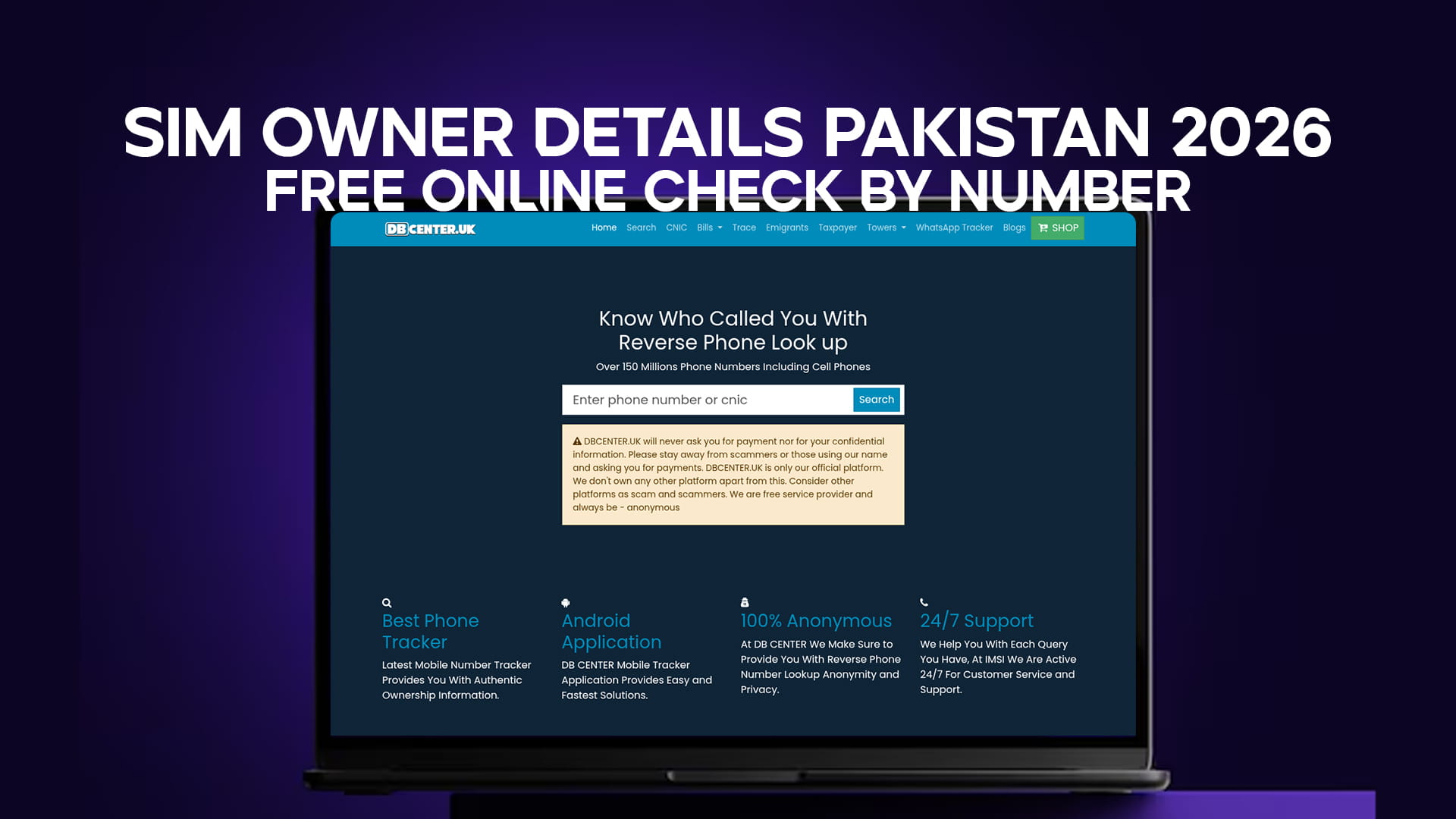
In 2026, checking SIM owner details in Pakistan online has become faster, more accessible, and more accurate than ever before. Platforms like DB Center now maintain databases of over 150 million phone numbers — including cell phones — making it possible to identify the owner of almost any Pakistani number within seconds, without paying anything.
This article walks you through everything about how SIM ownership works in Pakistan today, what information is accessible to the public, how to run a free check by number, and what to do with the information once you have it.
The State of Pakistan's Mobile Sector in 2026
Before getting into how to check a number, it helps to understand how the mobile sector in Pakistan actually works right now.
The Pakistan Telecommunication Authority (PTA) is the regulatory body that oversees all licensed telecom operators in the country. As of 2026, the five major operators are Jazz, Telenor, Zong, Ufone, and SCO. Each of these networks operates under PTA's licensing terms, which include strict rules about SIM registration and identity verification.
Since 2015, every SIM sold in Pakistan must be registered using biometric verification. The person buying a SIM places their finger on a scanner at the point of sale, and the system checks the biometric data against NADRA's national identity database in real time. If there is no CNIC match, no SIM is issued. This process has meant that millions of unregistered or ghost SIMs that used to exist on the network were deactivated, and the remaining SIMs are all tied to real, verified identities.
In 2026, this biometric link remains the foundation of SIM ownership records in Pakistan. Every number that is active on a Pakistani network — whether Jazz, Zong, Telenor, Ufone, or SCO — is connected to a CNIC holder whose identity has been verified by NADRA.
That connection between a SIM and a CNIC is what makes free SIM owner checks possible through platforms like DB Center.
Why Checking SIM Owner Details Still Matters in 2026
You might wonder: if every SIM in Pakistan is registered, why do people still need a third-party tool to check ownership? Why can't you just call the operator and ask?
The short answer is that telecom operators do not hand out customer information over the phone or online. They have privacy obligations. You cannot call Jazz or Zong and say "tell me who owns this number." They will not tell you, and they should not.
This is where reverse phone lookup platforms fill the gap. They aggregate publicly available records, user-submitted reports, and verified data to give ordinary users the ability to identify unknown callers without involving the operator directly.
Here are the situations in 2026 where checking SIM owner details is most relevant:
Persistent unknown calls. An unrecognized number keeps calling. You do not know whether to pick up, call back, or block it. A quick lookup tells you whether it is a business, an individual you know under a different number, or a flagged nuisance caller.
Telephone fraud and scams. Fraud calls remain a serious problem in Pakistan. Fake bank representatives, fake prize offers, fake government officials — scammers call millions of Pakistanis every year. Knowing who owns a suspicious number before engaging can prevent financial loss.
Online marketplace transactions. Buying and selling through WhatsApp groups and online classifieds is common across Pakistan. Before transferring money to a seller you have only spoken to by phone, verifying that their number is linked to the name they gave you is basic due diligence.
Harassment and threatening calls. When someone receives threats or persistent unwanted calls, identifying the number owner is often the first step before filing a complaint with the police or the PTA.
Employer and tenant verification. Businesses and landlords sometimes use reverse phone lookup to verify that a contact's phone number matches the name and identity they provided.
All of these are real, everyday situations. DB Center addresses all of them through a straightforward free search.
How Reverse Phone Lookup Works
Reverse phone lookup is the process of entering a phone number and receiving information about the person or entity associated with it. The name comes from the fact that you are working in reverse — instead of searching for a name to find a number, you are searching a number to find a name.
Here is how DB Center handles this process for Pakistani numbers specifically.
Data Collection DB Center's database is built from multiple sources. Public records form one layer — these include business registrations, directory listings, and other publicly filed information. User contributions form another layer — when people report or identify numbers through the platform, that information is added to the database. Verified data partnerships and telecom record aggregation form the third layer.
The result is a database of over 150 million phone numbers with varying levels of detail. For Pakistani numbers, the SIM registration system means there is a solid foundation of verified identity data to draw from.
Search Processing When you enter a number on DB Center, the platform runs a search across its entire database in real time. It cross-references the number against all available records and assembles the results into a readable output in just a few seconds.
Result Display The results you see reflect whatever data the platform has for that number. This can range from a full profile — name, CNIC, network, city, and caller reports — to partial results, such as only the network and region. The depth of the result depends entirely on how much verified information is available for that specific number.
How to Check SIM Owner Details in Pakistan — Free and Online
The process for checking a Pakistani number on DB Center is simple enough that anyone with a smartphone can do it. Here is the full step-by-step breakdown.
Step 1: Open DB Center on Your Browser
DB Center works on any browser — Chrome, Firefox, Safari, or the built-in browser on your Android or iPhone. You do not need to install any app. Just open your browser and go to the platform.
Step 2: Type the Number in the Search Bar
The search bar is on the homepage. Type the number you want to check. Pakistani numbers can be entered in several formats:
- 11-digit format: 03001234567
- With country code: +923001234567
- With dashes: 0300-1234567
DB Center accepts all standard formats. You do not need to worry about formatting it in a specific way.
Step 3: Hit Search
Press the search button or hit Enter. The system begins checking the number against its database immediately.
Step 4: Review the Results
Within a few seconds, the results page loads. Here is what you might see:
- The registered owner's full name
- The CNIC number linked to that SIM
- The mobile operator (Jazz, Telenor, Zong, Ufone, or SCO)
- The city or region of registration
- Community-submitted reports, including any fraud or spam flags
Step 5: Take Action Based on What You Found
Once you have the information, you decide what to do next. The platform gives you the data — what you do with it is up to you.
What Information Appears in a SIM Owner Search Result
Not every search returns the same level of detail. Here is a breakdown of what each piece of information means and why it matters.
Registered Name This is the name associated with the CNIC used to register the SIM. It comes directly from NADRA's identity records. If someone registered the SIM under their real name, this is accurate. If they used someone else's CNIC (which does happen), the name belongs to whoever holds that CNIC, not necessarily the person using the phone.
CNIC Number The 13-digit national identity number is the most powerful piece of information a SIM lookup can return. If you have the name and CNIC, you have the formal, government-verified identity of the SIM holder. This is information that can be used to file a formal complaint with law enforcement or the PTA if needed.
Network Operator Knowing whether a number is on Jazz, Telenor, Zong, Ufone, or SCO helps you understand a few things. For practical purposes, it tells you whether calling that number from your own network will incur extra charges. For investigative purposes, the operator is the entity that holds the full registration records and can be approached by law enforcement with a formal request.
City and Region The location of registration tells you where the SIM was originally activated. This can help narrow down who the caller might be, especially if combined with other context.
User Reports and Community Flags This is one of the most practical features on DB Center. Users from across Pakistan submit reports about numbers they have encountered. If a number has been flagged as a fraud line, a telemarketer, a scammer, or a harasser by multiple users, those flags appear prominently in the results. This community layer of data is often more current than static records because it updates in real time as people submit new reports.
Understanding Pakistan's Biometric SIM Verification System
Pakistan's SIM registration system is worth understanding in more depth, because it is the reason reverse lookup works as reliably as it does.
Before 2015, Pakistan had a massive problem with unregistered SIMs. These were SIMs sold without identity verification, making them essentially anonymous. They were used heavily in criminal activity — kidnappings, extortion, terrorism — because they could not be traced. The government and PTA launched a sweeping biometric verification campaign that gave all existing SIM holders a deadline to verify or lose their number.
Tens of millions of SIMs were deactivated during this period. What remained were only those SIMs that had been verified against a CNIC through the biometric system. From that point forward, every new SIM sold in Pakistan has required biometric verification at the point of sale.
By 2026, this system has been in place for over a decade. The result is a mobile network where essentially every active number is tied to a real, verified identity. This is one of the most comprehensive SIM registration regimes anywhere in the world.
NADRA manages the underlying identity database. The telecom operators connect to NADRA's verification API at the point of sale. The PTA maintains oversight of the entire process. When a number appears in DB Center's search results with a name and CNIC, that information ultimately traces back to this government-run biometric system.
Checking Multiple SIMs Registered on One CNIC
One of the questions people in Pakistan ask regularly is: how many SIMs are registered on my CNIC? This is a genuinely important question because SIM fraud — where someone registers multiple SIMs using another person's CNIC — does happen.
The PTA allows you to check this directly. Send your 13-digit CNIC number as an SMS to 668 from any mobile phone in Pakistan. You will receive a reply listing all the SIM numbers currently registered against your identity. If you see numbers you did not register yourself, that is a red flag. Report it immediately to the operator and the PTA.
DB Center complements this by allowing you to search individual numbers to see what name and CNIC they are registered under. If someone has registered a SIM using your CNIC and then used that number for bad purposes, you want to know about it and disconnect it before you are implicated.
Pakistan's Most Common Phone Scams in 2026 and How to Spot Them
Phone scams evolve, but the basic patterns stay consistent. Here are the types of fraud calls that remain prevalent in Pakistan in 2026 and how a reverse lookup helps you handle them.
The Bank OTP Scam A caller claims to be from your bank's fraud department and says your account has been compromised. They ask you to confirm your OTP to "secure" the account. The OTP is what gives them access. Before engaging with any caller claiming to be from your bank, search the number they called from. If it does not match the official bank helpline number and has fraud reports, hang up.
The Prize or Lottery Scam "You have won 5 lakh rupees in a lucky draw. Please send a 2,000 rupee processing fee to claim your prize." This scam has been running in Pakistan for decades and still catches new victims every year. A DB Center search on the calling number usually reveals multiple fraud reports from other users.
The Fake PTA Warning A caller identifies as a PTA officer and threatens to block your SIM for suspicious activity. They ask you to press a number or provide your CNIC to avoid the block. PTA does not make outbound calls to individual users about SIM blocking. Any such call is a scam. Look up the number to confirm.
The Investment Scam A caller offers you a high-return investment opportunity — usually in cryptocurrency or real estate — and asks for an upfront transfer. They build trust over multiple calls before asking for money. If the calling number has no verifiable identity on DB Center, treat it as suspicious.
The Impersonation Scam A caller claims to be a friend or relative in an emergency and asks for money urgently. Always verify by calling your actual friend or relative back on a number you already have saved. Then search the original number that called you to see who it actually belongs to.
What to Do After Identifying a Scam or Fraud Number
If a DB Center search confirms that a number is fraudulent or has been widely reported as a scam line, here is what to do next.
Block the number immediately. Every major smartphone now has a built-in block feature. Use it. On Android, long-press the call in your recent calls list and select "Block." On iPhone, go to the contact and scroll to "Block this Caller."
Report it to your operator. Jazz, Telenor, Zong, and Ufone all have complaint mechanisms. You can call their helplines and report a fraud number. The operator can flag it internally and in serious cases can suspend the number.
Report to PTA. The PTA has a complaint portal at complaints.pta.gov.pk. For serious cases involving threats, financial fraud, or harassment, submit a formal complaint there. PTA can direct the operator to take action and can escalate to FIA (Federal Investigation Agency) if needed.
File a police report if necessary. If you have suffered financial loss or have received threats, a police FIR is the appropriate step. The name and CNIC information from a DB Center lookup gives you something concrete to include in your complaint.
Submit the number to DB Center. By reporting what you experienced to the platform, you help protect the next person who searches that number. Community reporting is how the platform stays current and useful for everyone.
Why DB Center Is Worth Using in 2026
Pakistan has a few options for reverse phone lookup, but they are not all equal. DB Center's combination of database size, verification quality, and community reporting makes it one of the strongest options available for Pakistani users.
The 150 million number database is not just a round figure used for marketing. It reflects years of data aggregation across global and regional sources. For Pakistani numbers specifically, the biometric SIM registration data means there is a high hit rate on searches — most numbers return at least some useful information.
The platform does not require an account for basic searches. Many similar services put the most useful information behind a subscription wall. DB Center keeps the core lookup free and accessible, which matters in a country where the people most at risk of phone fraud are often not in a position to pay for protection tools.
Updates through community reporting mean the data is live, not static. A phone number that gets used in a new scam campaign today can be flagged and visible to searchers within hours. No static database can match that speed.
The interface works on low-end smartphones and slower internet connections — a practical consideration given that internet access in many parts of Pakistan is still limited to 3G speeds.
Tips for Staying Safe From Unknown Numbers in Pakistan
Looking up numbers after the fact is reactive. Here are some habits that help you stay ahead of unknown callers.
Save numbers carefully. Every time you deal with a business, service provider, or government office, save their contact number immediately. This reduces the chance of missing a legitimate call from a number you do not recognize.
Do not share your number publicly. On WhatsApp groups, social media, and online classifieds, limit how broadly you post your personal number. Once it is out, you have no control over where it ends up.
Check your CNIC SIM registration regularly. Send your CNIC to 668 every few months and verify the SIMs listed. If something new appears that you did not register, act on it quickly.
Use DB Center as your first response. Any time an unknown number calls and you feel uncertain, make searching it on DB Center your default first step before calling back or engaging.
Educate older family members. Scam callers in Pakistan specifically target older people who are less familiar with how these fraud attempts work. Showing them how to look up a number before they engage can genuinely prevent financial harm.
Conclusion
Checking SIM owner details in Pakistan in 2026 has never been easier or more reliable. The biometric registration system that has been in place since 2015 means every active SIM on Pakistan's networks is linked to a verified identity — and tools like DB Center make that identity information accessible to anyone who needs it.
Whether you are trying to identify a missed call, verify a contact, protect yourself from a scammer, or trace a threatening caller, the process is the same: open DB Center, enter the number, and read the results. It takes under a minute and costs nothing for a standard search.
Pakistan's mobile network has grown to nearly 200 million connections. The people behind most of those numbers are honest, ordinary users. But among them are scammers, fraudsters, and harassers who count on you not knowing who they are. A free reverse phone lookup takes that advantage away from them.
The next time an unknown number calls, you know exactly what to do.