Your phone buzzes. A number you do not recognize. You wait, the call ends, and seconds later a WhatsApp message arrives from the same number. It could be a delivery rider, a new colleague, or someone from a school group you forgot about. It could also be a scammer who has spent the last week calling different numbers looking for someone willing to talk.
The frustrating part is that both possibilities feel the same from the outside. The number looks like any other Pakistani mobile number. There is no obvious sign telling you which category it belongs to.
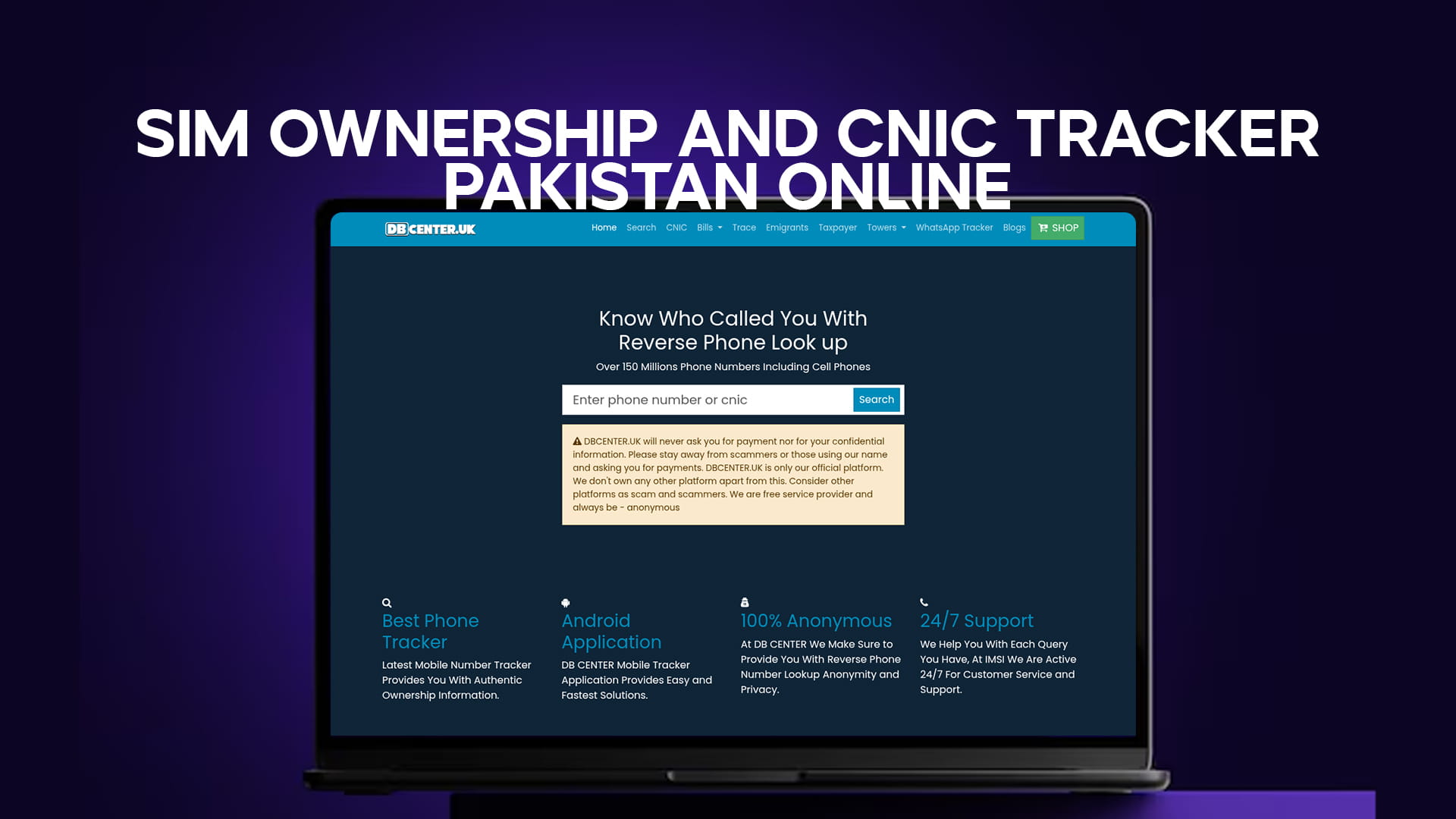
That is the gap that SIM ownership verification and CNIC-linked lookup tools are designed to fill. By searching a number through a platform like DB Center — which maintains a reverse phone lookup database of over 150 million numbers including cell phones — you can move from uncertainty to informed decision in under a minute. No guessing. No unnecessary risk. Just the information that is publicly available about that number and what other people have reported about it.
This article covers everything you need to know about SIM ownership and CNIC tracking in Pakistan: how the system works, why it matters, what tools are available, and how to use them responsibly to protect yourself and the people around you.
The Foundation: How SIM Registration Works in Pakistan
To understand why SIM ownership verification is useful, you first need to understand how SIM registration is supposed to work in Pakistan.
Pakistan's telecom regulator, the Pakistan Telecommunication Authority, requires that every SIM card sold in the country be registered against the buyer's CNIC — Computerized National Identity Card. This is a 13-digit unique number issued by NADRA to every adult Pakistani citizen. The registration process involves biometric verification at the point of sale, meaning the buyer's fingerprint is supposed to confirm their identity before the SIM is activated.
This system was introduced to bring accountability to mobile communication. Before biometric SIM registration, anonymous SIMs were easy to obtain and widely used in criminal activity, harassment, and fraud. The shift to CNIC-linked registration was meant to ensure that every active mobile number could be traced to a real, identifiable individual.
The system has significantly improved the landscape. The majority of active SIMs in Pakistan today are legitimately registered. However, problems persist. Fraudulent registrations still happen through biometric spoofing, misuse of photocopied identity documents, and corrupt agents who bypass verification requirements. The result is a situation where most SIMs are legitimate but a meaningful minority are not — and from the outside, there is no obvious difference.
This is precisely what makes SIM ownership lookup valuable. The ability to check a number against available records and community-reported data gives ordinary citizens a tool to identify the legitimate ones from the questionable ones before they engage.
What CNIC-Linked Information Reveals About a Phone Number
When a SIM is registered against a CNIC, the association between that number and the identity card becomes part of the record. For the owner of the CNIC, this is primarily a security concern. If someone registers a SIM under your CNIC without your permission, that number becomes your legal responsibility until you discover and report the unauthorized registration.
For someone receiving a call from an unknown number, the CNIC linkage is relevant in a different way. Knowing that a number is legitimately registered to a real person — as opposed to being registered fraudulently or not at all — changes how you assess the risk of engaging with it.
DB Center draws from multiple publicly available sources to provide information about phone numbers. This includes carrier data, publicly listed records, and community-submitted reports from users who have previously encountered a specific number. When a number is linked to publicly available identity information, that data appears in the lookup results. When it has been reported by multiple users for suspicious activity, those reports surface alongside the basic registration data.
The combination of these sources gives a more complete picture than any single data point could provide on its own. A number that is registered to a legitimate carrier, linked to a real identity in public records, and has never been flagged by other users is very different from a number with no verifiable registration history and three reports filed against it for fraud.
PTA's Own Verification System and Its Limits
Pakistan's PTA offers an official channel for a specific kind of SIM verification. By sending a blank SMS to 668 from any active mobile number, Pakistani citizens receive a complete list of all SIM cards currently registered against their CNIC across all telecom networks. This service is free, fast, and official.
The 668 service is one of the most important tools available for personal identity protection. If someone has used your CNIC to register SIMs without your knowledge, this check reveals it. You can then contact the relevant network operators to block those unauthorized SIMs and file a complaint with PTA.
For the personal protection use case, 668 is the right tool. But its scope is deliberately narrow. It tells you about SIMs registered under your own identity. It does not let you look up who owns a number that called you. It does not tell you whether a number someone gave you as a business contact is legitimate. It does not help you check the background of a WhatsApp contact you are not sure about.
That is where DB Center fills the gap. The two tools work in complementary ways. PTA's 668 service protects your own CNIC registration. DB Center's reverse lookup lets you check any number you encounter, from any source, against a database of over 150 million records and the accumulated reports of its user community.
Used together, they cover the most important aspects of SIM and number verification that matter to ordinary Pakistani users.
Why SIM Fraud Is Still a Problem Despite Biometric Registration
A common misconception is that biometric SIM registration has solved the problem of fraudulent numbers in Pakistan. The reality is more complicated.
Biometric verification made fraudulent registration significantly harder than it used to be. It did not make it impossible. Several pathways remain through which illegitimate SIMs continue to enter circulation.
Photocopied identity documents remain a vulnerability. Copies of CNICs change hands during hotel check-ins, property rentals, job applications, photocopying shops, and dozens of other routine transactions. In some cases, these copies are used by unscrupulous agents who register SIMs using the copied CNIC details while finding ways to bypass or falsify the biometric requirement.
Compromised biometric data is a more technical problem that security researchers have documented in various contexts. Fingerprint data, once captured through illicit means, can potentially be used to falsify verification.
Stolen or found phones are a simpler route. A phone that still has its SIM active after being stolen or lost can be used to create WhatsApp accounts, access linked services, and conduct fraud before the original owner realizes what is happening and takes steps to block the number.
Registered SIMs sold informally represent another route. Some people register SIMs legitimately and then sell them through informal markets, effectively transferring a CNIC-linked number to a different user without any official record of the change.
Each of these pathways creates numbers that may appear in lookup results as registered SIMs — because they are — but whose actual users are not the legitimate CNIC holder. Community reports from other users who have encountered these numbers are often the most timely indicator that something is wrong, which is why the crowd-sourced component of DB Center's database is so valuable.
Real Scenarios Where SIM and CNIC Lookup Makes a Difference
It helps to anchor these concepts in real situations that Pakistani users encounter regularly.
The business contact you cannot quite verify. Someone contacts you about a potential deal. They provide a mobile number as their contact. Before moving forward, you look up the number on DB Center. The results show a carrier registration consistent with the region they claim to be from, no fraud reports, and a name that matches what they told you. You proceed with more confidence. Alternatively, the lookup shows multiple fraud reports filed by other users in the past month. You ask more questions before agreeing to anything.
The repeated unknown caller. A number calls you several times over a few days without leaving a message. You look it up on DB Center. The results show it has been reported by dozens of other users as an insurance scam operation. You block it immediately and do not call back.
The WhatsApp account claiming to be someone you know. A message arrives from an unknown number claiming to be a colleague who has changed their number. You look up the number. No record matches the identity being claimed, and the number was recently registered. You contact your colleague through their known number and confirm they never sent any such message.
The elderly parent who received a suspicious call. Your mother received a call from someone claiming to be from her bank, asking for her account details. You look up the number on DB Center and find it has been reported multiple times as a banking impersonation scam. You report the incident to the bank and block the number.
These are not edge cases. They are everyday situations that millions of people in Pakistan navigate. Having a verification tool changes how confidently and safely those situations can be handled.
Understanding the Limits of Online Verification Tools
Responsible use of any lookup tool requires understanding what it can and cannot do.
DB Center returns publicly available information and community-submitted reports. For numbers with rich histories — well-known businesses, frequently reported scam lines, numbers listed in public directories — the results will be detailed and useful. For numbers that are newly registered, rarely searched, or belong to private individuals who have never been reported for anything, the results may be minimal.
Minimal results do not mean a number is suspicious. A clean lookup can simply mean the number has not attracted any particular attention, which is true of the vast majority of legitimate mobile numbers. The absence of fraud reports is not a guarantee of legitimacy, just as the presence of reports is not necessarily proof of guilt — though multiple consistent reports from different users over time are a strong signal.
The tool is most powerful when used as one layer in a broader approach to verification, not as a single definitive source. If a lookup raises concerns, follow up through independent channels. If it comes back clean but something about the interaction still feels wrong, trust that instinct and verify through other means.
What no online tool can provide — and what DB Center does not claim to offer — is real-time location tracking of a SIM. Tracing a person's physical location through their mobile number requires legal authorization, a court order, and cooperation from telecom operators. Any service advertising this capability to ordinary members of the public without those requirements is not offering what it claims. DB Center is honest about its scope: reverse phone identification and verification, backed by a database of over 150 million records.
How to Protect Your CNIC and Your Registered SIMs
Understanding the landscape of SIM fraud naturally raises the question of what you can do to protect yourself proactively.
Check your registered SIMs regularly. The 668 service is free and takes ten seconds. Make it a habit to check your CNIC registrations every few months. If you spot unauthorized SIMs, report them before they can be used to create problems linked to your identity.
Be careful with CNIC photocopies. Write the intended use on every photocopy you hand over. This creates a record and deters misuse. "For hotel check-in dated [date]" on a photocopy is harder to repurpose than a clean, unmarked copy.
Never share OTPs with callers. No legitimate bank, telecom company, or government agency will call you and ask you to read back an OTP. An OTP exists specifically so that only you can use it. Anyone asking for it is trying to take access away from you.
Enable two-step verification on WhatsApp. Go to Settings, Account, Two-Step Verification and set a six-digit PIN. Even if someone gains access to your SIM through a swap, they cannot activate your WhatsApp account without this PIN.
Report suspicious numbers. When you look up a number and find it is a scam, or when a number calls you with suspicious intent, file a report. The report costs you nothing and directly benefits every person who receives a call from that number afterward.
How DB Center Serves Pakistani Users Specifically
Most reverse phone lookup platforms were built with Western markets in mind. Their databases are optimized for North American and European numbers. Search a Pakistani mobile number on many of these platforms and you get nothing back — or results that are clearly not relevant.
DB Center takes a different approach. Its database of over 150 million numbers includes strong coverage of mobile numbers from South Asia, with Pakistani numbers across all major networks represented meaningfully. When you search a number on DB Center, you are far more likely to get a useful result than you would be with a platform designed for a different market.
The mobile-first design also matters in a country where most internet access happens on smartphones. The platform loads cleanly on standard Android devices with typical Pakistani mobile data speeds. A lookup does not require a desktop computer, a fast connection, or any technical knowledge. You type the number, you search, you get results.
And the community reporting system is particularly effective in high-volume markets like Pakistan. Fraud campaigns in Pakistan tend to target large numbers of people simultaneously — the same scam number might call thousands of people in a single day. When even a fraction of those people file reports, the number accumulates flags quickly. By the time the twentieth person searches that number, the first ten reports are already there waiting.
Building Verification Into Everyday Habits
The single most effective way to benefit from SIM ownership lookup and CNIC verification tools is to make using them a habit rather than a reaction.
Most people only think about verification after something has already gone wrong — after a call that turned out to be a scam, after money was sent to a fraudulent account, after personal information was shared with someone who misused it. At that point, the lookup is useful for filing a report and understanding what happened, but the damage is done.
The better habit is checking before engaging. When an unknown number calls, look it up before calling back. When an unknown number messages you on WhatsApp, look it up before responding. When a new business contact gives you a mobile number, look it up before sending any documents or money.
This takes under a minute each time. Over the course of a year, it takes maybe an hour of your time in total. What it potentially prevents is a fraud that could take weeks to recover from financially and even longer to recover from in terms of lost trust.
DB Center makes this habit easy to maintain. The tool is free, fast, accessible on any smartphone, and backed by a database large enough to return useful results for a significant proportion of searches.
Final Thoughts
SIM ownership and CNIC tracking in Pakistan has moved from a capability available only to telecom regulators and law enforcement into something ordinary citizens can do themselves, free of charge, in seconds.
DB Center is at the center of this shift for Pakistani users. With over 150 million phone numbers in its database, community-driven fraud reports, carrier-level data, and strong coverage of Pakistani mobile numbers, it gives anyone who receives an unknown call or message a practical way to find out who is behind it.
The tools are there. The information is available. Checking a number before you engage is no longer complicated or expensive — it is a thirty-second habit that costs nothing and could save you from something that costs a great deal.
The next time an unknown number appears on your screen, you do not have to wonder. Look it up, make an informed decision, and move on with full confidence in whatever you choose to do next.