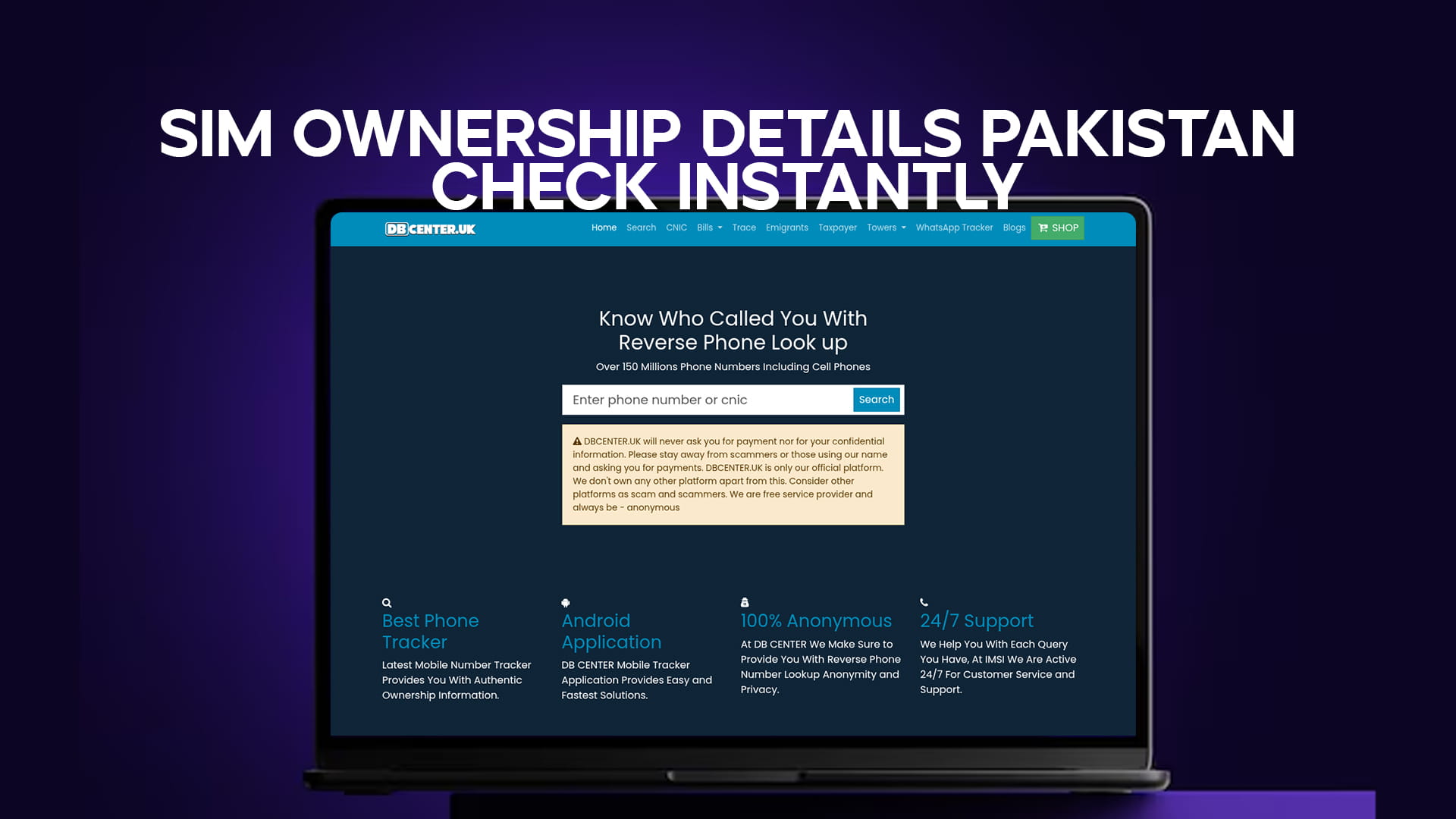
If you have ever received a call from an unknown number and wondered who was on the other end, you are not alone. Millions of people in Pakistan deal with this every single day. Spam calls, harassment calls, fraud attempts — it has become a real problem. Knowing how to check SIM ownership details in Pakistan is one of the most practical things you can do to protect yourself.
This guide covers everything about SIM ownership in Pakistan. How the system works, how you can check SIM details registered on your CNIC, what to do when someone is misusing your identity, and how DB Center can help you identify unknown numbers quickly.
What Is SIM Ownership in Pakistan?
Every SIM card sold in Pakistan is supposed to be registered under a valid CNIC (Computerized National Identity Card). This rule was put in place by the Pakistan Telecommunication Authority, commonly known as PTA. The idea is simple — if every SIM is tied to a real identity, it becomes much harder for criminals to use anonymous numbers for fraud, harassment, or illegal activity.
When you buy a SIM card from any network — Jazz, Telenor, Zong, Ufone, or SCO — the retailer scans your CNIC and biometric data before activating it. Your fingerprint is verified, your CNIC number is logged, and the SIM is registered under your name.
In theory, this means every active SIM in Pakistan has a traceable owner.
In practice, things get a bit more complicated. SIM fraud is common. Some people register SIMs using stolen CNICs or fake biometric data. Others buy already-activated SIMs from the grey market. And a lot of people are completely unaware that multiple SIMs are registered under their name without their knowledge.
Why You Should Check SIM Ownership Details
There are several real reasons why someone in Pakistan needs to check SIM ownership details.
You received a suspicious call. Maybe someone called threatening you, asking for money, or pretending to be from a government agency. Before you panic or respond, it helps to know whether the number is registered under a real identity.
You want to verify your own SIM registrations. Thousands of Pakistanis have found out — sometimes through tax notices or legal trouble — that SIMs were registered under their CNIC without their knowledge. Checking your own registrations regularly is good practice.
Someone is harassing you from an unknown number. Harassment over phone calls and text messages is unfortunately common. Knowing whose number it is gives you the information you need to file a proper complaint.
You lost your phone and want to check if your SIM is being misused. If your phone was stolen, someone could potentially be using your SIM for transactions, calls, or other activity under your name.
In all these situations, having access to SIM ownership information is not just useful — it is necessary.
How to Check SIMs Registered on Your CNIC – PTA Method
The Pakistan Telecommunication Authority has an official system for checking how many SIM cards are registered against any CNIC number. This is one of the most useful services for Pakistani citizens and it is completely free.
Method 1: SMS to 668
This is the quickest way to check SIM registrations on your CNIC.
- Open your messaging app on any mobile phone.
- Type your CNIC number (without dashes). For example: 4210112345678
- Send this SMS to 668.
- Within a few minutes, you will receive a reply listing all SIM cards registered under that CNIC, along with the telecom operator for each one.
This service works across all major networks. You do not need internet access. You do not need to download anything. It is straightforward and accessible to everyone.
Method 2: PTA Website
PTA also has a web portal where you can check SIM ownership details.
- Go to the official PTA website.
- Look for the SIM Information System (SIS) section.
- Enter your CNIC number and complete the verification steps.
- The system will show you a list of all registered SIMs under that CNIC.
The web portal gives slightly more detail compared to the SMS method and is useful if you want a more complete record.
What to Do If You Find Unauthorized SIMs
If the check reveals SIM cards you never registered, take action immediately. You can visit the nearest franchise of the relevant telecom operator and request that the unauthorized SIM be blocked or de-registered. You should also file a complaint with PTA directly at their helpline or through their complaint portal.
Do not ignore unauthorized SIM registrations. They can be used for financial fraud, harassment, and in some cases criminal activity linked back to your identity.
How Many SIMs Can One Person Register in Pakistan?
According to PTA regulations, a single CNIC can have a maximum of 5 SIMs registered across all networks combined. So you could have two Jazz SIMs, one Telenor, one Zong, and one Ufone — but not more than five total.
There is an exception for senior citizens, who are allowed a slightly higher limit under certain conditions.
The limit was introduced specifically to cut down on SIM fraud and bulk registration abuse. Before these limits were enforced, some individuals had hundreds of SIMs registered under a single identity — which were then sold to others or used for fraudulent activity.
Reverse Phone Lookup in Pakistan – Find Out Who Called You
Checking your own SIM registrations through PTA is one thing. But what about when someone calls you from an unknown number and you want to find out who they are?
This is where reverse phone lookup tools come in.
A reverse phone lookup lets you enter a phone number and find out details about who it belongs to. Instead of searching by name to find a number, you do it the other way around — start with the number, find the person.
DB Center is one of the tools built for exactly this. With a database covering over 150 million phone numbers including cell phones, it allows users to run a reverse phone lookup and get useful information about who is behind an unknown number. Whether you received a call from a Pakistani mobile number, a landline, or even an international number showing up on your screen, DB Center can help you check it.
The process is simple. You enter the number in the search field and the system pulls up whatever information is available for that number. This can include the name associated with the number, the telecom carrier, the region, and whether other users have flagged it as spam or suspicious.
For people in Pakistan who regularly deal with unknown or suspicious calls, this kind of tool is genuinely useful. Instead of guessing or ignoring, you can get actual information.
SIM Ownership and Telecom Fraud in Pakistan
Telecom fraud in Pakistan is not a minor issue. According to multiple reports from PTA and consumer protection groups, SIM-related fraud costs Pakistani citizens billions of rupees every year.
The most common types of SIM fraud include:
SIM Swapping. A criminal contacts your mobile network pretending to be you. They convince the network to issue a new SIM with your number and deactivate yours. Once they have your number, they can bypass two-factor authentication on your bank accounts, email, and other platforms.
Ghost SIM Registration. SIMs are registered using stolen or forged CNIC data and then used for illegal activity. The victim only finds out when they are contacted by law enforcement.
Caller ID Spoofing. Someone uses software to make a call appear as if it is coming from a Pakistani number — even a government or bank number — when in reality it is coming from abroad or from a VoIP service.
OTP Fraud. You receive a call claiming to be from your bank asking for a one-time password. This is almost always a scam. Real banks do not ask for OTPs over the phone.
Understanding these methods does not just satisfy curiosity — it helps you recognize when something unusual is happening and respond before real damage is done.
How DB Center Helps With Unknown Numbers in Pakistan
When a suspicious number calls you, the last thing you want to do is call back without knowing anything. DB Center gives you a way to check first.
The platform runs one of the largest reverse phone lookup databases available, with information on over 150 million phone numbers. It covers cell phone numbers, which are often harder to trace than landlines. For Pakistani users, this means you have a real resource for identifying unknown callers rather than relying on guesswork.
Here is what makes DB Center practical for everyday use:
Instant results. You do not wait hours or fill out lengthy forms. Enter the number and get information back quickly.
Wide coverage. The database includes mobile numbers, which account for the vast majority of calls in Pakistan. This is especially relevant given that Pakistan has one of the highest mobile penetration rates in Asia.
User reports. Many reverse lookup tools include community-generated reports where users flag numbers as scam, spam, telemarketer, or harassment. This crowd-sourced layer adds real-world context to the raw data.
No technical skills needed. The interface is built for regular users. You do not need to know anything about telecom systems or data to use it.
For someone who just wants to know if the number that called them three times today is a scammer or a legitimate caller, DB Center does the job without any hassle.
What Information Can You Find Through SIM Ownership Checks?
There is often some confusion about what you can actually find when you check SIM ownership details in Pakistan, so it is worth being clear.
Through the PTA method (SMS to 668), you can find out how many SIMs are registered under a specific CNIC and which network each SIM belongs to. You cannot find the actual phone numbers from this check — only the count and the network.
Through official complaints and legal channels, law enforcement can request detailed SIM registration records from telecom operators, including the exact number, registration date, biometric data used, and retailer information.
Through reverse phone lookup tools like DB Center, you can find publicly available information associated with a phone number. This includes carrier information, geographic data, and in many cases user-submitted reports about that number's activity.
None of these methods are meant for surveillance or tracking individuals without reason. The purpose is consumer protection — giving ordinary people a way to protect themselves from fraud, harassment, and identity misuse.
Reporting Suspicious Numbers in Pakistan
If you confirm that a number is being used for fraud or harassment, you have a few options for reporting it.
PTA Complaint Portal. The Pakistan Telecommunication Authority has an online complaint system where you can report illegal telecom activity, including fraud calls, spam, and harassment. Your complaint can trigger an investigation and potentially lead to the SIM being deactivated.
FIA Cybercrime Wing. For cases involving financial fraud, blackmail, or online crime connected to a phone number, the Federal Investigation Agency's Cybercrime Wing handles reports. You can report through their website or walk into a regional office.
Your Telecom Operator. All major operators — Jazz, Telenor, Zong, Ufone — have fraud and spam reporting mechanisms. Some even have dedicated apps or short codes for reporting suspicious numbers directly.
Marking Numbers on Lookup Platforms. When you use a service like DB Center and identify a number as spam or fraudulent, reporting it on the platform helps others. Reverse lookup databases improve over time when users contribute reports.
Tips to Protect Your SIM and Identity in Pakistan
Prevention is always better than dealing with the aftermath. A few habits go a long way toward protecting your SIM and personal identity.
Check your PTA SIM registrations at least once every few months. It takes less than a minute via SMS to 668 and tells you instantly if anything unusual is registered under your CNIC.
Never share your OTP with anyone over the phone — not with someone claiming to be from your bank, your mobile network, or any government agency.
If you sell or lose your phone, contact your telecom operator immediately to either block or secure your SIM. Your number may be tied to banking apps, email recovery, and social media logins.
Be cautious about giving your CNIC to retailers or individuals you do not fully trust. Some SIM fraud starts with a photocopy of your CNIC falling into the wrong hands.
Use a reverse lookup tool before calling back an unknown number. A quick search on DB Center can tell you whether that number has been flagged by other users as suspicious.
The Bigger Picture — SIM Regulation and Digital Identity in Pakistan
Pakistan's push toward biometric SIM verification was one of the earliest and most aggressive in the region. The 2015 reverification drive required millions of SIM holders to get their SIMs reverified biometrically or face disconnection. Billions of SIMs were deactivated during that process.
Since then, the system has become more robust, but challenges remain. The grey market for SIMs still exists. Identity theft related to CNIC misuse continues to affect citizens. And as mobile banking, ride-hailing, e-commerce, and government services increasingly rely on phone numbers for verification, the stakes around SIM ownership have never been higher.
Your phone number is no longer just a way to make calls. It is tied to your financial accounts, your digital identity, and your legal standing in multiple situations. Treating it with the same seriousness you would treat your CNIC is not an overreaction — it is basic digital safety.
Tools like the PTA SIM check system and reverse lookup services like DB Center exist precisely because ordinary people need accessible ways to manage and verify information in a telecom environment that is both essential and vulnerable.
Final Thoughts
Checking SIM ownership details in Pakistan is not complicated. The PTA system makes it easy to verify what is registered under your own CNIC, and tools like DB Center make it practical to check who is behind an unknown number before you respond to a call or message.
The real issue is awareness. Most people do not know these tools exist until they have already been affected by fraud or harassment. If you are reading this before that happens, take five minutes today to send an SMS to 668 and see what comes back. It is a small step that can prevent a large problem.
And the next time an unknown number calls you at an odd hour asking you to act fast or share personal information — check it first. Knowledge is the first line of defense.