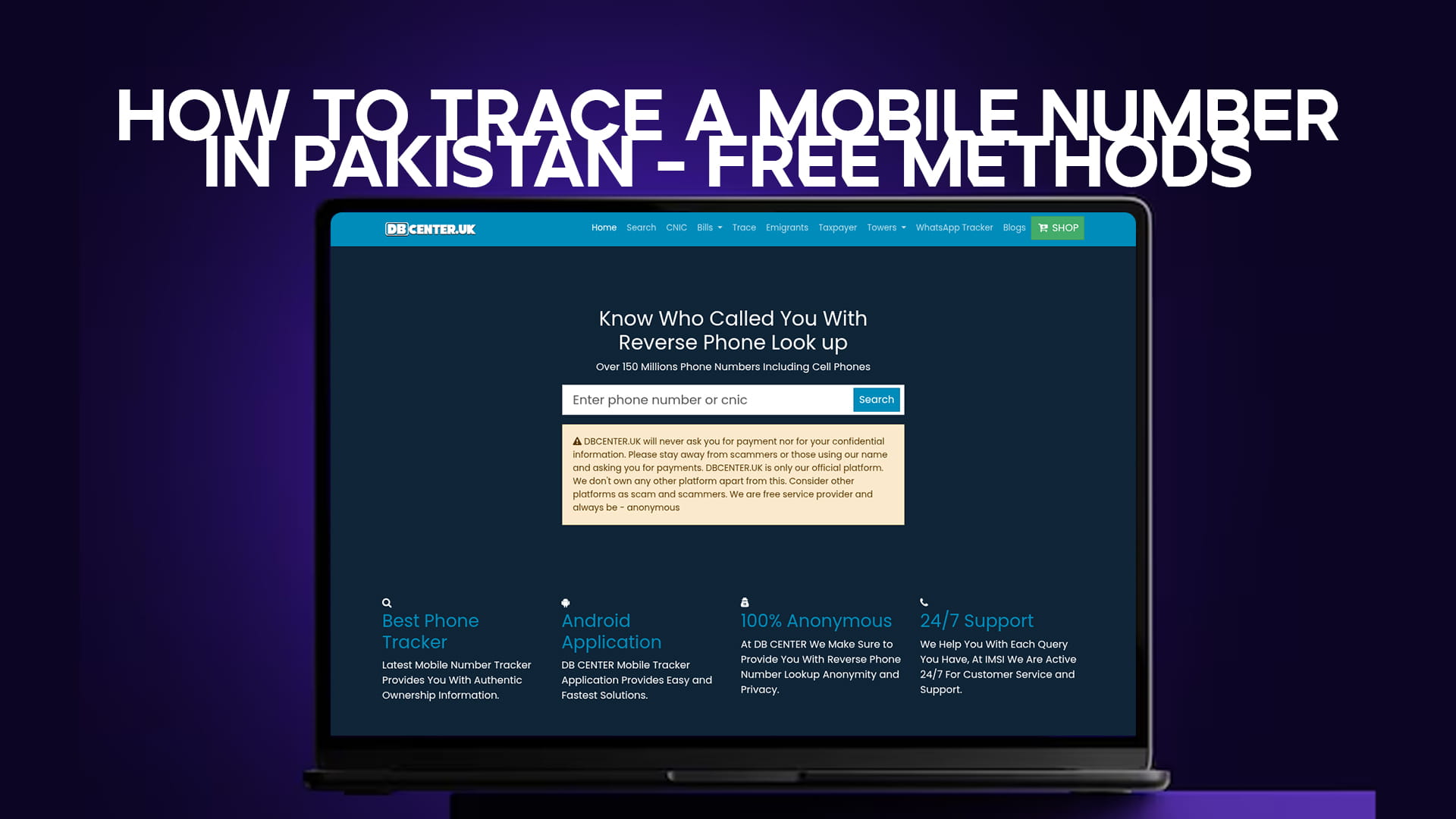
Almost everyone in Pakistan has reached for this search after the same experience: a call from an unknown number, a missed call at an odd hour, a WhatsApp message from someone not in your contacts, or a stream of scam and spam calls that will not stop. The instinct is to find out who is behind the number.
It helps to be clear from the start about what is realistically possible and what is not. Tracing a number, for an ordinary person, mostly means identifying the network and region it belongs to, seeing whether others have flagged it as spam, and — for SIMs registered against your own identity — confirming what is in your name. What it does not mean is pulling up a stranger's full name, home address, and live location from a number alone. That level of detail is held by the telecom operators and the regulator, and access to it is restricted to law enforcement acting through proper legal process. Any free website claiming to hand you a stranger's complete identity and location from a number is either guessing, recycling crowd-sourced labels, or simply lying.
With that framing in place, here are the methods that genuinely work, all free, and the lines you should not cross.
Method 1: Identify the Network and Region from the Prefix
The quickest piece of information sits in the number itself. Pakistani mobile numbers carry a four-digit operator prefix after the leading zero, and that prefix tells you which network the number is on. As a rough guide, 0300-series and similar blocks map to Jazz, 0345-type blocks to Telenor, 0333-type blocks to Ufone, and 0314-type blocks to Zong, among others, with the allocations shared across the major operators.
Knowing the network does not identify the person, but it is genuinely useful. It tells you which operator to report a nuisance number to, and it can be a first sanity check on a caller who claims to be from a particular company or service. DB Center's number trace tool automates this and surfaces the basic associated information a number lookup can legitimately return.
If the site does not load: some networks in Pakistan filter it. Switch on any free VPN, such as Proton VPN or Windscribe, and it opens instantly.
Method 2: Caller-ID and Spam-Flagging Apps
The most effective free way to put a name to an unknown caller is a community caller-ID app, the best known of which is Truecaller. These apps work on a simple principle: millions of users have shared their contact books and reported numbers, so when an unknown number calls, the app checks it against that shared pool and shows whatever name or label others have associated with it, plus a spam score if many people have flagged it.
This is powerful for the common case — spotting that an incoming call is a known telemarketer, a loan-spam operation, or a reported scam — and it is the realistic answer to "who keeps calling me." Two caveats are worth keeping in mind. The information is crowd-sourced, so a name shown is whatever strangers labelled the number as, not an official record, and it can be wrong or out of date. And these apps work by collecting contact data, so installing one means contributing to that pool yourself, which is a privacy trade-off you should make knowingly.
Method 3: Check the SIMs Registered Against Your Own CNIC
This is the one form of "tracing" that gives you authoritative, official data — because it is about your own identity rather than someone else's. The Pakistan Telecommunication Authority runs a service that lets you see every SIM registered against your CNIC across all networks.
Send your 13-digit CNIC number as an SMS to 668, and you receive back the count of SIMs registered in your name. This matters more than it first appears. PTA rules cap the number of SIMs an individual may hold, and identity misuse — where someone registers a SIM against your CNIC without your knowledge — is a real problem. If the number that comes back is higher than the SIMs you actually use, some have been registered fraudulently, and you can have them blocked through the relevant operator. Pairing this with a quick check of your own CNIC status is a sensible identity-hygiene habit to run once in a while.
Method 4: Report and Trace Harassment Through Official Channels
When a number is not just unknown but actively harassing, threatening, or defrauding you, the informal methods above stop being enough, and the official route is both more effective and the only one with legal weight.
The Pakistan Telecommunication Authority operates complaint mechanisms for nuisance, spam, and fraudulent calls and messages, and you can report a number to your own operator as well. For anything threatening, extortionate, or involving blackmail or fraud, the Federal Investigation Agency's Cybercrime Wing is the appropriate authority. The FIA can do what no app or website can: lawfully compel the operator to identify the registered owner behind a number as part of an investigation. Keep evidence — call logs, screenshots with dates and times, and any voicemails — because a clear record makes a complaint far stronger.
This is the honest answer to "how do I find out who is really behind this number." For genuine harm, the path runs through the regulator and the FIA, not through a lookup site.
Method 5: Cross-Reference What You Already Have
Sometimes you are not starting from nothing — you have a number and a name a caller gave you, and you simply want to check whether they are consistent. A broader identity search can help you cross-reference the limited information you already hold, which is useful for low-stakes verification such as confirming a marketplace seller's claimed details line up before you proceed.
It is worth being clear that this is verification of information you legitimately possess, not a way to manufacture a stranger's profile from a bare number. The distinction matters both practically and legally.
The Legal and Ethical Limits You Must Respect
Tracing a number sits close to a line that Pakistani law takes seriously, and it is important to stay on the right side of it.
Identifying a spam caller, reporting a fraudster, or checking SIMs on your own CNIC are all legitimate. Using number-tracing to locate, monitor, contact, or pursue a private individual against their wishes is not, and depending on what follows it can amount to an offence under the Prevention of Electronic Crimes Act (PECA) 2016, which covers cyberstalking and harassment, alongside privacy protections. The detailed subscriber data behind a number is deliberately restricted precisely because unrestricted access would enable stalking and abuse.
A simple test keeps you safe: if your reason for tracing a number is to protect yourself — to screen a caller, stop spam, or report a threat — you are on solid ground. If the goal is to find and pursue someone who has not invited the contact, stop, because that is the conduct the law exists to prevent. Related monitoring tools marketed as a phone tracker carry the same caution: their legitimate uses are narrow, and using them against another adult without consent crosses into territory PECA addresses. The same applies to WhatsApp activity trackers, which raise identical consent and privacy concerns.
Common Questions asked by Users
Can I find the owner's name of any mobile number for free? Not their official registered name. Free caller-ID apps may show a crowd-sourced label that others gave the number, and a trace tool can show the network and region, but the operator's official subscriber record is restricted to law enforcement acting through legal process.
How do I check how many SIMs are on my CNIC? Send your 13-digit CNIC as an SMS to 668. The PTA service replies with the number of SIMs registered against your identity across all networks, so you can spot any you did not register.
What is the best free way to identify a spam caller? A community caller-ID app such as Truecaller is the most effective, because it checks the number against millions of user reports and shows a spam score. Treat the names it shows as crowd-sourced rather than official.
Someone is harassing me from an unknown number — what should I do? Block and report the number within your phone and to your operator, keep dated evidence such as screenshots and call logs, and for anything threatening or fraudulent file a complaint with the FIA Cybercrime Wing, which can lawfully identify the registered owner.
Is it legal to trace a mobile number in Pakistan? For legitimate purposes — screening callers, stopping spam, checking your own SIMs, or reporting a threat — yes. Using tracing to monitor or pursue a private individual without consent can be an offence under PECA 2016.
Do paid websites that promise full owner details actually work? Be sceptical. Civilians cannot lawfully access full subscriber records, so a site promising a stranger's complete name, address, and location is generally selling guesswork or recycled data, and may itself be a scam designed to take your money or your information.
The Short Version
For an ordinary person in Pakistan, tracing a number means identifying its network and region, checking it against community spam reports with a caller-ID app, and — for your own identity — seeing which SIMs are registered on your CNIC by texting 668. DB Center's free number trace tool covers the basic lookup without a login or fee. If the site does not open, a VPN fixes it.
When a number crosses from nuisance into harassment or fraud, the real power lies with the PTA and the FIA Cybercrime Wing, who can do lawfully what no website can. Keep your tracing to protecting yourself, and you stay both effective and on the right side of the law.