Discovering that connections exist in your name which you never authorised is genuinely alarming. The instinct is either to panic or to assume it is a glitch and ignore it. Neither serves you well.
The realistic position is this: unauthorised SIMs are a solvable problem with a defined process, and that process works. But it only works if you start it. A SIM registered to your identity and used by someone else is a liability that grows the longer it sits there, because whatever it is used for traces back to you.
Here is the sequence, in order.
Step One: Confirm and Record What You Found
Before acting, capture the evidence. Keep the 668 reply message — do not delete it. Note the date you ran the check, the total count, and the per-network breakdown.
Then account honestly for every connection you can explain. Old data SIMs, a handset given to a relative but registered by you, a business connection set up years ago. Subtract those. What remains unexplained is your actual problem, and knowing the exact number and network makes every subsequent step faster.
Step Two: Verify Your CNIC Status
Before heading anywhere, confirm the state of the CNIC itself. Unauthorised SIM registration sometimes accompanies wider identity misuse, and a CNIC that has been blocked, duplicated, or otherwise flagged tells you the problem may be broader than telecom.
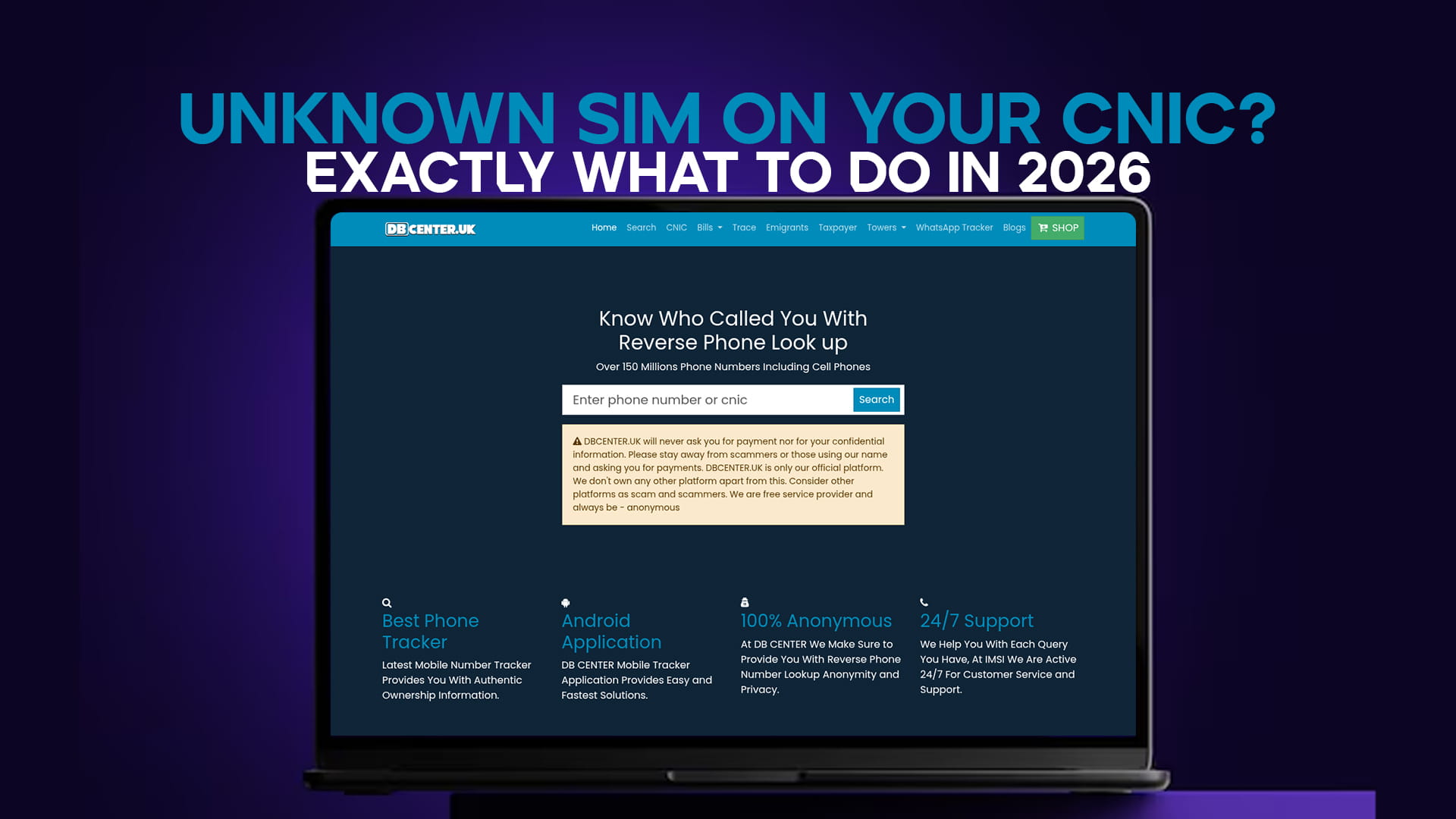
Run DB Center's CNIC verification tool to see whether your card is active, expired, or blocked. If it returns anything other than a clean active status, mention that at the NADRA counter as well — it may be connected.
Step Three: Visit the Right Franchise With Your Original CNIC
This is the step that cannot be done remotely, by design. Blocking a connection requires biometric verification so that nobody can disconnect your service by simply knowing your CNIC number.
Go to a franchise or customer service centre of the specific network showing unauthorised connections. Bring your original CNIC, not a photocopy. Explain that you have run a PTA 668 check, that connections appear in your name which you did not authorise, and that you want them blocked.
The staff will verify your identity through fingerprint biometrics and process the block, updating PTA's records. Ask for a reference or complaint number before you leave, and keep it.
If the unauthorised SIMs span more than one operator, repeat this at each. Each network holds its own registration records and can only act on its own connections.
Step Four: Escalate If the Franchise Does Not Resolve It
If a franchise refuses to act, stalls, or fails to follow through, you are not out of options. File a formal complaint with PTA through its Complaint Management System at pta.gov.pk, quoting the network, the connections in question, and any reference number you were given. PTA's toll-free helpline is 0800-25625.
Where the unauthorised SIMs have been used for fraud, threats, or blackmail against you or in your name, this moves beyond a telecom matter. The FIA Cybercrime Wing has the legal authority to investigate and to compel operators to identify who was behind a connection. Reach them at 051-9106384, by email at [email protected], or online at fia.gov.pk/complaint.
Step Five: Watch for Related Misuse
An identity used to register SIMs may have been used elsewhere. In the weeks after resolving the SIM issue, stay alert for unfamiliar messages from services you never signed up for, contact from anonymous or hidden senders, and any indication that your details are circulating.
If you receive messages from concealed numbers, it helps to understand how those services actually work — the explainer on the anonymous message sender sets out why such messages are far more traceable than senders assume, which matters if you need to report one. For an unfamiliar number contacting you directly, the number trace tool returns the basic details a legitimate lookup can provide, and a broader identity search helps you assemble what you know before filing a complaint.
Step Six: Close the Door Behind You
Once resolved, reduce the chance of it recurring. Complete SIM registration yourself through biometric verification rather than letting a retailer handle your CNIC unsupervised. Be careful where you leave CNIC photocopies. And be sceptical of the apps that market themselves around SIM and phone monitoring — many phone tracker services collect far more of your data than they protect, and installing one to solve an identity problem tends to create a new one.
Re-run the 668 check a few weeks later to confirm the blocks took effect, then periodically thereafter.
The Short Version
Record the evidence, subtract the connections you can genuinely explain, and verify your CNIC status. Then take your original CNIC to the franchise of each network showing unauthorised SIMs and have them blocked after biometric verification, keeping the reference number. If the operator does not resolve it, escalate to PTA; if the SIMs were used for fraud, escalate to the FIA. Re-check after a few weeks to confirm.