You pick up your phone and see a missed call from a number you don't recognise. It happens every day in Pakistan. Maybe it was a bank, a delivery service, or someone from your past. Maybe it was a scammer. You don't know, and that's the problem.
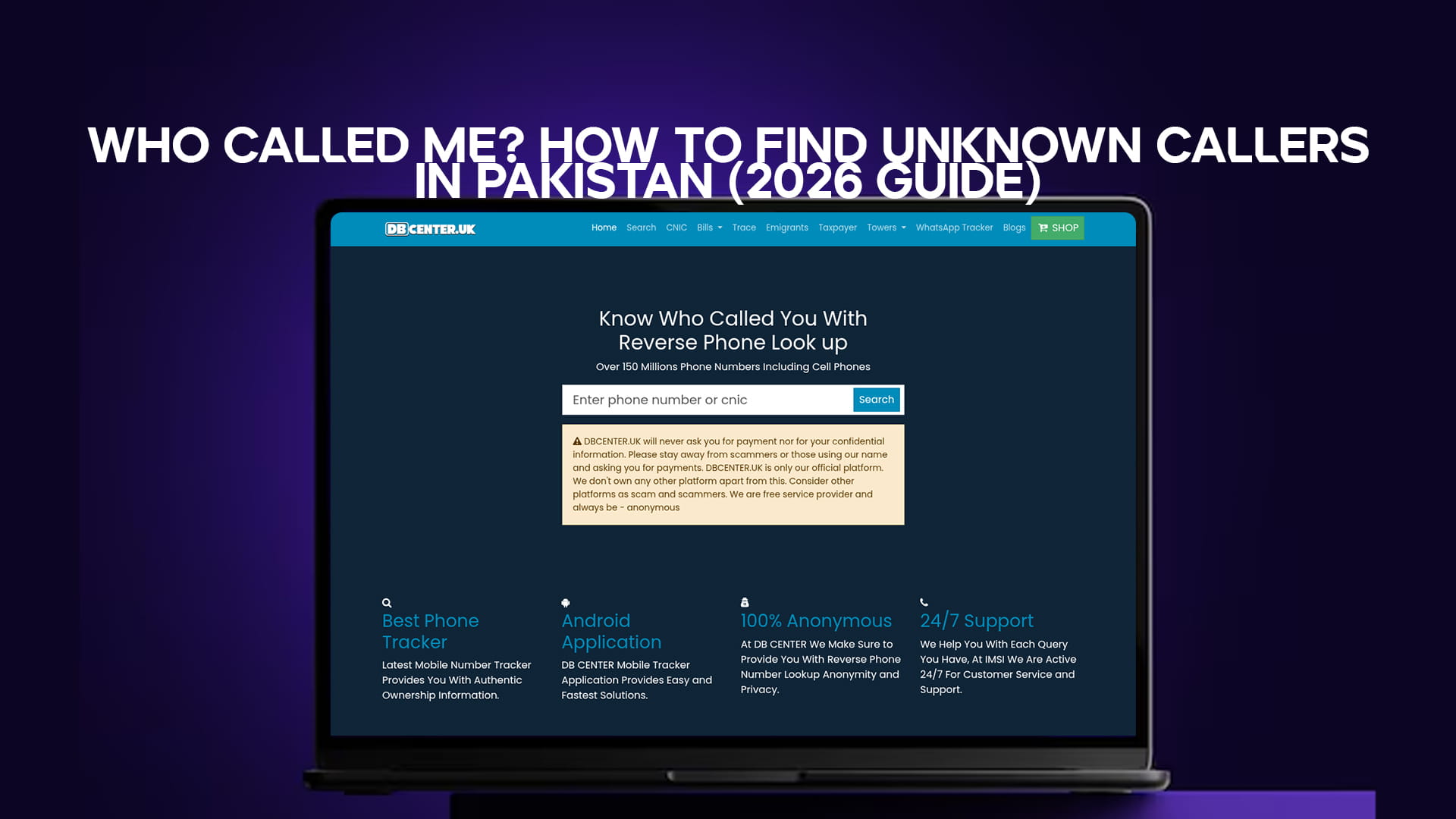
The good news is that finding out who called you is not as hard as it used to be. With the right reverse phone lookup tool, you can search any Pakistan mobile or landline number and get results in seconds. DB Center gives you access to over 150 million phone numbers, including cell phones, and it works for numbers across all Pakistani networks.
This guide walks you through everything you need to know about reverse phone lookup in Pakistan in 2026.
What Is Reverse Phone Lookup?
A regular phone book lets you search a name to find a number. Reverse phone lookup works the opposite way. You enter a phone number, and the service tells you who that number belongs to.
It sounds simple, and it is. You type in the number that called you. The database checks it against its records. If there is a match, you see the name, location, or other details attached to that number.
DB Center runs this kind of search across a database of more than 150 million phone numbers in Pakistan. That includes numbers on Jazz, Telenor, Zong, Ufone, and PTCL landlines. The database gets updated regularly, so you are not searching through outdated records.
Why Do People in Pakistan Get So Many Unknown Calls?
Pakistan has one of the highest mobile phone penetration rates in South Asia. By 2026, there are well over 190 million active SIM cards in the country. More phones means more calls, and not all of them are welcome.
Here are the most common reasons people receive unknown or unexpected calls in Pakistan:
Telemarketing and Sales Calls Banks, insurance companies, mobile network operators, and real estate companies regularly call people who never asked to hear from them. These calls come from call centres using large lists of numbers. The caller ID often shows an unfamiliar number.
Scam Calls Phone scams are a serious problem in Pakistan. Common scams include fake prize announcements, fake bank fraud alerts, SIM swap attempts, and job offer scams. Scammers often use numbers that look like local ones, sometimes even spoofing real business numbers.
Missed Calls from Genuine Sources Not every unknown call is a threat. It could be a delivery rider, a government office, a school, a doctor's clinic, or a friend calling from a new number. You might miss something important if you ignore every call you don't recognise.
Calls from Abroad Pakistan has a large diaspora. Overseas Pakistanis in the UAE, Saudi Arabia, the UK, and elsewhere often call family members using local forwarding numbers or VoIP numbers that don't show the country code clearly.
In all these cases, knowing who the number belongs to helps you decide what to do next.
How to Use DB Center for Reverse Phone Lookup in Pakistan
Using DB Center is straightforward. You do not need to create an account or download anything.
Step 1: Get the Number Write down or copy the full number that called you. For Pakistani numbers, this usually means an 11-digit number starting with 03 for mobile, or a landline number with a city code.
Step 2: Enter the Number on DB Center Go to DB Center and type the number into the search box. Use the full number format. The search works with both local format (03xx xxxxxxx) and international format (+92 3xx xxxxxxx).
Step 3: Review the Results DB Center checks the number against its database of over 150 million records. Results can include the name registered to the number, the telecom operator, the city or region, and any user-submitted reports about the number.
Step 4: Make an Informed Decision Once you see the results, you can decide whether to call back, block the number, or report it. If other users have flagged the number as a scam or spam, that information will often appear in the results too.
What Information Can You Find Through Reverse Phone Lookup?
The amount of information available depends on the number itself and what is in the database. Here is what DB Center can typically show for a Pakistan phone number:
Name of the Registered Owner For many numbers, especially landlines and older registered mobile numbers, the database holds the name of the person or business the SIM is registered to.
Telecom Operator DB Center can identify which network the number belongs to. This tells you whether it is a Jazz, Telenor, Zong, Ufone, or PTCL number. Knowing the operator can sometimes help you identify where a call might have originated.
Location or City Landline numbers in Pakistan include a city code, making it easy to identify the originating city. For mobile numbers, location data depends on what is available in the database.
Spam and Scam Reports One of the most useful features is community-sourced reporting. If other users have already searched the same number and left comments or ratings, you will see that data. A number flagged multiple times as a scam is worth blocking immediately.
Business Information Many business numbers in Pakistan are publicly registered. If the number belongs to a bank, hospital, courier company, or other business, DB Center often shows the business name and category.
How to Identify Scam Calls in Pakistan
Scam calls have become increasingly sophisticated in Pakistan. Knowing the warning signs helps, but having a tool to verify numbers quickly gives you a real advantage.
These are the most common types of phone scams targeting people in Pakistan right now:
Fake Prize Scams The caller tells you that you have won a prize in a lucky draw. They ask for your CNIC number, bank details, or a small processing fee. No legitimate company runs a prize draw this way.
Bank Impersonation Scams A caller claims to be from your bank's fraud department. They say your account has been compromised and ask you to confirm your card number, PIN, or OTP. Real banks never ask for this over the phone.
Job Offer Scams You receive a call offering a well-paying job, often abroad. The scammer eventually asks for a registration fee, medical test payment, or visa processing fee. Once you pay, they disappear.
SIM Swap Fraud The caller pretends to be from your telecom operator and asks you to share a verification code that was just sent to your phone. This code is used to port your number to a new SIM that the scammer controls.
Blackmail and Extortion Calls These callers claim to have compromising information or recordings. They threaten to share it with your contacts unless you pay money.
If a number calling you matches any of these patterns, use DB Center to check whether others have reported it. A quick search can save you from real financial or personal harm.
Pakistan's Most Common Area Codes and Mobile Prefixes
If you receive a call from an unfamiliar number format, knowing the basics of Pakistan's numbering system helps.
Pakistani landline numbers start with a city code. Lahore uses 042, Karachi uses 021, Islamabad and Rawalpindi share 051, Faisalabad uses 041, and Peshawar uses 091. If you receive a call from a landline number with an unfamiliar city code, you can look up the code to know which city it originates from.
Mobile number prefixes in Pakistan are as follows. Numbers starting with 0300, 0301, 0302, 0303, and 0304 belong to Mobilink/Jazz. Numbers starting with 0310, 0311, and 0312 are Zong numbers. Ufone numbers start with 0331, 0332, and 0333. Telenor uses 0340, 0341, 0342, 0343, and 0345. Warid numbers (now merged with Jazz) use 0321, 0322, and 0323.
Knowing the prefix tells you the network. It does not tell you the owner, but it rules out some possibilities and helps you decide whether to call back or look the number up first.
How DB Center Compares to Other Ways of Finding Unknown Callers
People in Pakistan use several methods to identify unknown callers. Here is how they compare to using DB Center.
Googling the Number Typing a phone number into Google sometimes works if the number is publicly listed on a website or has been reported on a forum. It is free but inconsistent. Many numbers return no useful results at all.
Truecaller Truecaller is a popular app in Pakistan and works well for identifying callers in real time. However, it requires installing an app and sharing your own contacts with the service. Some users prefer not to do this. DB Center works as a web search without requiring an app or sharing any personal data.
Asking Around Sometimes people send a screenshot of the number to a WhatsApp group and ask if anyone recognises it. This works occasionally but is slow and unreliable.
Calling Back Calling back an unknown number sometimes answers the question, but it can also confirm to a scammer that your number is active, leading to more unwanted calls.
DB Center offers something different. It searches a database of over 150 million records, shows operator information, displays community reports, and does not require you to share your contacts or install anything. It is a clean, direct lookup.
Tips for Protecting Yourself from Unknown and Spam Calls in Pakistan
Knowing how to look up a number is useful. Reducing the number of unwanted calls you receive in the first place is even better.
Keep your phone number off public platforms. If you do not need your number on Facebook, LinkedIn, or classified ad sites, do not put it there. Number scrapers collect publicly listed numbers and sell them to telemarketing firms.
Register with your telecom's Do Not Call service. All major operators in Pakistan offer some form of opt-out for marketing calls. It does not stop all unwanted calls but reduces the volume.
Do not share your OTP with anyone. One-time passwords sent by your bank or telecom operator are for your eyes only. No company representative will ever ask you to read one out loud over a call.
Block numbers after confirming they are spam. Once DB Center or another tool confirms a number is a scammer or telemarketer, block it immediately. On most Android and iPhone models, you can block a number directly from the recent calls list.
Report scam numbers. DB Center allows users to leave information about numbers they have looked up. If you receive a scam call, reporting the number helps other users in Pakistan avoid the same caller.
Using DB Center for Business Verification in Pakistan
Reverse phone lookup is not just for personal use. Small business owners, HR departments, and freelancers in Pakistan often need to verify whether a number belongs to a real business before proceeding with a transaction.
If someone contacts you about a business deal, purchase, or job and gives you a phone number, checking that number on DB Center takes under a minute. If the number comes back as a residential number or an unregistered SIM in a different city from where the business supposedly operates, that is a red flag worth paying attention to.
Similarly, if you are a landlord, employer, or service provider and receive an inquiry from an unknown number, a quick lookup tells you whether the number has been flagged by other users in the past.
Final Thoughts
Getting a call from an unknown number is a small thing, but what you do next matters. Calling back without checking first wastes your time at best and exposes you to scammers at worst. Ignoring every unknown call means you might miss something genuinely important.
DB Center gives you a middle option. Search the number first, see what the database says, check whether other users have flagged it, and then decide. With over 150 million Pakistan phone numbers in the database including mobile numbers across all major networks, most searches return useful results.
The service is available online, works without an app, and does not ask you to hand over your own contact list. For anyone in Pakistan who wants to know who called them, it is the most direct way to find out.